11. Practical Exercise: Version 3
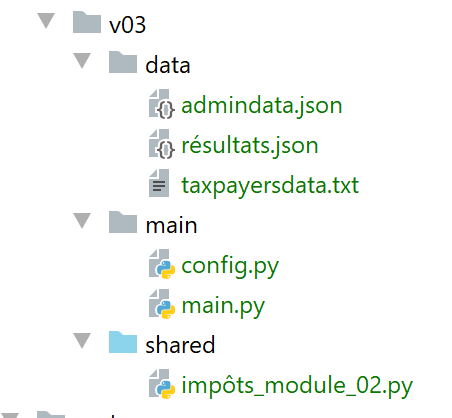
This new version introduces two changes:
- the data required to calculate the tax, provided by the tax authority, is stored in a JSON file [admindata.json]:
{
    "limites": [9964, 27519, 73779, 156244, 0],
    "coeffR": [0, 0.14, 0.3, 0.41, 0.45],
    "coeffN": [0, 1394.96, 5798, 13913.69, 20163.45],
    "PLAFOND_QF_DEMI_PART": 1551,
    "PLAFOND_REVENUS_CELIBATAIRE_POUR_REDUCTION": 21037,
    "PLAFOND_REVENUS_COUPLE_POUR_REDUCTION": 42074,
    "VALEUR_REDUC_DEMI_PART": 3797,
    "PLAFOND_DECOTE_CELIBATAIRE": 1196,
    "PLAFOND_DECOTE_COUPLE": 1970,
    "PLAFOND_IMPOT_COUPLE_POUR_DECOTE": 2627,
    "PLAFOND_IMPOT_CELIBATAIRE_POUR_DECOTE": 1595,
    "ABATTEMENT_DIXPOURCENT_MAX": 12502,
    "ABATTEMENT_DIXPOURCENT_MIN": 437
}
- The results of the tax calculation will also be placed in a JSON file [results.json]:
[
  {
    "marié": "oui",
    "enfants": 2,
    "salaire": 55555,
    "impôt": 2814,
    "surcôte": 0,
    "décôte": 0,
    "réduction": 0,
    "taux": 0.14
  },
  {
    "marié": "oui",
    "enfants": 2,
    "salaire": 50000,
    "impôt": 1384,
    "surcôte": 0,
    "décôte": 384,
    "réduction": 347,
    "taux": 0.14
  },
  …
  {
    "marié": "oui",
    "enfants": 3,
    "salaire": 200000,
    "impôt": 42842,
    "surcôte": 17283,
    "décôte": 0,
    "réduction": 0,
    "taux": 0.41
  }
]
11.1. The configuration script [config.py]
The configuration script will be as follows:
| def configure():
import os
# absolute path of this script's folder
script_dir = os.path.dirname(os.path.abspath(__file__))
# application dependencies
absolute_dependencies = [
f"{script_dir}/../shared",
]
# application configuration
config = {
# absolute path of the taxpayer file
"taxpayersFilename": f"{script_dir}/../data/taxpayersdata.txt",
# absolute path of the results file
"resultsFilename": f"{script_dir}/../data/résultats.json",
# absolute path of tax administration data file
"admindataFilename": f"{script_dir}/../data/admindata.json"
}
# update syspath
from myutils import set_syspath
set_syspath(absolute_dependencies)
# return the config
return config
|
- Line 8: Add the [shared] folder to the Python Path. This folder contains the [impôts_module_02] module used by the main script;
11.2. Main script [main.py]
The main script for version 3 is as follows:
| # configure the application
import config
config = config.configure()
# syspath is configured - imports can be made
from impôts_module_02 import calcul_impôt, get_admindata, get_taxpayers_data, record_results_in_json_file
# taxpayer file
taxpayers_filename = config['taxpayersFilename']
# results file
results_filename = config['resultsFilename']
# tax administration data file
admindata_filename = config['admindataFilename']
# code
try:
# reading tax administration data
admindata = get_admindata(admindata_filename)
# reading taxpayer data
taxpayers = get_taxpayers_data(taxpayers_filename)
# results list
results = []
# taxpayers' taxes are calculated
for taxpayer in taxpayers:
# tax calculation returns a dictionary of keys
# ['married', 'children', 'salary', 'tax', 'surcôte', 'décôte', 'réduction', 'taux']
result = calcul_impôt(admindata, taxpayer['marié'], taxpayer['enfants'], taxpayer['salaire'])
# the dictionary is added to the list of results
results.append(result)
# we record the results
record_results_in_json_file(results_filename, results)
except BaseException as erreur:
# there may be various errors: no file, incorrect file content
# display the error and exit the application
print(f"L'erreur suivante s'est produite : {erreur}]\n")
finally:
print("Travail terminé...")
|
Notes
- Lines 2–4: We configure the application, specifically its Python path;
- line 7: we import the functions we need into [main.py];
- Lines 9–14: The names of the files used by the application are retrieved from the configuration;
- The main script in version 3 has three differences compared to those in versions 1 and 2:
- line 21: tax authority data is retrieved from the JSON file [./data/admindata.json];
- line 32: the tax calculation results are placed in the JSON file [./data/results.json];
- line 7: the functions in version 3 are located in the module [impots.modules.impôts_module_02];
11.3. The module [impots.v02.modules.impôts_module_02]
The module [impots.v02.modules.impôts_module_02] has the following structure:
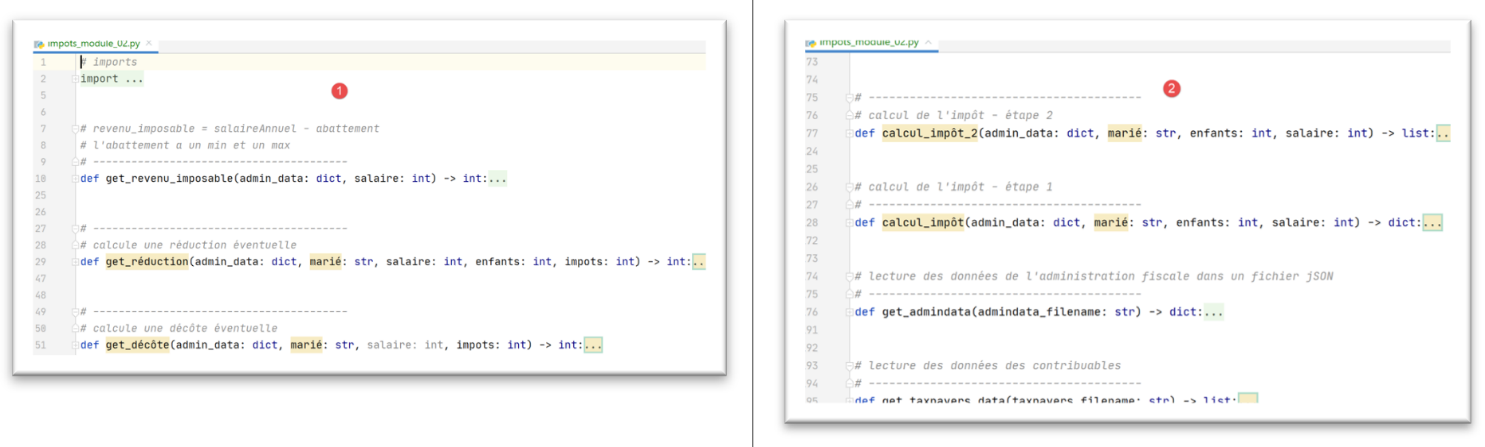
- The module contains functions already present in the module used by version 1, with one difference. When the version 2 module reuses a function from the version 1 module, it does so with an additional parameter: [adminData] (lines 29, 51, 77, 127). This parameter represents the dictionary of tax data from the JSON file [adminData.json]. In the Version 1 module, this data did not need to be passed to the functions because it was globally defined for them, meaning the functions were already aware of it;
11.4. Reading data from the tax administration
The [get_admindata] function is as follows:
| # read data from tax authorities in a jSON file
# ----------------------------------------
def get_admindata(admindata_filename: str) -> dict:
# reading tax administration data
# we let any exceptions go up: file missing, jSON content incorrect
file = None
try:
# open file jSON in read mode
file = codecs.open(admindata_filename, "r", "utf8")
# transfer content to a dictionary
admin_data = json.load(file)
# we return the result
return admin_data
finally:
# close the file if it has been opened
if file:
file.close()
|
- line 9: retrieve the image dictionary from the read JSON file;
11.5. Saving the results
The [record_results_in_json_file] function is as follows:
| # writing results to a jSON file
# ----------------------------------------
def record_results_in_json_file(results_filename: str, results: list):
file = None
try:
# opening the results file
file = codecs.open(results_filename, "w", "utf8")
# block writing
json.dump(results, file, ensure_ascii=False)
finally:
# close the file if it has been opened
if file:
file.close()
|
- line 7: create a UTF-8 encoded file;
- line 9: write the [results] list to the JSON file. UTF-8 characters are not escaped (ensure_ascii=False);
11.6. Function Modifications
Some functions now receive an additional [admin_data] parameter. This slightly changes their syntax. Take, for example, the [calcul_impôt] function:
| # tax calculation - step 1
# ----------------------------------------
def calcul_impôt(admin_data: dict, marié: str, enfants: int, salaire: int) -> dict:
# married: yes, no
# children: number of children
# salary: annual salary
# limits, coeffr, coeffn: data tables for tax calculation
#
# tax calculation with children
result1 = calcul_impôt_2(admin_data, marié, enfants, salaire)
impot1 = result1["impôt"]
# tax calculation without children
if enfants != 0:
result2 = calcul_impôt_2(admin_data, marié, 0, salaire)
impot2 = result2["impôt"]
# application of the family allowance ceiling
if enfants < 3:
# PLAFOND_QF_DEMI_PART euros for the first 2 children
impot2 = impot2 - enfants * admin_data['plafond_qf_demi_part']
else:
# PLAFOND_QF_DEMI_PART euros for the first 2 children, double for subsequent children
impot2 = impot2 - 2 * admin_data['plafond_qf_demi_part'] - (enfants - 2) * 2 * admin_data[
'plafond_qf_demi_part']
else:
impot2 = impot1
result2 = result1
# we take the highest tax with the rate and surcharge that go with it
if impot1 > impot2:
impot = impot1
taux = result1["taux"]
surcôte = result1["surcôte"]
else:
surcôte = impot2 - impot1 + result2["surcôte"]
impot = impot2
taux = result2["taux"]
# calculation of any discount
décôte = get_décôte(admin_data, marié, salaire, impot)
impot -= décôte
# calculation of any tax reduction
réduction = get_réduction(admin_data, marié, salaire, enfants, impot)
impot -= réduction
# result
return {"marié": marié, "enfants": enfants, "salaire": salaire, "impôt": math.floor(impot), "surcôte": surcôte,
"décôte": décôte, "réduction": réduction, "taux": taux}
|
Notes
- where [calcul_tax] calls other functions, it passes [admin_data] as the first parameter (lines 10, 14, 39, 42);
- where [tax_calculation] uses tax constants, it now accesses them via the [admin_data] dictionary (lines 19, 22);
All functions receiving [admin_data] as a parameter undergo these same types of changes.
11.7. Results
The results obtained are those presented at the beginning of Section 8.3.