39. Conclusion
Let’s review the work done in this document:
Chapter | File | Contents |
Course Overview | ||
Setting Up a Work Environment | ||
[bases] | The basics of the Python language – language structures – data types – functions – console output – format strings – type conversion – lists – dictionaries – regular expressions | |
[strings] | String notation – methods of the <str> class – encoding/decoding strings in UTF-8 | |
[exceptions] | Exception handling | |
[fonctions] | Scope of variables – parameter passing – using modules – Python Path – named parameters – recursive functions | |
[fichiers] | Reading/writing a text file – handling UTF-8 encoded files – file management jSON | |
[impots/v01] | Version 1 of the application exercise: an income tax calculation. The application is available in 18 versions – version 1 implements a procedural solution | |
[imports] | Managing application dependencies by importing modules – a dependency management method is presented – it is used throughout the document – Python management Path | |
[impots/v02] | The version 2 of the application builds on version 1 by gathering all configuration constants into a configuration file | |
[impots/v03] | The version 3 of the application builds on version 2 by using functions encapsulated in a module—dependency management is handled via configuration – introduction of the jSON file to read the data needed to calculate the tax and write the calculation results | |
[classes/01] | Classes – inheritance – methods and properties – getters / setters – constructor – [__dict__] property | |
[classes/02] | Overview of the [BaseEntity] and [MyException] classes used in the rest of the document – [BaseEntity] facilitates object/dictionary conversions | |
[troiscouches] | Layered architecture and interface-based programming. This chapter presents the programming methods used in the rest of the document | |
[impots/v04] | Version 4 of the application – this version implements a solution with a layered architecture, interface-based programming, and the use of classes derived from [BaseEntity] and [MyException] | |
[databases/mysql] | Installing SGBD MySQL – connecting to the database – creating a table – executing commands SQL SELECT, UPDATE, DELETE, INSERT – transaction – configured queries SQL | |
[databases/postgresql] | Installation of SGBD PostgreSQL – database connection – table creation – execution of commands SQL SELECT, UPDATE, DELETE, INSERT – transaction – configured queries SQL | |
[databases/anysgbd] | Writing code independent of SGBD | |
[databases/sqlalchemy] | The ORM (Object Relational Mapper) SqlAlchemy – a ORM allows for unified work with different SGBD - mapping classes / tables SQL – operations on table image classes SQL | |
[impots/v05] | Version 5 of the tax calculation application – Using the layered architecture of version 04 andORM SqlAlchemy to work with the SGBD MySQL and PostgreSQL | |
[inet] | Internet Programming – TCP / IP Protocol (Transfer Control Protocol / Internet Protocol) – HTTP Protocols (HyperText Transfer Protocol) – SMTP (Simple Mail Transfer Protocol) – POP (Post Office Protocol) – IMAP (Internet Message Access Protocol) | |
[flask] | Web services with the Flask web framework – displaying a page HTML – web service jSON – requests GET and POST – managing a web session | |
[impots/http-servers/01] [impots/http-clients/01] | Version 6 of the application exercise - Creating a web service jSON for tax calculation with a multi-tier architecture - Writing a web client for this server with a multi-tier architecture – client/server programming – using the [requests] module | |
[impots/http-servers/02] [impots/http-clients/02] | Version 7 of the application release – version 6 has been improved: the client and server are multithreaded – utilities [Logger] to log client/server exchanges – [SendMail] to send an email to the application administrator | |
[impots/http-servers/03] [impots/http-clients/03] | Version 8 of the application exercise – version 7 is improved by using a session | |
[xml] | Management XML with the [xmltodict] module | |
[impots/http-servers/04] [impots/http-clients/04] | Version 9 of the application exercise – version 8 is modified to have client/server exchanges in XML; | |
[impots/http-servers/05] [impots/http-clients/05] | Version 10 of the application exercise – instead of processing N taxpayers via N GET requests, a single request POST is used with the N taxpayers in the body of POST | |
[impots/http-servers/06] [impots/http-clients/06] | Version 11 of the application year – the application’s client/server architecture is modified: the [métier] layer moves from the server to the client | |
[impots/http-servers/07] | Version 12 of the application exercise – this version implements a MVC server (Model – View – Controller) that delivers, at the client’s request, either jSON, XML, or HTML. This chapter implements the jSON and XML versions of the server | |
[impots/http-clients/07] | Implementation of clients, jSON, and XML of the MVC server from version 12 | |
[impots/http-servers/07] | Implementation of the HTML server from the version 12 – using the CSS Bootstrap framework – | |
[impots/http-servers/08] | Version 13 of the application exercise - Refactoring the code from version 12 – session management with the [flask_session] module and a Redis server – using encrypted passwords | |
[impots/http-servers/09] [impots/http-clients/09] | Version 14 of the application exercise – implementation of URL with a token CSRF (Cross-Site Request Forgery) | |
[impots/http-servers/10] | Version 15 of the application exercise – refactoring the code from version 14 to handle two types of actions: ASV (Action Show View), which are used only to display a view without modifying the server state, ADS (Do Something Action) which performs an action that changes the server’s state – these actions all end with a redirect to a ASV action – this allows for proper handling of client browser page refreshes | |
[impots/http-servers/11] | Version 16 of the application – management of URL with prefix | |
[impots/http-servers/12] | Version 17 of the application – porting version 16 to an Apache / Windows server | |
[impots/http-servers/13] | Version 18 of the application – fixes a bug in version 17 |
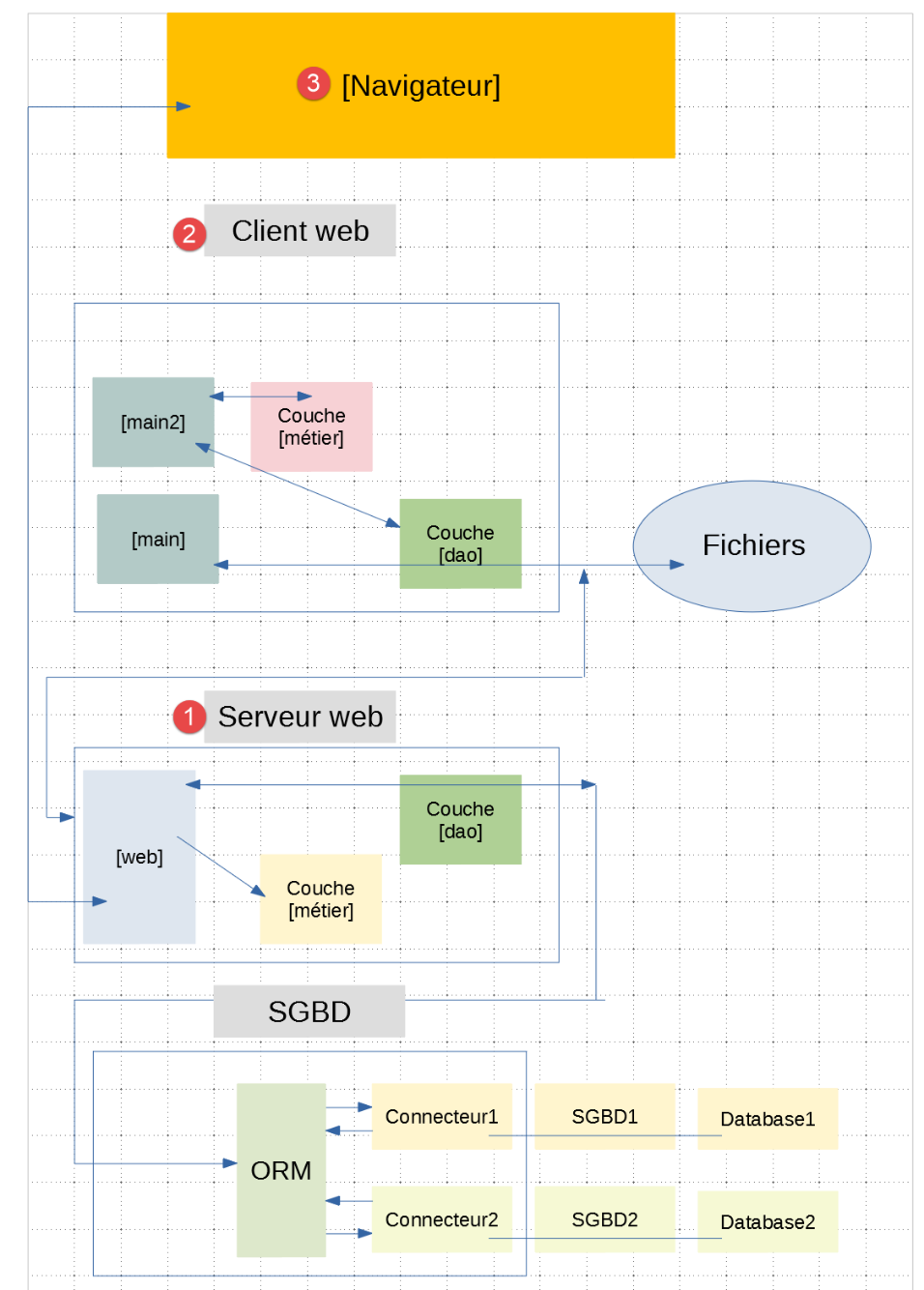
The client/server tax calculation applications have implemented the following architecture:
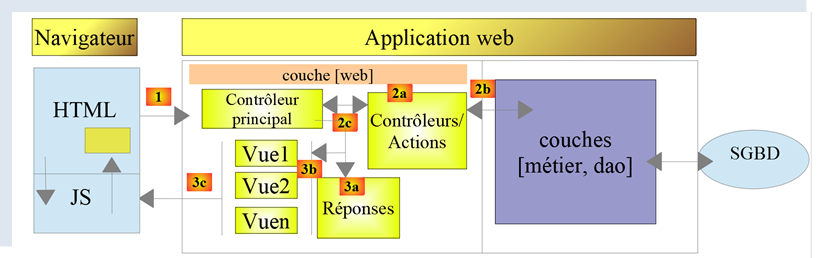
The [web] layer above was implemented using a MVC architecture:
The document’s content is dense. Readers who make it to the end will gain a solid understanding of MVC web programming in Python/Flask and, beyond that, a solid understanding of MVC web programming in other languages.
Additional information on the Flask framework can be found in the document [https://blog.miguelgrinberg.com/post/the-flask-mega-tutorial-part-i-hello-world] by author Miguel Grinberg. I have read some sections of his course, and they struck me as very educational. The author covers many concepts not addressed in this document.