28. 应用练习:第 10 版
28.1. 简介
在税款计算服务器的客户端示例中,如果需要处理 N 名纳税人,线程会依次发送 N 个请求。此处的思路是发送一个包含所有 N 名纳税人的请求。对于每名纳税人,都需要发送 [marié, enfants, salaire] 信息。可以将这些信息作为参数发送:
- 作为 URL 的参数。这样会得到一个冗长且意义不大的 URL;
- 在请求正文(body)中。我们知道,对于使用浏览器的用户而言,该正文是隐藏的;
在两种情况下,均可使用 [GET] 或 [POST] 请求。我们将使用 POST 请求,并将参数封装在 HTTP 请求的正文中。
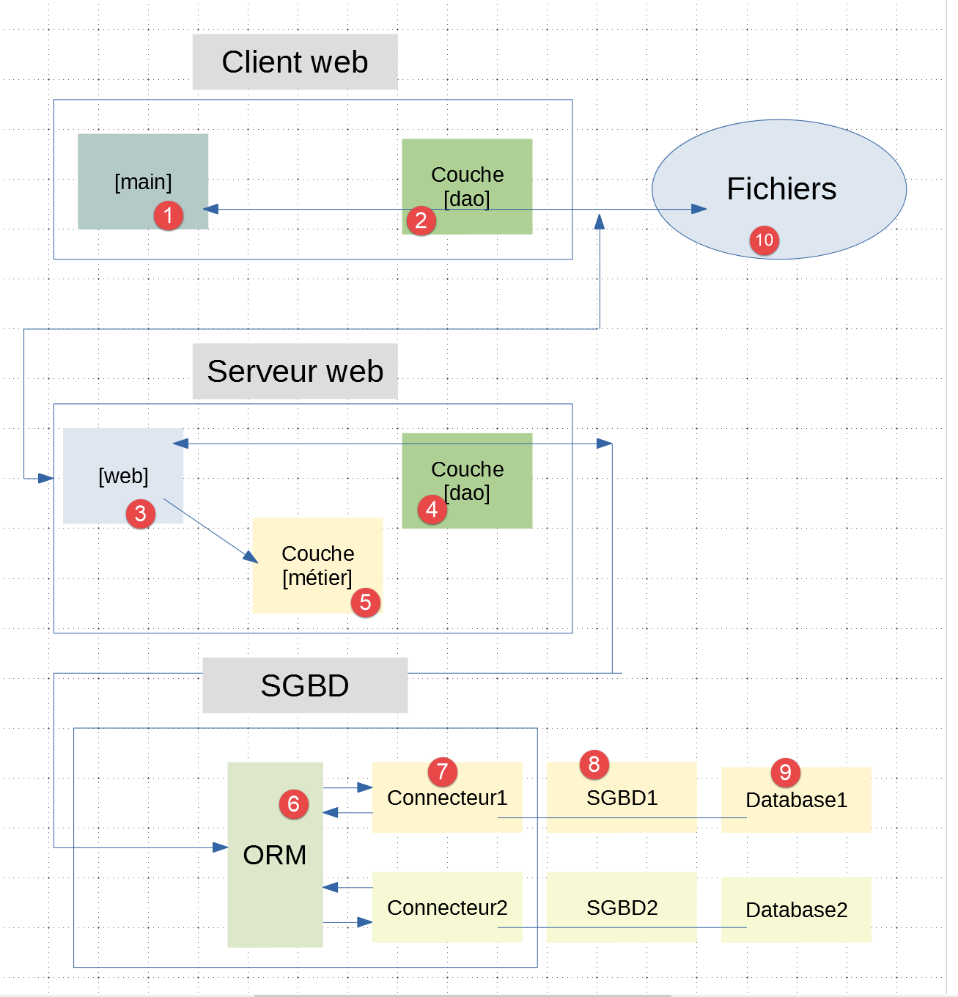
客户端/服务器架构未发生变化:
28.2. Web 服务器
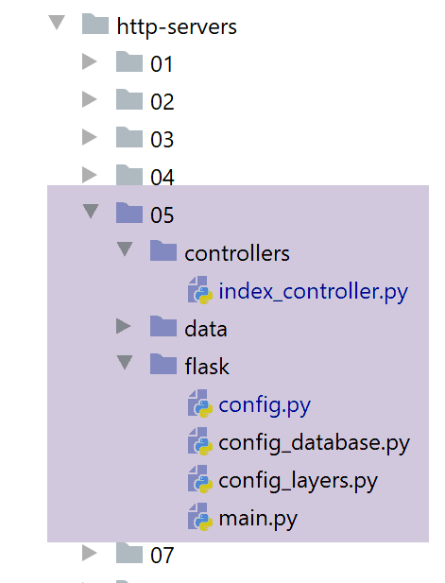
文件 [http-servers/05] 最初是通过复制文件 [http-servers/02] 获得的。 我们回到客户端与服务器之间的 jSON 数据交换。我们已经看到,从 jSON 切换到 XML 非常简单。
28.2.1. 配置
[config, config_database, config_layers]的配置与之前版本类似。此处不再赘述。
28.2.2. 主脚本 [main]
[main]脚本与我们复制的[http-servers/02]文件夹中的脚本完全相同。唯一不同之处在于:
# 首页 URL
@app.route('/', methods=['POST'])
@auth.login_required
def index():
    …
- 第2行:现在URL是通过POST生成的;
28.2.3. 控制器 [index_controller]
[index_controller] 控制器演变如下:
# 导入依赖项

import json

from flask_api import status
from werkzeug.local import LocalProxy


def execute(request: LocalProxy, config: dict) -> tuple:
    # 依赖项
    from ImpôtsError import ImpôtsError
    from TaxPayer import TaxPayer

    # 获取帖子正文 - 等待一个字典列表
    msg_erreur = None
    list_dict_taxpayers = None
    # POST 的正文 jSON
    request_text = request.data
    try:
        # 将其转换为字典列表
        list_dict_taxpayers = json.loads(request_text)
    except BaseException as erreur:
        # 记录错误
        msg_erreur = f"le corps du POST n'est pas une chaîne jSON valide : {erreur}"
    # 列表是否不为空?
    if not msg_erreur and (not isinstance(list_dict_taxpayers, list) or len(list_dict_taxpayers) == 0):
        # 记录错误
        msg_erreur = "le corps du POST n'est pas une liste ou alors cette liste est vide"
    # 是否有一个字典列表?
    if not msg_erreur:
        erreur = False
        i = 0
        while not erreur and i < len(list_dict_taxpayers):
            erreur = not isinstance(list_dict_taxpayers[i], dict)
            i += 1
        # 错误?
        if erreur:
            msg_erreur = "le corps du POST doit être une liste de dictionnaires"
    # 错误?
    if msg_erreur:
        # 向客户端发送错误响应
        résultats = {"réponse": {"erreurs": [msg_erreur]}}
        return résultats, status.HTTP_400_BAD_REQUEST

    # 逐个检查 TaxPayers
    # 起初没有错误
    list_erreurs = []
    for dict_taxpayer in list_dict_taxpayers:
        # 根据 dict_taxpayer 生成 TaxPayer
        msg_erreur = None
        try:
            # 接下来的操作将排除参数不
            # TaxPayer 类的属性,以及其值
            # 不正确的情况
            TaxPayer().fromdict(dict_taxpayer)
        except BaseException as erreur:
            msg_erreur = f"{erreur}"
        # 字典中必须包含某些键
        if not msg_erreur:
            # 字典中必须包含键 [marié, enfants, salaire]
            keys = dict_taxpayer.keys()
            if 'marié' not in keys or 'enfants' not in keys or 'salaire' not in keys:
                msg_erreur = "le dictionnaire doit inclure les clés [marié, enfants, salaire]"
        # 有错误?
        if msg_erreur:
            # 在 TaxPayer 本身中发现了错误
            dict_taxpayer['erreur'] = msg_erreur
            # 将 TaxPayer 添加到错误列表中
            list_erreurs.append(dict_taxpayer)

    # 已处理所有纳税人——是否有错误?
    if list_erreurs:
        # 向客户发送错误响应
        résultats = {"réponse": {"erreurs": list_erreurs}}
        return résultats, status.HTTP_400_BAD_REQUEST

    # 无错误,可以继续处理
    # 从税务机关获取数据
    admindata = config["admindata"]
    métier = config["layers"]["métier"]
    try:
        # 逐个处理 TaxPayer
        list_taxpayers = []
        for dict_taxpayer in list_dict_taxpayers:
            # 计算税款
            taxpayer = TaxPayer().fromdict(
                {'marié': dict_taxpayer['marié'], 'enfants': dict_taxpayer['enfants'],
                 '工资': dict_taxpayer['salaire']})
            métier.calculate_tax(taxpayer, admindata)
            # 将结果保存为字典
            list_taxpayers.append(taxpayer.asdict())
        # 将响应发送给客户端
        return {"réponse": {"results": list_taxpayers}}, status.HTTP_200_OK
    except ImpôtsError as erreur:
        # 向客户端发送错误响应
        return {"réponse": {"erreurs": f"[{erreur}]"}}, status.HTTP_500_INTERNAL_SERVER_ERROR
- 第 9 行:控制器接收:
- 来自客户端的请求 [request];
- 服务器的配置 [config];
- 第14-18行:提取POST的请求主体。封装在HTTP请求主体中的参数可以采用多种编码方式。我们之前已经遇到过其中一种:[x-www-form-urlencoded]。 这里我们将使用另一种编码:jSON;
- 第18行:[request.data] 可用于提取请求 HTTP 的正文(body)。 此处获取的是文本,且我们知道该文本来自 jSON,它代表了一个字典列表 [marié, enfants, salaire];
- 第19-24行:提取该字典列表;
- 第22-24行:若jSON的提取出现问题,则记录错误;
- 第26-28行:若发现获取的对象不是列表或为空列表,则记录错误;
- 第29-38行:若成功获取列表,则验证其确为字典列表;
- 第 40-43 行:若出现错误,则在此终止并向客户端发送错误响应;
- 第 45-69 行:现在检查每个字典:
- 它们必须包含键 [marié, enfants, salaire];
- 它们必须能够构建一个有效的 [TaxPayer] 对象;
- 第65-69行:若在某个字典中检测到错误,则将其记录在该字典中,并关联键值‘erreur’;
- 第 72-75 行:包含错误的字典已被汇总到列表 [list_erreurs] 中。如果该列表不为空,则将其发送给客户端作为错误响应;
- 第 77 行:至此,已知可根据客户端发送的请求正文创建类型为 [TaxPayer] 的对象列表;
- 第84-91行:处理接收到的字典列表;
- 第 86 行:基于一个字典,创建一个 [TaxPayer] 对象;
- 第 89 行:计算该 [TaxPayer] 的税额;
- 第 91 行:由于税额计算,[taxpayer] 已被修改。将其转换为字典并添加到结果列表中;
- 第 93 行:将该结果列表发送给客户端;
28.2.4. 服务器测试
我们将使用 Postman 客户端测试服务器:
- 启动Web服务器SGBD和邮件服务器[hMailServer];
- 启动 Postman 客户端及其控制台(Ctrl-Alt-C);
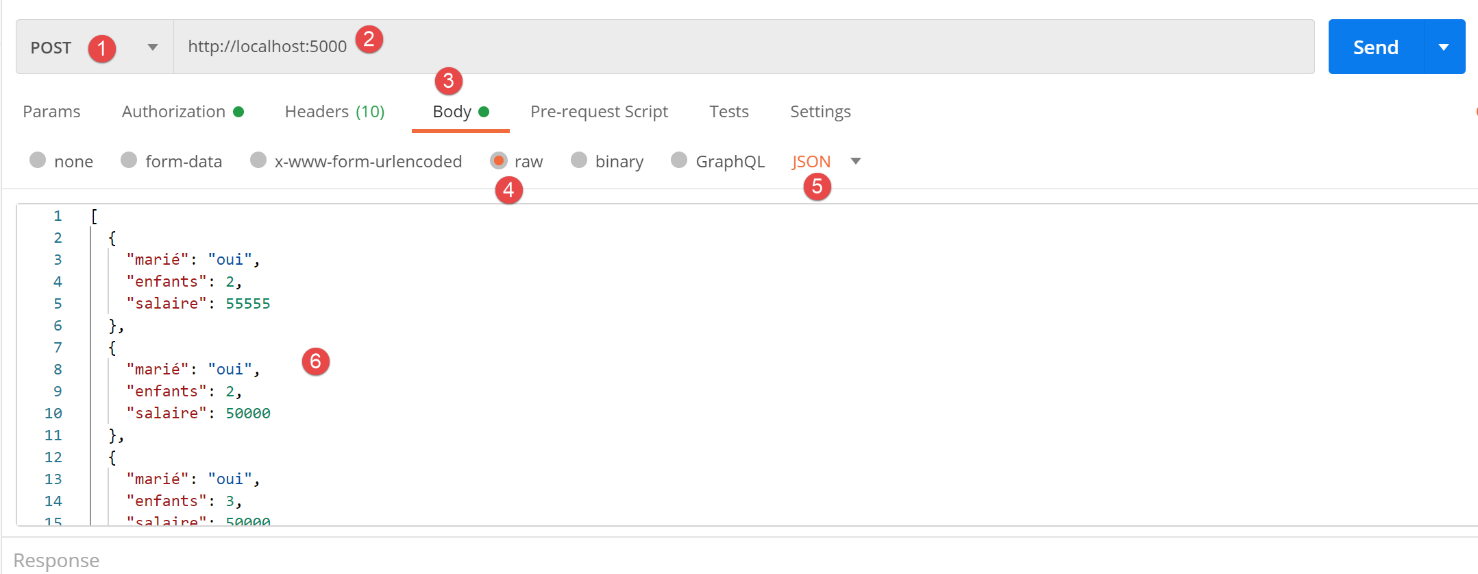
- 在 [1] 中:发送请求 [POST];
- 在 [2] 中:服务器返回的 URL;
- 转换为 [3]:请求主体 HTTP;
- 在 [5] 中:指定该正文应以字符串 jSON 的形式发送;
- 在 [4] 中:切换至 [raw] 模式,以便复制/粘贴字符串 jSON;
- 在 [6] 中:粘贴从不同版本的 [résultats.json] 文件中提取的字符串 jSON。随后,针对每位纳税人仅保留 [marié, salaire, enfants] 的属性;
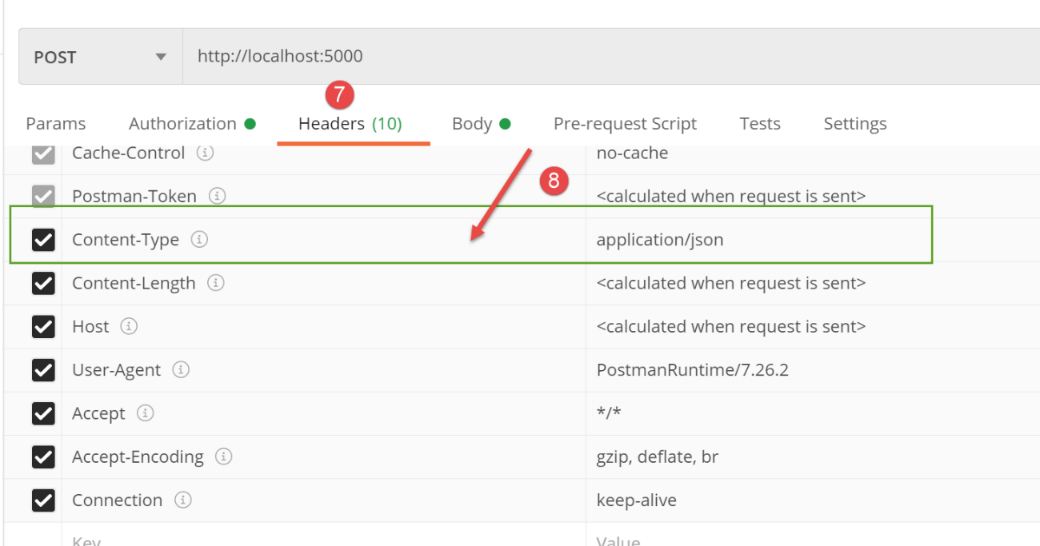
- 在 [7] 中,查看 Postman 客户端将发送给服务器的 HTTP 头部;
- 在 [8] 中,可以看到它将发送一个 [Content-Type] 头部,告知服务器该请求包含一个编码为 jSON 的请求体。这源于之前选择的 [5];
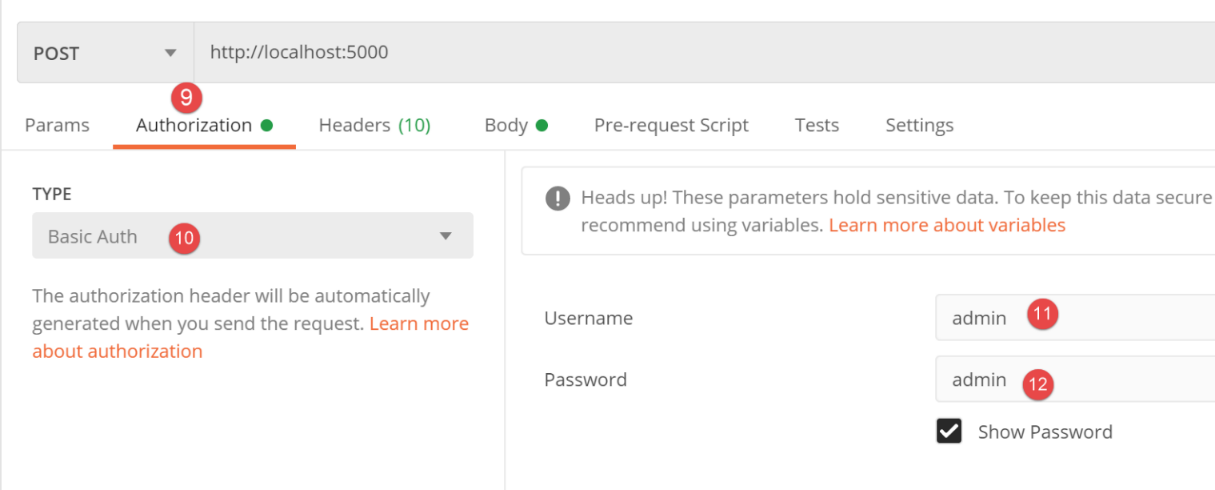
- 在 [9-12] 中:将服务器所需的标识符放入请求中;
发送此请求。服务器的响应如下:
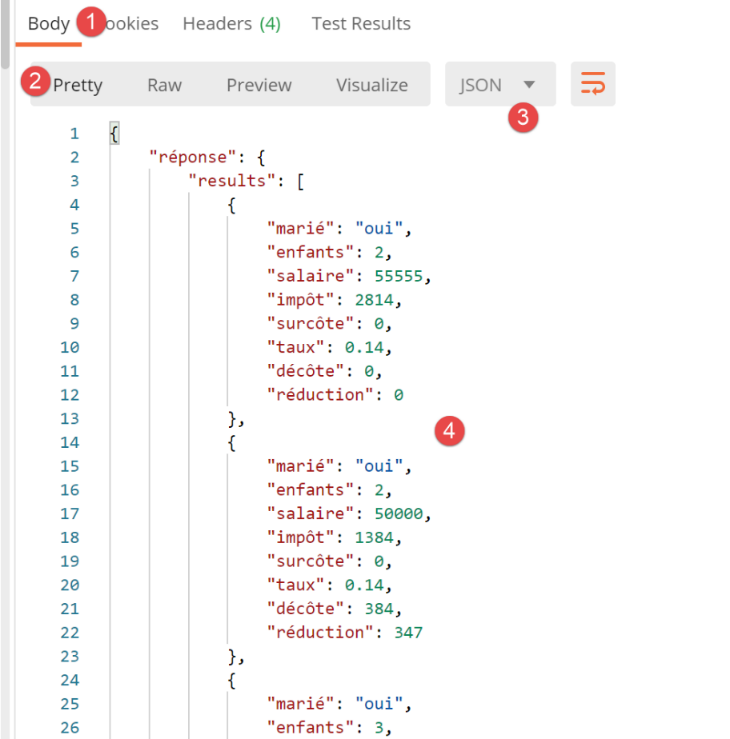
- 在 [3] 中,我们收到了来自 jSON 的数据;
- 在 [4] 中,显示纳税人的税款;
让我们在 Postman 控制台(Ctrl-Alt-C)中查看发生的客户端/服务器对话:
Postman客户端发送了以下文本:
- 第 1 行:向服务器发送 POST;
- 第2行:发送身份验证头HTTP;
- 第 3 行:客户端告知服务器将发送字符串 jSON,且该字符串长度为 824 字节(第 11 行);
- 第13-69行:请求的jSON正文;
服务器向他返回了以下内容:
HTTP/1.0 200 OK
Content-Type: application/json; charset=utf-8
Content-Length: 1461
Server: Werkzeug/1.0.1 Python/3.8.1
Date: Tue, 28 Jul 2020 07:16:34 GMT

{"réponse": {"results": [{"marié": "oui", "enfants": 2, "salaire": 55555, "impôt": 2814, "surcôte": 0, "taux": 0.14, "décôte": 0, "réduction": 0}, {"marié": "oui", "enfants": 2, "salaire": 50000, "impôt": 1384, "surcôte": 0, "taux": 0.14, "décôte": 384, "réduction": 347}, {"marié": "oui", "enfants": 3, "salaire": 50000, "impôt": 0, "surcôte": 0, "taux": 0.14, "décôte": 720, "réduction": 0}, {"marié": "non", "enfants": 2, "salaire": 100000, "impôt": 19884, "surcôte": 4480, "taux": 0.41, "décôte": 0, "réduction": 0}, {"marié": "non", "enfants": 3, "salaire": 100000, "impôt": 16782, "surcôte": 7176, "taux": 0.41, "décôte": 0, "réduction": 0}, {"marié": "oui", "enfants": 3, "salaire": 100000, "impôt": 9200, "surcôte": 2180, "taux": 0.3, "décôte": 0, "réduction": 0}, {"marié": "oui", "enfants": 5, "salaire": 100000, "impôt": 4230, "surcôte": 0, "taux": 0.14, "décôte": 0, "réduction": 0}, {"marié": "non", "enfants": 0, "salaire": 100000, "impôt": 22986, "surcôte": 0, "taux": 0.41, "décôte": 0, "réduction": 0}, {"marié": "oui", "enfants": 2, "salaire": 30000, "impôt": 0, "surcôte": 0, "taux": 0.0, "décôte": 0, "réduction": 0}, {"marié": "non", "enfants": 0, "salaire": 200000, "impôt": 64210, "surcôte": 7498, "taux": 0.45, "décôte": 0, "réduction": 0}, {"marié": "oui", "enfants": 3, "salaire": 200000, "impôt": 42842, "surcôte": 17283, "taux": 0.41, "décôte": 0, "réduction": 0}]}}
- 第 1 行:请求成功;
- 第2行:服务器响应正文为字符串jSON。该字符串长度为1461字节(第3行);
- 第7行:服务器的响应为jSON;
现在我们来测试一些错误情况。
情况 1:发送任意内容
POST / HTTP/1.1
Authorization: Basic YWRtaW46YWRtaW4=
Content-Type: application/json
User-Agent: PostmanRuntime/7.26.2
Accept: */*
Cache-Control: no-cache
Postman-Token: 47652706-9744-46a0-a682-de010e5406c0
Host: localhost:5000
Accept-Encoding: gzip, deflate, br
Connection: keep-alive
Content-Length: 3

abc

HTTP/1.0 400 BAD REQUEST
Content-Type: application/json; charset=utf-8
Content-Length: 125
Server: Werkzeug/1.0.1 Python/3.8.1
Date: Tue, 28 Jul 2020 07:43:27 GMT

{"réponse": {"erreurs": ["le corps du POST n'est pas une chaîne jSON valide : Expecting value: line 1 column 1 (char 0)"]}}
- 第13行:发送的字符串[abc]并非有效的jSON字符串(第3行);
- 第 15 行:服务器返回 400 错误代码;
- 第 21 行:服务器的响应 jSON;
情况 2:发送一个有效的字符串 jSON,但该字符串不是列表
POST / HTTP/1.1
Authorization: Basic YWRtaW46YWRtaW4=
Content-Type: application/json
User-Agent: PostmanRuntime/7.26.2
Accept: */*
Cache-Control: no-cache
Postman-Token: 03b64735-9239-47b3-b92d-be7c9ebc7559
Host: localhost:5000
Accept-Encoding: gzip, deflate, br
Connection: keep-alive
Content-Length: 17

{"att1":"value1"}

HTTP/1.0 400 BAD REQUEST
Content-Type: application/json; charset=utf-8
Content-Length: 97
Server: Werkzeug/1.0.1 Python/3.8.1
Date: Tue, 28 Jul 2020 07:50:11 GMT

{"réponse": {"erreurs": ["le corps du POST n'est pas une liste ou alors cette liste est vide"]}}
情况 3:发送字符串 jSON,该字符串是一个列表,且其元素并非全是字典
POST / HTTP/1.1
Authorization: Basic YWRtaW46YWRtaW4=
Content-Type: application/json
User-Agent: PostmanRuntime/7.26.2
Accept: */*
Cache-Control: no-cache
Postman-Token: a1528a5f-777c-413f-b3be-7d4e9955b12a
Host: localhost:5000
Accept-Encoding: gzip, deflate, br
Connection: keep-alive
Content-Length: 7

[0,1,2]

HTTP/1.0 400 BAD REQUEST
Content-Type: application/json; charset=utf-8
Content-Length: 85
Server: Werkzeug/1.0.1 Python/3.8.1
Date: Tue, 28 Jul 2020 07:52:10 GMT

{"réponse": {"erreurs": ["le corps du POST doit être une liste de dictionnaires"]}}
情况 4:发送一个包含字典的列表,其中有一个字典的键不正确
POST / HTTP/1.1
Authorization: Basic YWRtaW46YWRtaW4=
Content-Type: application/json
User-Agent: PostmanRuntime/7.26.2
Accept: */*
Cache-Control: no-cache
Postman-Token: ba964d81-c9d9-46ff-a521-b4c4e5639484
Host: localhost:5000
Accept-Encoding: gzip, deflate, br
Connection: keep-alive
Content-Length: 19

[{"att1":"value1"}]

HTTP/1.0 400 BAD REQUEST
Content-Type: application/json; charset=utf-8
Content-Length: 112
Server: Werkzeug/1.0.1 Python/3.8.1
Date: Tue, 28 Jul 2020 07:54:33 GMT

{"réponse": {"erreurs": [{"att1": "value1", "erreur": "MyException[2, la clé [att1] n'est pas autorisée]"}]}}
情况 5:发送一个包含一个缺少键的字典的字典列表:
POST / HTTP/1.1
Authorization: Basic YWRtaW46YWRtaW4=
Content-Type: application/json
User-Agent: PostmanRuntime/7.26.2
Accept: */*
Cache-Control: no-cache
Postman-Token: 98aec51d-f37d-4c14-81cd-c7ffcbbcdc65
Host: localhost:5000
Accept-Encoding: gzip, deflate, br
Connection: keep-alive
Content-Length: 18

[{"marié":"oui"}]

HTTP/1.0 400 BAD REQUEST
Content-Type: application/json; charset=utf-8
Content-Length: 125
Server: Werkzeug/1.0.1 Python/3.8.1
Date: Tue, 28 Jul 2020 07:56:40 GMT

{"réponse": {"erreurs": [{"marié": "oui", "erreur": "le dictionnaire doit inclure les clés [marié, enfants, salaire]"}]}}
情况 6:发送一个包含字典列表,其中有一个字典的键虽正确但部分键的值有误:
POST / HTTP/1.1
Authorization: Basic YWRtaW46YWRtaW4=
Content-Type: application/json
User-Agent: PostmanRuntime/7.26.2
Accept: */*
Cache-Control: no-cache
Postman-Token: 3083e601-dee4-4e15-9ea4-fc0328d0fcf0
Host: localhost:5000
Accept-Encoding: gzip, deflate, br
Connection: keep-alive
Content-Length: 46

[{"marié":"x", "enfants":"x", "salaire":"x"}]

HTTP/1.0 400 BAD REQUEST
Content-Type: application/json; charset=utf-8
Content-Length: 167
Server: Werkzeug/1.0.1 Python/3.8.1
Date: Tue, 28 Jul 2020 07:59:32 GMT

{"réponse": {"erreurs": [{"marié": "x", "enfants": "x", "salaire": "x", "erreur": "MyException[31, l'attribut marié [x] doit avoir l'une des valeurs oui / non]"}]}}
28.3. Web客户端
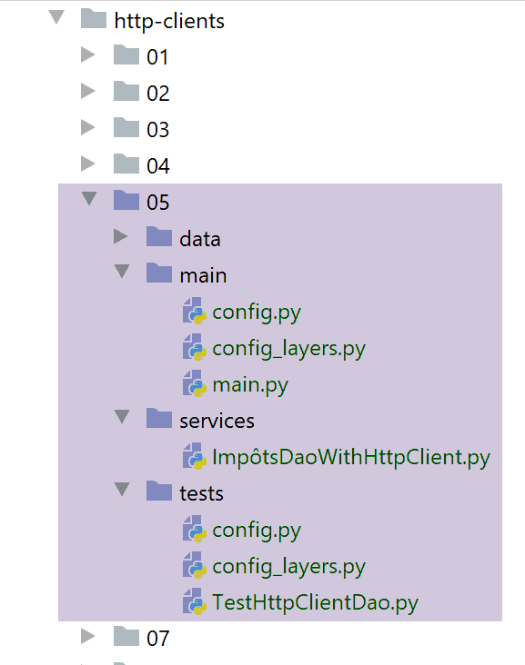
文件 [http-clients/05](版本 10)最初是通过复制文件 [http-clients/02](版本 7)获得的。随后该文件被修改。
28.3.1. [dao] 层
[dao] 层由以下 [ImpôtsDaoWithHttpClient] 类实现:
# 导入

import requests
from flask_api import status

from AbstractImpôtsDao import AbstractImpôtsDao
from AdminData import AdminData
from ImpôtsError import ImpôtsError
from InterfaceImpôtsMétier import InterfaceImpôtsMétier
from TaxPayer import TaxPayer


class ImpôtsDaoWithHttpClient(AbstractImpôtsDao, InterfaceImpôtsMétier):

    # 构造函数
    def __init__(self, config: dict):
        …

    # 未使用的方法
    def get_admindata(self) -> AdminData:
        pass

    # 计算税款
    def calculate_tax(self, taxpayer: TaxPayer, admindata: AdminData = None):
        …

    # 批量模式下的税款计算
    def calculate_tax_in_bulk_mode(self, taxpayers: list) -> list:
        # 允许异常上报

        # 将纳税人转换为字典列表
        # 仅保留属性[marié, enfants, salaire]
        list_dict_taxpayers = list(
            map(lambda taxpayer:
                taxpayer.asdict(included_keys=[
                    '_TaxPayer__marié',
                    '_TaxPayer__enfants',
                    '_TaxPayer__salaire']),
                taxpayers))

        # 连接服务器
        config_server = self.__config_server
        if config_server['authBasic']:
            response = requests.post(config_server['urlServer'], json=list_dict_taxpayers,
                                     auth=(config_server["user"]["login"],
                                           config_server["user"]["password"]))
        else:
            response = requests.post(config_server['urlServer'], json=list_dict_taxpayers)
        # 调试模式?
        if self.__debug:
            # 日志记录器
            if not self.__logger:
                self.__logger = self.__config['logger']
            # 正在登录
            self.__logger.write(f"{response.text}\n")
        # 响应状态码HTTP
        status_code = response.status_code
        # 将响应 jSON 放入字典
        résultat = response.json()
        # 如果状态码不为 200,则报错 OK
        if status_code != status.HTTP_200_OK:
            # 已知错误与响应中的键 [erreurs] 相关联
            raise ImpôtsError(93, résultat['réponse']['erreurs'])
        # 已知该结果与响应中的键 [results] 相关联
        list_dict_taxpayers2 = résultat['réponse']['results']
        # 使用收到的结果更新初始纳税人列表
        for i in range(len(taxpayers)):
            # 更新纳税人列表[i]
            taxpayers[i].fromdict(list_dict_taxpayers2[i])
        # 此处参数 [taxpayers] 已根据服务器结果进行更新
- 第 1-26 行:代码与版本 7 及其他版本保持一致;
- 第27-70行:引入了一个新方法[calculate_tax_in_bulk_mode],其作用是计算纳税人列表的税额;
- 第28行:[taxpayers]即为该纳税人列表;
- 第31-39行:通过函数[map],将[TaxPayer]类型的对象列表转换为字典列表;
- 第34-38行:所使用的lambda函数将一个类型为[TaxPayer]的对象转换为一个类型为[dict]的字典,该字典仅包含键[marié, enfants, salaire]。 为此,我们使用了方法 [BaseEntity.asdict] 中的名为 [included_keys] 的参数。 需要提醒的是,要了解应放入参数 [excluded_keys, included_keys] 中的属性确切名称,必须使用预定义字典 [taxpayer.__dict__];
- 第 41-48 行:连接服务器并获取其响应 HTTP;
- 第44、48行:
- 使用静态方法 [requests.post] 向服务器发送 POST 请求;
- 使用名为 [json] 的参数来指示 POST 的主体是一个字符串 jSON。这将产生两个结果:
- 分配给名为 [json] 的参数的对象(此处为字典列表)将被转换为字符串 jSON;
- 标题
将被包含在 POST 的 HTTP 头部中;
- 第59行:将服务器的响应jSON反序列化到字典[résultat]中;
- 第61-63行:处理服务器可能发回的错误;
- 第 65 行:税额计算结果存储在字典列表中;
- 第67-69行:利用这些结果更新方法第28行最初接收的纳税人列表[taxpayers];
- 第70行:此处已使用税额计算结果更新了初始纳税人列表;
28.3.2. 主脚本 [main]
主脚本 [main] 的变更如下:仅对由客户端创建的线程执行的函数 [thread_function] 进行了修改。其余代码保持不变。
# 在单线程中执行 [dao] 层
# taxpayers 是一个纳税人列表
def thread_function(dao: ImpôtsDaoWithHttpClient, logger: Logger, taxpayers: list):
    # 线程开始日志
    thread_name = threading.current_thread().name
    nb_taxpayers = len(taxpayers)
    # 日志
    logger.write(f"début du calcul de l'impôt des {nb_taxpayers} contribuables\n")
    # 正在计算纳税人的税款
    dao.calculate_tax_in_bulk_mode(taxpayers)
    # 日志
    logger.write(f"fin du calcul de l'impôt des {nb_taxpayers} contribuables\n")
- 第 9-10 行:此前有一个循环,依次将每位纳税人传递给方法 [dao.calculate_tax];而在此处,仅对方法 [dao.calculate_tax_in_bulk_mode] 进行一次调用,并将所有纳税人一次性传递给该方法;
28.3.3. 客户端执行
我们将比较以下版本的执行时间:
- 7,其中每个纳税人都会被纳入一个 HTTP 请求;
- 10(即本版本),将纳税人合并到单个 HTTP 请求中;
首先是版本 6。为了比较这两个版本,我们将服务器的 [sleep_time] 属性设置为零,以避免线程被迫等待。客户端日志如下:
2020-07-28 14:20:45.811347, Thread-1 : début du thread [Thread-1] avec 4 contribuable(s)
2020-07-28 14:20:45.811347, Thread-1 : début du calcul de l'impôt de {"id": 1, "marié": "oui", "enfants": 2, "salaire": 55555}
…
2020-07-28 14:20:45.913065, Thread-3 : fin du calcul de l'impôt de {"id": 11, "marié": "oui", "enfants": 3, "salaire": 200000, "impôt": 42842, "surcôte": 17283, "taux": 0.41, "décôte": 0, "réduction": 0}
2020-07-28 14:20:45.913065, Thread-3 : fin du thread [Thread-3]
因此,客户端计算11名纳税人税款的执行时间为[913065-811347= 101718],即约102毫秒。
现在对版本 10(零服务器 sleep_time)进行同样的操作。此时客户端日志如下:
2020-07-28 14:25:31.871428, Thread-1 : début du calcul de l'impôt des 4 contribuables
2020-07-28 14:25:31.873594, Thread-2 : début du calcul de l'impôt des 3 contribuables
2020-07-28 14:25:31.877429, Thread-3 : début du calcul de l'impôt des 3 contribuables
2020-07-28 14:25:31.882855, Thread-4 : début du calcul de l'impôt des 1 contribuables
2020-07-28 14:25:31.930723, Thread-2 : {"réponse": {"results": [{"marié": "non", "enfants": 3, "salaire": 100000, "impôt": 16782, "surcôte": 7176, "taux": 0.41, "décôte": 0, "réduction": 0}, {"marié": "oui", "enfants": 3, "salaire": 100000, "impôt": 9200, "surcôte": 2180, "taux": 0.3, "décôte": 0, "réduction": 0}, {"marié": "oui", "enfants": 5, "salaire": 100000, "impôt": 4230, "surcôte": 0, "taux": 0.14, "décôte": 0, "réduction": 0}]}}
….
2020-07-28 14:25:31.935958, Thread-4 : fin du calcul de l'impôt des 1 contribuables
2020-07-28 14:25:31.935958, Thread-1 : fin du calcul de l'impôt des 4 contribuables
因此,客户端计算11名纳税人税款的执行时间为[935958-871428= 64530 ns](第8行减去第1行),即约65毫秒。这一新版10相较于版本7,性能提升了约57%。
28.3.4. 客户端 [dao] 层的测试
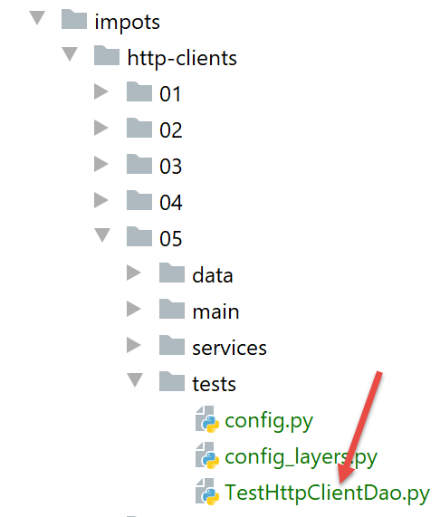
版本 10 客户端的 [TestHttpClientDao] 测试结果与版本 7 非常接近:
import unittest

from Logger import Logger


class TestHttpClientDao(unittest.TestCase):

    def test_1(self) -> None:
        from TaxPayer import TaxPayer

        # {'已婚': '是', '子女': 2, '工资': 55555,
        # '税额': 2814, '附加费': 0, '减免': 0, '减免额': 0, '税率': 0.14}
        taxpayer = TaxPayer().fromdict({"marié": "oui", "enfants": 2, "salaire": 55555})
        dao.calculate_tax_in_bulk_mode([taxpayer])
        # 验证
        self.assertAlmostEqual(taxpayer.impôt, 2815, delta=1)
        self.assertEqual(taxpayer.décôte, 0)
        self.assertEqual(taxpayer.réduction, 0)
        self.assertAlmostEqual(taxpayer.taux, 0.14, delta=0.01)
        self.assertEqual(taxpayer.surcôte, 0)

    …

if __name__ == '__main__':
    # 配置应用程序
    import config
    config = config.configure({})

    # 日志记录
    logger = Logger(config["logsFilename"])
    # 将其存储在配置中
    config["logger"] = logger
    # 获取 [dao] 层
    dao = config["layers"]["dao"]

    # 执行测试方法
    print("tests en cours...")
    unittest.main()
- 第 14 行:不再调用方法 [dao.calculate_tax],而是调用方法 [dao.calculate_tax_in_bulk_mode],并向其传递一个纳税人的列表(括号的存在);
所有测试均通过。