17. [TD]: securing the web server / jSON for elections
Keywords: multi-tier architecture, Spring, dependency injection, web service / jSON secure, client / server
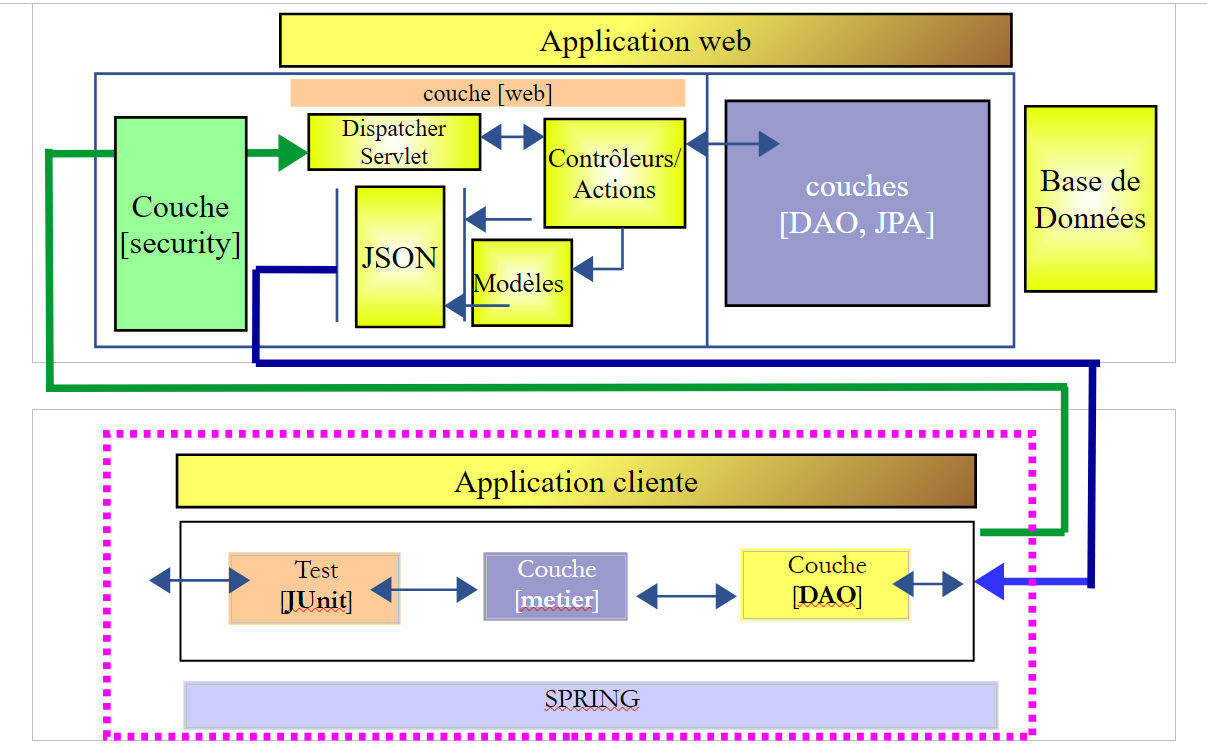
We will now apply what we learned in the previous chapter to the TD election system. The architecture will be as follows:
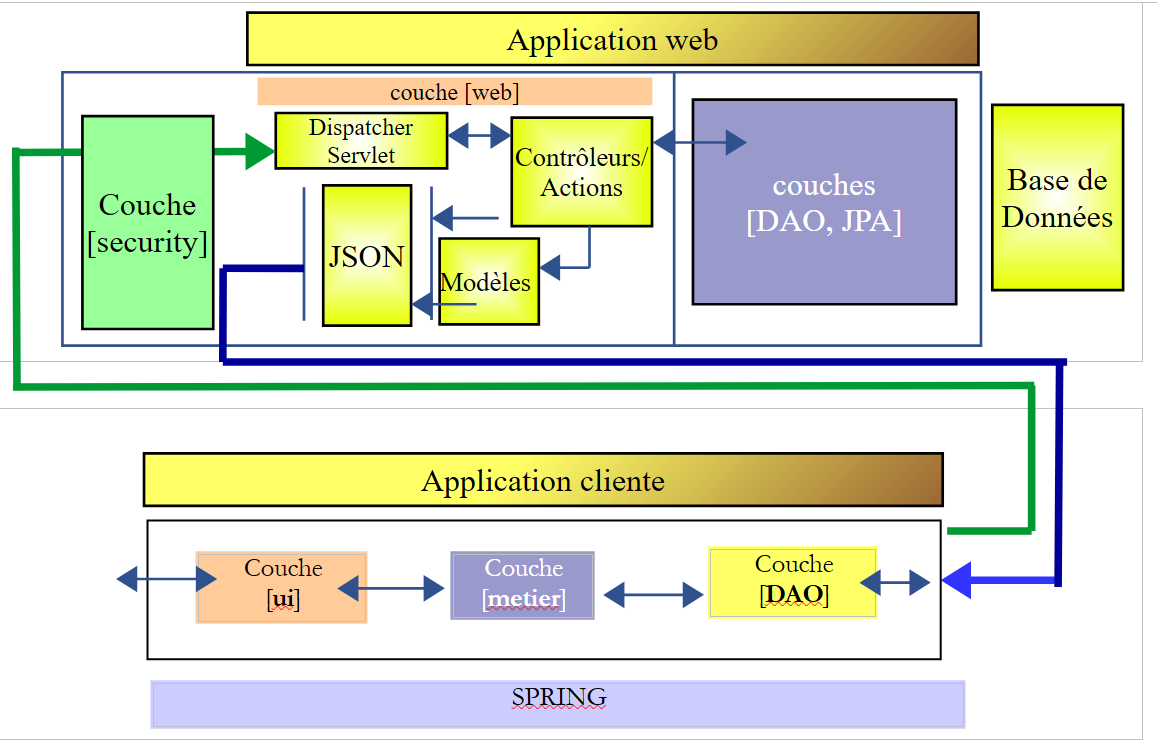 |
The process will proceed as follows:
- writing the server;
- writing the client without the [ui] layer but with a JUnit test of the [métier] layer;
- writing the client with the [ui] layer;
17.1. Support
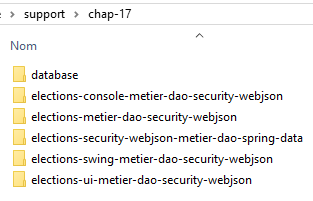 | 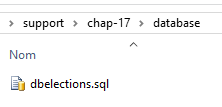 |
The projects in this chapter can be found in the [support / chap-17] folder. The SQL script is used to generate the database required for testing.
17.2. The database
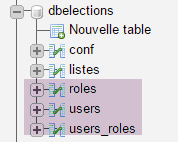
The secure server database must now contain the tables [USERS], [ROLES], and [USERS_ROLES]:
 | 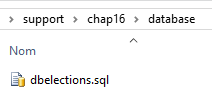 |
The SQL script for generating the database is available in the document support.
17.3. The secure server
To set up the secure election server, simply copy and paste the sample project [intro-spring-security-server-01]:
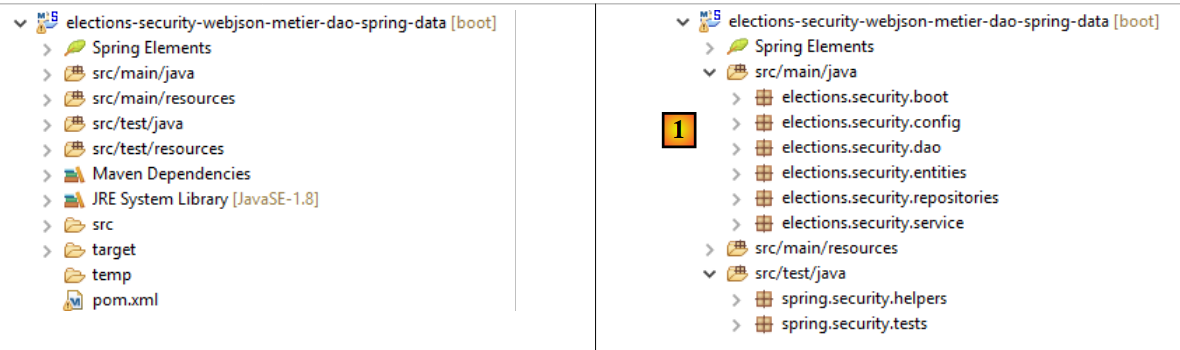 |
Task: Rename the packages as shown in [1].
Once this is done, we modify the [pom.xml] file as follows:
<project xmlns="http://maven.apache.org/POM/4.0.0" xmlns:xsi="http://www.w3.org/2001/XMLSchema-instance"
    xsi:schemaLocation="http://maven.apache.org/POM/4.0.0 http://maven.apache.org/xsd/maven-4.0.0.xsd">
    <modelVersion>4.0.0</modelVersion>
    <groupId>istia.st.elections</groupId>
    <artifactId>elections-security-webjson-metier-dao-spring-data</artifactId>
    <version>0.0.1-SNAPSHOT</version>

    <name>elections-security-webjson-metier-dao-spring-data</name>
    <description>elections spring security</description>

    <properties>
        <project.build.sourceEncoding>UTF-8</project.build.sourceEncoding>
        <java.version>1.8</java.version>
    </properties>

    <parent>
        <groupId>org.springframework.boot</groupId>
        <artifactId>spring-boot-starter-parent</artifactId>
        <version>1.2.7.RELEASE</version>
    </parent>

    <dependencies>
        <dependency>
            <groupId>istia.st.elections</groupId>
            <artifactId>elections-webjson-metier-dao-spring-data</artifactId>
            <version>0.0.1-SNAPSHOT</version>
        </dependency>
        <!-- Spring security -->
        ...
    </dependencies>
    <!-- plugins -->
    <build>
        ...
    </build>

</project>
- On lines 23–27, replace the dependency on the [intro-server-webjson-01] project with the dependency on the [elections-webjson-metier-dao-spring-data] project discussed in paragraph 12;
- On lines 4–7, enter the properties of the new project;
We still need to modify the project's configuration classes:
[DaoConfig]
package elections.security.config;

import org.springframework.context.annotation.Bean;
import org.springframework.context.annotation.ComponentScan;
import org.springframework.context.annotation.Import;
import org.springframework.data.jpa.repository.config.EnableJpaRepositories;

@EnableJpaRepositories(basePackages = { "elections.security.repositories" })
@ComponentScan(basePackages = { "elections.security.dao" })
@Import({ elections.dao.config.DaoConfig.class })
public class DaoConfig {

    // constants
    final static private String[] ENTITIES_PACKAGES = { "elections.dao.entities", "elections.security.entities" };


    @Bean
    public String[] packagesToScan() {
        return ENTITIES_PACKAGES;
    }

}
The changes are in the following lines:
- lines 8, 9, 14: enter the correct package names;
- line 10: the imported class is now [elections.dao.config.DaoConfig] from the [elections-webjson-metier-dao-spring-data] project;
Note: As mentioned, this configuration only works if class [elections.dao.config.DaoConfig] has the annotation [@Configuration]. Please verify this.
[SecurityConfig]
package elections.security.config;

...

@EnableWebSecurity
@ComponentScan(basePackages = { "elections.security.service" })
@Import({ WebConfig.class, DaoConfig.class })
public class SecurityConfig extends WebSecurityConfigurerAdapter {

    ...
}
The changes are on the following lines:
- line 6: change the package name;
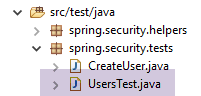
That's it. Perform an initial test by running the JUnit test []:
 |
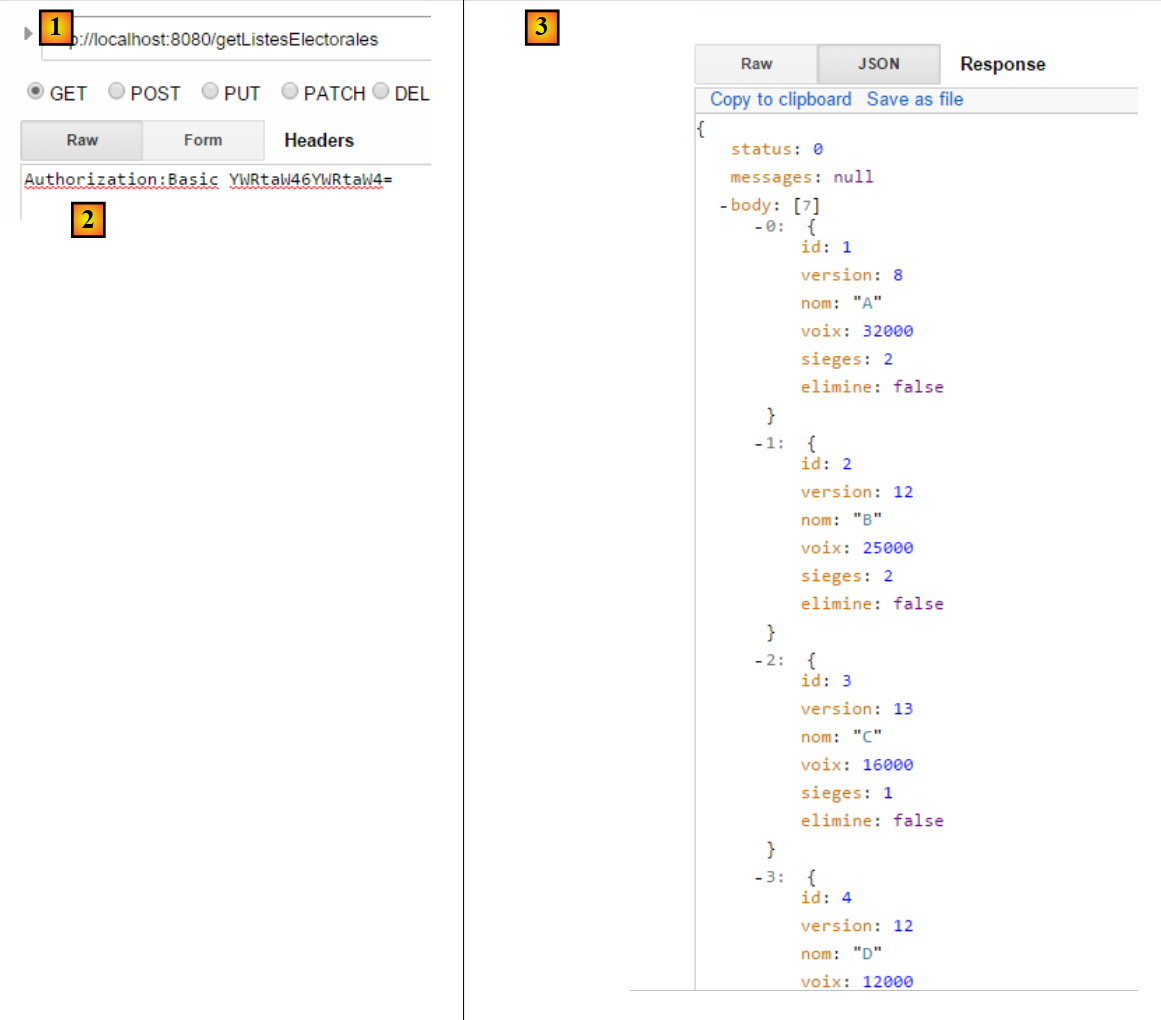
Run the [Boot] boot class, then use the [Advanced Rest Client] Chrome extension to perform the following test:
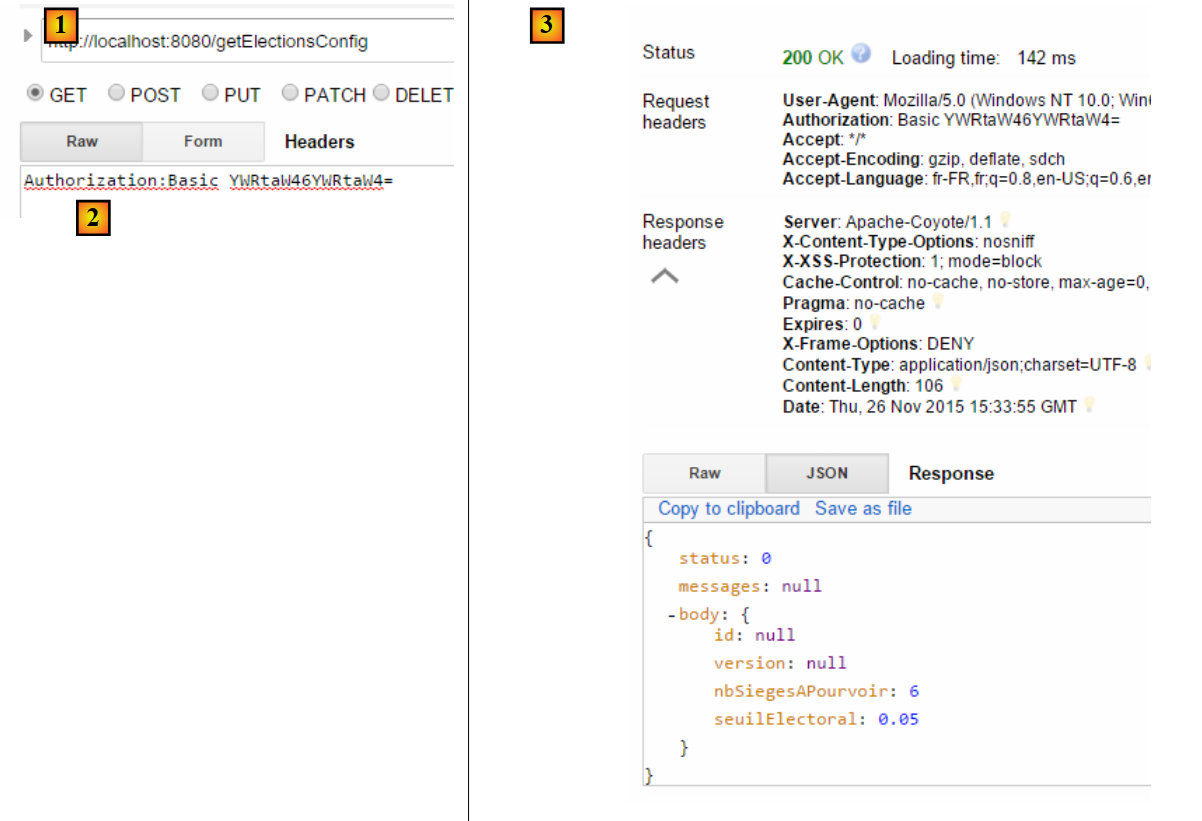 |
In [1], the request. In [3], the response. In [2], the header HTTP is the user authentication header [admin, admin]: Authorization:Basic YWRtaW46YWRtaW4=
Now, the competing lists:
 |
17.4. The secure server client without the [ui] layer
 |
Copy and paste the [elections-ui-metier-dao-webjson] project into the [elections-metier-dao-security-webjson] project.
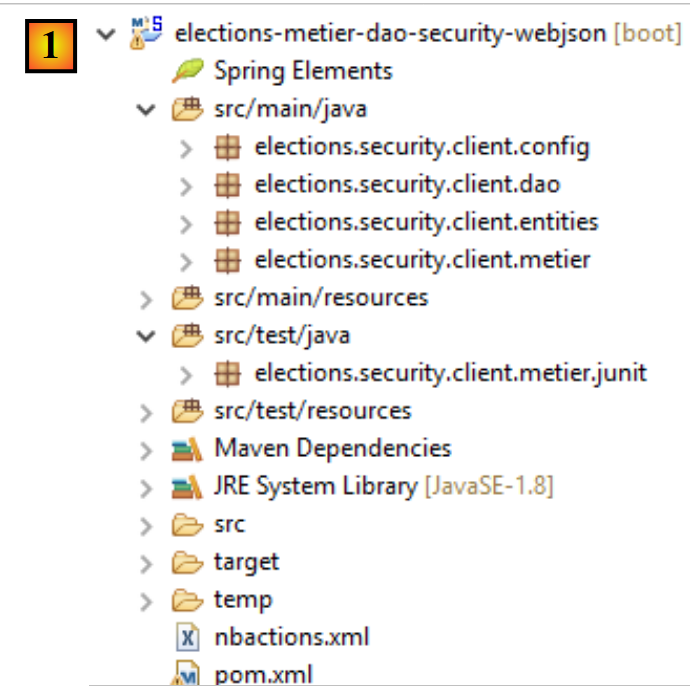 |
Task: In [1], rename the packages if necessary and delete those from the [ui] layer and the [boot] startup classes.
We will now proceed as described in section 16.5.
17.4.1. Maven Configuration
Only the project identification section changes:
<project xmlns="http://maven.apache.org/POM/4.0.0" xmlns:xsi="http://www.w3.org/2001/XMLSchema-instance"
    xsi:schemaLocation="http://maven.apache.org/POM/4.0.0 http://maven.apache.org/xsd/maven-4.0.0.xsd">
    <modelVersion>4.0.0</modelVersion>
    <groupId>istia.st.elections</groupId>
    <artifactId>elections-metier-dao-security-webjson</artifactId>
    <version>0.0.1-SNAPSHOT</version>
    <description>Client jUnit du serveur web / jSON</description>
    <name>elections-metier-dao-security-webjson</name>
...
17.4.2. Refactoring of the [métier] layer
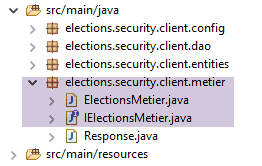 |
The [IElectionsMetier] interface is updated as follows:
package elections.security.client.metier;

import elections.security.client.entities.ListeElectorale;
import elections.security.client.entities.User;

public interface IElectionsMetier {

    // authentication
    public void authenticate(User user);

    // get the lists in competition
    public ListeElectorale[] getListesElectorales(User user);

    // the number of seats to be filled
    public int getNbSiegesAPourvoir(User user);

    // the electoral threshold
    public double getSeuilElectoral(User user);

    // recording results
    public void recordResultats(User user, ListeElectorale[] listesElectorales);

    // calculating seats
    public ListeElectorale[] calculerSieges(User user, ListeElectorale[] listesElectorales);

}
All methods have as their first parameter the user who wants to use the secure server's resources.
The [ElectionsMetier] implementation evolves as follows:
package elections.security.client.metier;

import java.io.IOException;

import org.springframework.beans.factory.annotation.Autowired;
import org.springframework.context.ApplicationContext;
import org.springframework.stereotype.Component;

import com.fasterxml.jackson.core.type.TypeReference;
import com.fasterxml.jackson.databind.ObjectMapper;

import elections.security.client.dao.IClientDao;
import elections.security.client.entities.ElectionsConfig;
import elections.security.client.entities.ElectionsException;
import elections.security.client.entities.ListeElectorale;
import elections.security.client.entities.User;

@Component
public class ElectionsMetier implements IElectionsMetier {

  @Autowired
  private IClientDao dao;
  @Autowired
  private ApplicationContext context;

  // election configuration
  private ElectionsConfig electionsConfig;

  private ElectionsConfig getElectionsConfig(User user) {
    if(electionsConfig!=null){
      return electionsConfig;
    }
    // mappers jSON
    ObjectMapper mapperResponse = context.getBean(ObjectMapper.class);
    try {
      // request
      Response<ElectionsConfig> response = mapperResponse.readValue(dao.getResponse(user, "/getElectionsConfig", null),
              new TypeReference<Response<ElectionsConfig>>() {
      });
      // mistake?
      if (response.getStatus() != 0) {
        // 1 exception is thrown
        throw new ElectionsException(response.getStatus(), response.getMessages());
      } else {
        electionsConfig = response.getBody();
        return electionsConfig;
      }
    } catch (ElectionsException e1) {
      throw e1;
    } catch (IOException | RuntimeException e2) {
      throw new ElectionsException(100, e2);
    }
  }

  @Override
  public ListeElectorale[] getListesElectorales(User user) {
   ...
  }

  @Override
  public int getNbSiegesAPourvoir(User user) {
    return getElectionsConfig(user).getNbSiegesAPourvoir();
  }

  @Override
  public double getSeuilElectoral(User user) {
    return getElectionsConfig(user).getSeuilElectoral();
  }

  @Override
  public void recordResultats(User user, ListeElectorale[] listesElectorales) {
    ...
  }

  @Override
  public ListeElectorale[] calculerSieges(User user, ListeElectorale[] listesElectorales) {
    ...
  }

  @Override
  public void authenticate(User user) {
    dao.getResponse(user, "/authenticate", null);
  }
}
Task: Complete the code above.
17.4.3. Spring Configuration
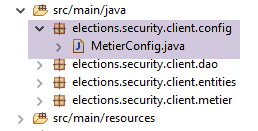 |
The [MetierConfig] class evolves as follows:
package elections.security.client.config;

...

@ComponentScan({ "elections.security.client.dao", "elections.security.client.metier" })
public class MetierConfig {
Line 5: The packages to be scanned must be updated.
17.4.4. The JUnit test for the [métier] layer
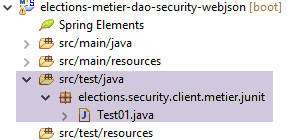 |
The [Test01] test class changes as follows:
package elections.security.client.metier.junit;

import org.junit.Assert;
import org.junit.BeforeClass;
import org.junit.Test;
import org.junit.runner.RunWith;
import org.springframework.beans.factory.annotation.Autowired;
import org.springframework.boot.test.SpringApplicationConfiguration;
import org.springframework.test.context.junit4.SpringJUnit4ClassRunner;

import com.fasterxml.jackson.core.JsonProcessingException;
import com.fasterxml.jackson.databind.ObjectMapper;

import elections.security.client.config.MetierConfig;
import elections.security.client.entities.ElectionsException;
import elections.security.client.entities.ListeElectorale;
import elections.security.client.entities.User;
import elections.security.client.metier.IElectionsMetier;

@SpringApplicationConfiguration(classes = MetierConfig.class)
@RunWith(SpringJUnit4ClassRunner.class)
public class Test01 {

    // layer [electionsMetier]
    @Autowired
    private IElectionsMetier electionsMetier;

    // mapper jSON
    private final ObjectMapper mapper = new ObjectMapper();

    // users
    static private User admin;
    static private User user;
    static private User unknown;

    @BeforeClass
    public static void initTest() {
        admin = new User("admin", "admin");
        user = new User("user", "user");
        unknown = new User("x", "y");
    }

    @Test()
    public void checkUserUser() {
        ElectionsException se = null;
        try {
            electionsMetier.authenticate(user);
        } catch (ElectionsException e) {
            se = e;
        }
        Assert.assertNotNull(se);
        Assert.assertEquals("403 Forbidden", se.getErreurs().get(0));
    }

    @Test()
    public void checkUserUnknown() {
        ElectionsException se = null;
        try {
            electionsMetier.authenticate(unknown);
        } catch (ElectionsException e) {
            se = e;
        }
        Assert.assertNotNull(se);
        Assert.assertEquals("401 Unauthorized", se.getErreurs().get(0));
    }

    @Test()
    public void checkUserAdmin() {
        ElectionsException se = null;
        try {
            electionsMetier.authenticate(admin);
        } catch (ElectionsException e) {
            se = e;
        }
        Assert.assertNull(se);
    }

    /**
     * vérification 1 : méthode de calcul des sièges on fixe en dur les listes
     */
    @Test
    public void calculSieges1() {
        // create the table of 7 candidate lists
        ListeElectorale[] listes = new ListeElectorale[7];
        listes[0] = new ListeElectorale("A", 32000, 0, false);
        listes[1] = new ListeElectorale("B", 25000, 0, false);
        listes[2] = new ListeElectorale("C", 16000, 0, false);
        listes[3] = new ListeElectorale("D", 12000, 0, false);
        listes[4] = new ListeElectorale("E", 8000, 0, false);
        listes[5] = new ListeElectorale("F", 4500, 0, false);
        listes[6] = new ListeElectorale("G", 2500, 0, false);
        // the seats for each list are calculated
        listes = electionsMetier.calculerSieges(admin,listes);
        // check results
        Assert.assertEquals(2, listes[0].getSieges());
        Assert.assertFalse(listes[0].isElimine());
        Assert.assertEquals(2, listes[1].getSieges());
        Assert.assertFalse(listes[1].isElimine());
        Assert.assertEquals(1, listes[2].getSieges());
        Assert.assertFalse(listes[2].isElimine());
        Assert.assertEquals(1, listes[3].getSieges());
        Assert.assertFalse(listes[3].isElimine());
        Assert.assertEquals(0, listes[4].getSieges());
        Assert.assertFalse(listes[4].isElimine());
        Assert.assertEquals(0, listes[5].getSieges());
        Assert.assertTrue(listes[5].isElimine());
        Assert.assertEquals(0, listes[6].getSieges());
        Assert.assertTrue(listes[6].isElimine());
    }

    /**
     * vérification 2 : méthode de calcul des sièges on demande les listes à la couche [metier] puis on fixe en dur les
     * voix
     */
    @Test
    public void calculSieges2() {
        // create the table of 7 candidate lists
        ListeElectorale[] listes = electionsMetier.getListesElectorales(admin);
        // the voices are hard-fixed
        listes[0].setVoix(32000);
        listes[1].setVoix(25000);
        listes[2].setVoix(16000);
        listes[3].setVoix(12000);
        listes[4].setVoix(8000);
        listes[5].setVoix(4500);
        listes[6].setVoix(2500);
        // the seats obtained by each list are calculated
        listes = electionsMetier.calculerSieges(admin,listes);
        // check results
        Assert.assertEquals(2, listes[0].getSieges());
        Assert.assertFalse(listes[0].isElimine());
        Assert.assertEquals(2, listes[1].getSieges());
        Assert.assertFalse(listes[1].isElimine());
        Assert.assertEquals(1, listes[2].getSieges());
        Assert.assertFalse(listes[2].isElimine());
        Assert.assertEquals(1, listes[3].getSieges());
        Assert.assertFalse(listes[3].isElimine());
        Assert.assertEquals(0, listes[4].getSieges());
        Assert.assertFalse(listes[4].isElimine());
        Assert.assertEquals(0, listes[5].getSieges());
        Assert.assertTrue(listes[5].isElimine());
        Assert.assertEquals(0, listes[6].getSieges());
        Assert.assertTrue(listes[6].isElimine());
    }

    /**
     * vérification 3 méthode de calcul des sièges on provoque une exception
     */
    @Test(expected = ElectionsException.class)
    public void calculSieges3() {
        // we create a table of 24 candidate lists, each with 1 vote
        ListeElectorale[] listes = new ListeElectorale[25];
        // all 25 lists will have the same number of votes (4%)
        for (int i = 0; i < listes.length; i++) {
            listes[i] = new ListeElectorale("Liste" + (i + 1), 1, 0, false);
        }
        // calculation of seats - normally there should be a ElectionsException
        // with an electoral threshold of 5%
        electionsMetier.calculerSieges(admin,listes);
    }

    /**
     * enregistrement des résultats de l'élection
     *
     * @throws JsonProcessingException
     */
    @Test
    public void ecritureResultatsElections() throws JsonProcessingException {
        // create the table of 7 candidate lists
        ListeElectorale[] listes = electionsMetier.getListesElectorales(admin);
        // the voices are hard-fixed
        listes[0].setVoix(32000);
        listes[1].setVoix(25000);
        listes[2].setVoix(16000);
        listes[3].setVoix(12000);
        listes[4].setVoix(8000);
        listes[5].setVoix(4500);
        listes[6].setVoix(2500);
        // the seats obtained by each list are calculated
        listes = electionsMetier.calculerSieges(admin,listes);
        // display results
        for (int i = 0; i < listes.length; i++) {
            System.out.println(mapper.writeValueAsString(listes[i]));
        }
        // results are entered into the database
        electionsMetier.recordResultats(admin,listes);
        // check results
        listes = electionsMetier.getListesElectorales(admin);
        // display results
        for (int i = 0; i < listes.length; i++) {
            System.out.println(mapper.writeValueAsString(listes[i]));
        }
        Assert.assertEquals(2, listes[0].getSieges());
        Assert.assertFalse(listes[0].isElimine());
        Assert.assertEquals(2, listes[1].getSieges());
        Assert.assertFalse(listes[1].isElimine());
        Assert.assertEquals(1, listes[2].getSieges());
        Assert.assertFalse(listes[2].isElimine());
        Assert.assertEquals(1, listes[3].getSieges());
        Assert.assertFalse(listes[3].isElimine());
        Assert.assertEquals(0, listes[4].getSieges());
        Assert.assertFalse(listes[4].isElimine());
        Assert.assertEquals(0, listes[5].getSieges());
        Assert.assertTrue(listes[5].isElimine());
        Assert.assertEquals(0, listes[6].getSieges());
        Assert.assertTrue(listes[6].isElimine());
    }
}
Task: Understand this test and verify that it passes.
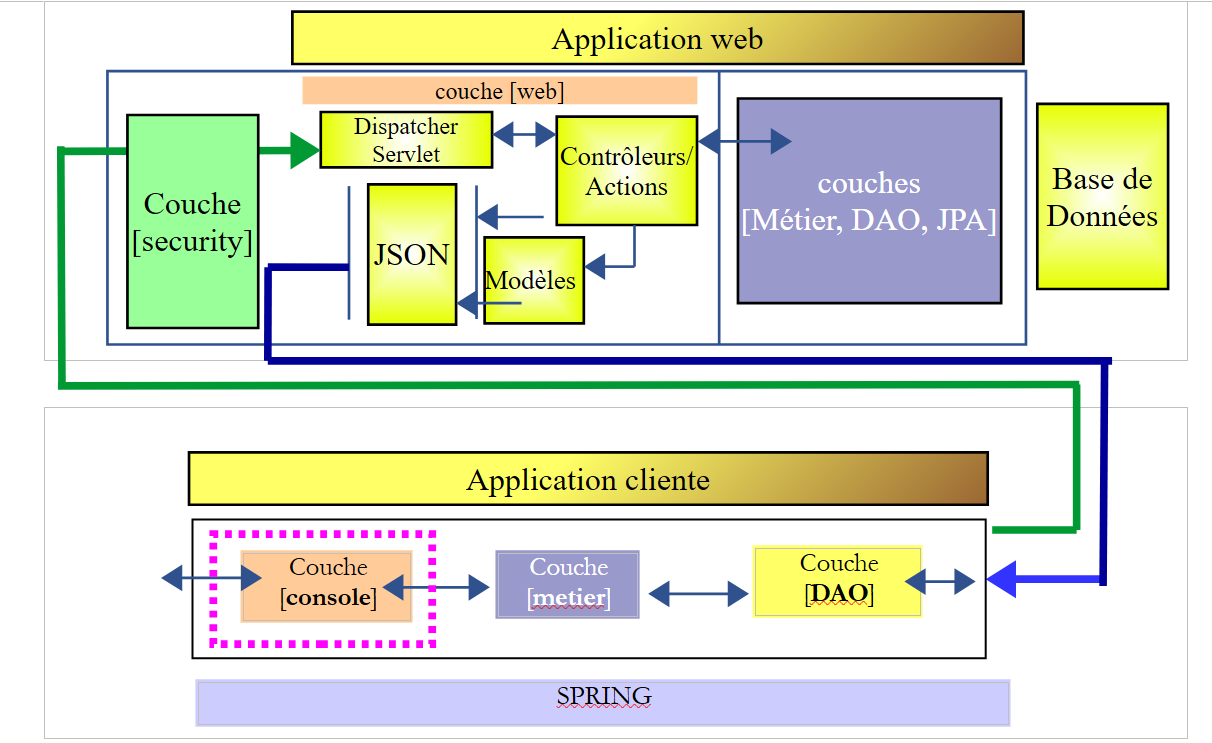
17.5. The client of the secure server with a [console] layer
 |
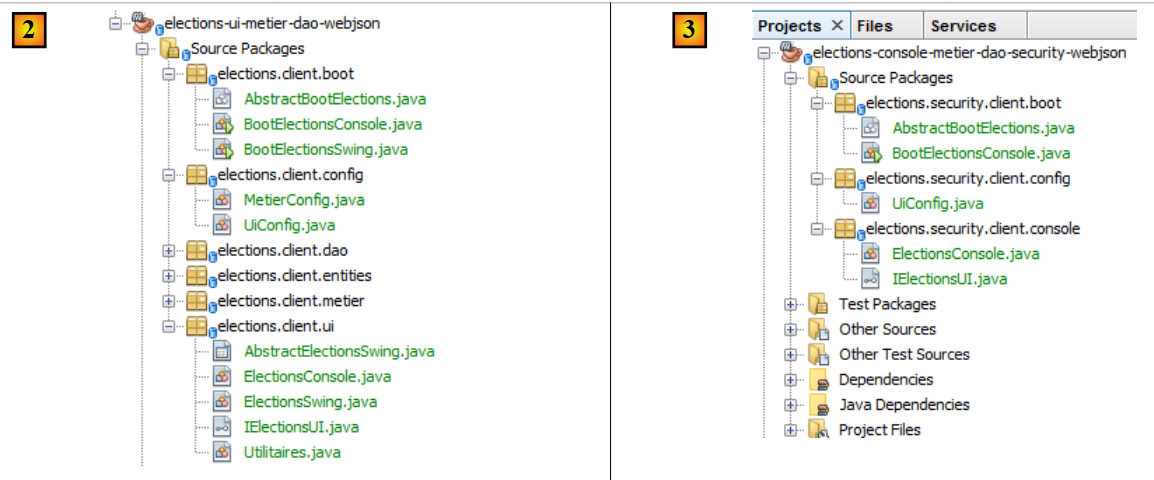
With Netbeans, we open the Maven projects [elections-metier-dao-security-webjson] and [elections-ui-metier-dao-webjson], then we build a new project [elections-console-metier-dao-security-webjson] by copying and pasting from the project [elections-ui-metier-dao-webjson]:
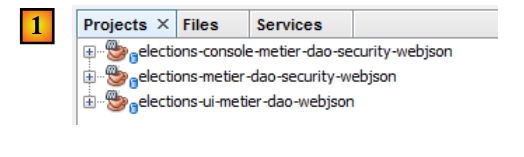 |
Most of the classes in the new [3] project come from the [elections-ui-metier-dao-webjson] and [2] projects, which were clients of the unsecured web server / jSON:
 |
Follow these steps to build the new Maven project:
- Copy and paste the [elections-ui-metier-dao-webjson] project into the [elections-ui-metier-dao-security-webjson] project;
- In the new project:
- delete the [elections.client.dao, elections.client.metier, elections.client.entities] packages;
- in the [elections.client.ui] package, keep only the [ElectionsConsole] console class and its [IElectionsUI] interface;
- rename the packages as indicated to [3];
- fix the import issues in the various classes using [clic droit / Fix Imports];
At this stage, the new project contains numerous errors.
17.5.1. Maven Configuration
The [pom.xml] file for the new project is as follows:
<project xmlns="http://maven.apache.org/POM/4.0.0" xmlns:xsi="http://www.w3.org/2001/XMLSchema-instance"
    xsi:schemaLocation="http://maven.apache.org/POM/4.0.0 http://maven.apache.org/xsd/maven-4.0.0.xsd">
    <modelVersion>4.0.0</modelVersion>
    <groupId>istia.st.elections</groupId>
    <artifactId>elections-console-metier-dao-security-webjson</artifactId>
    <version>0.0.1-SNAPSHOT</version>
    <name>elections-console-metier-dao-security-webjson</name>
    <description>couche console du client web / jSON</description>

    <properties>
        <project.build.sourceEncoding>UTF-8</project.build.sourceEncoding>
        <java.version>1.8</java.version>
    </properties>

    <parent>
        <groupId>org.springframework.boot</groupId>
        <artifactId>spring-boot-starter-parent</artifactId>
        <version>1.2.7.RELEASE</version>
    </parent>

    <dependencies>
        <dependency>
            <groupId>istia.st.elections</groupId>
            <artifactId>elections-metier-dao-security-webjson</artifactId>
            <version>0.0.1-SNAPSHOT</version>
        </dependency>
    </dependencies>

    <build>
        <plugins>
            <plugin>
                <groupId>org.apache.maven.plugins</groupId>
                <artifactId>maven-surefire-plugin</artifactId>
                <version>2.18.1</version>
            </plugin>
        </plugins>
    </build>

</project>
- lines 4–8: the Maven ID of the new project;
- lines 22–26: the dependency on the [elections-metier-dao-security-webjson] project that we just built in Section 17.4, which provides the [DAO] and [métier] layers;
17.5.2. Spring Configuration
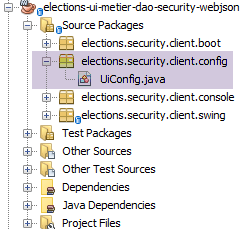 |
The [UiConfig] class is as follows:
package elections.security.client.config;

import elections.security.client.entities.User;
import org.springframework.context.annotation.Bean;
import org.springframework.context.annotation.ComponentScan;
import org.springframework.context.annotation.Import;

@Import(MetierConfig.class)
@ComponentScan(basePackages = {"elections.security.client.console","elections.security.client.swing"})
public class UiConfig {

  // director
  private final User ADMIN = new User("admin", "admin");

  @Bean
  private User admin() {
    return ADMIN;
  }

}
- Line 8: We import the [elections.security.client.config.MetierConfig] class from the [elections-metier-dao-security-webjson] project discussed in Section 17.4;
- line 9: we declare the packages where the Spring beans are located;
- lines 12–18: the bean [admin] is the user [admin, admin], which will be used by the console application. Recall that this is the only user authorized to query the secure web server /jSON;
17.5.3. The console boot application
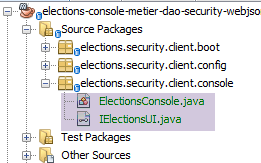 |
The [ElectionsConsole] class evolves as follows:
package elections.security.client.console;

import java.util.Arrays;
import java.util.Comparator;
import java.util.Scanner;

import org.springframework.beans.factory.annotation.Autowired;
import org.springframework.stereotype.Component;

import elections.security.client.entities.ElectionsException;
import elections.security.client.entities.ListeElectorale;
import elections.security.client.entities.User;
import elections.security.client.metier.IElectionsMetier;

@Component
public class ElectionsConsole implements IElectionsUI {

    @Autowired
    private IElectionsMetier electionsMetier;

  @Autowired
  private User admin;

    @Override
    public void run() {
        // competing lists
        ListeElectorale[] listes;
        // data entry
        try (Scanner clavier = new Scanner(System.in)) {
            // lists in competition are requested from the [metier] layer
            listes = electionsMetier.getListesElectorales(admin);
            // voice recording
            System.out.println("Il y a " + listes.length
                    + " listes en compétition. Veuillez indiquer le nombre de voix de chacune d'elles :");
            for (int i = 0; i < listes.length; i++) {
                boolean saisieOK = false;
                while (!saisieOK) {
                    System.out.print("Nombre de voix de la liste [" + listes[i].getNom() + "] : ");
                    try {
                        listes[i].setVoix(Integer.parseInt(clavier.nextLine()));
                        saisieOK = true;
                    } catch (ElectionsException | NumberFormatException ex) {
                        System.out.println("Nombre de voix incorrect. Veuillez recommencer");
                    }
                }
            }
        }
        // we calculate the number of seats
        listes=electionsMetier.calculerSieges(admin,listes);
        // we record the results
        electionsMetier.recordResultats(admin,listes);
        // lists sorted in descending order of votes
        Arrays.sort(listes, new CompareListesElectorales());
        // we display them
        System.out.println("\nRésultats de l'élection\n");
        for (int i = 0; i < listes.length; i++) {
            System.out.println(listes[i]);
        }
    }

    // electoral list comparison class
    class CompareListesElectorales implements Comparator<ListeElectorale> {

        // comparison of two candidate lists by number of votes
        @Override
        public int compare(ListeElectorale listeElectorale1, ListeElectorale listeElectorale2) {
            // compare the votes cast for these two lists
            int nbVoix1 = listeElectorale1.getVoix();
            int nbVoix2 = listeElectorale2.getVoix();
            if (nbVoix1 < nbVoix2) {
                return +1;
            } else {
                if (nbVoix1 > nbVoix2)
                    return -1;
                else
                    return 0;
            }
        }
    }

}
The ElectionsConsole class changes very little. You just need to remember that the methods in the [métier] layer now require a user as their first parameter (lines 31, 49, 51). This is provided by the injection in lines 21–22. The injected user is the one authorized to query the web server / jSON.
Task: Test the console application (remember to start the secure server first).
17.6. The client of the secure server with a [swing] layer
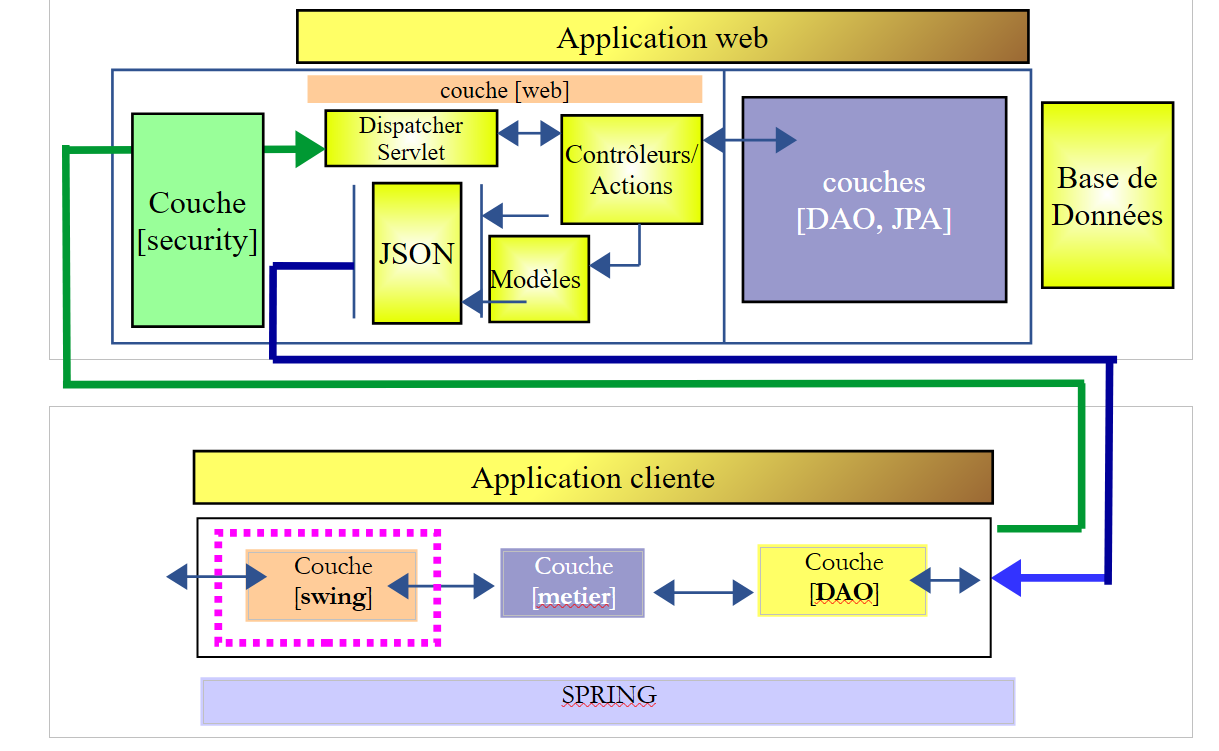 |
We create a new project Netbeans [elections-swing-metier-dao-security-webjson] by copying and pasting the [elections-ui-metier-dao-webjson] project:
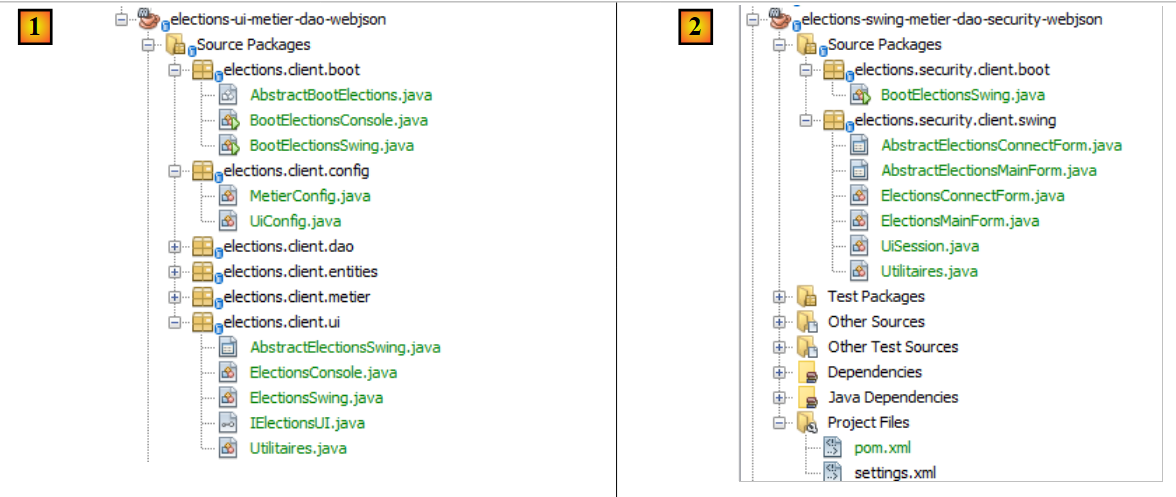 |
In the new [2] project:
- delete the packages [elections.client.dao, elections.client.metier, elections.client.entities];
- in the [elections.client.ui] package, delete the [ElectionsConsole, IElectionsUI] classes;
- rename the packages as indicated in [2];
- in the [elections.security.client.swing] package, rename the [AbstractElectionsSwing] class that implements the graphical interface to [AbstractElectionsMainForm] and the [ElectionsSwing] class that implements the event handlers for thegraphical interface to [ElectionsMainForm];
- resolve the import issues in the various classes using [clic droit / Fix Imports];
At this stage, there are numerous errors.
17.6.1. Maven Configuration
The [pom.xml] file evolves as follows:
<project xmlns="http://maven.apache.org/POM/4.0.0" xmlns:xsi="http://www.w3.org/2001/XMLSchema-instance"
    xsi:schemaLocation="http://maven.apache.org/POM/4.0.0 http://maven.apache.org/xsd/maven-4.0.0.xsd">
    <modelVersion>4.0.0</modelVersion>
    <groupId>istia.st.elections</groupId>
    <artifactId>elections-swing-metier-dao-security-webjson</artifactId>
    <version>0.0.1-SNAPSHOT</version>
    <name>elections-swing-metier-dao-security-webjson</name>
    <description>couche swing du client web / jSON</description>

    <properties>
        <project.build.sourceEncoding>UTF-8</project.build.sourceEncoding>
        <java.version>1.8</java.version>
    </properties>

    <parent>
        <groupId>org.springframework.boot</groupId>
        <artifactId>spring-boot-starter-parent</artifactId>
        <version>1.2.7.RELEASE</version>
    </parent>

    <dependencies>
        <dependency>
            <groupId>istia.st.elections</groupId>
            <artifactId>elections-console-metier-dao-security-webjson</artifactId>
            <version>0.0.1-SNAPSHOT</version>
        </dependency>
    </dependencies>

    <build>
        <plugins>
            <plugin>
                <groupId>org.apache.maven.plugins</groupId>
                <artifactId>maven-surefire-plugin</artifactId>
                <version>2.18.1</version>
            </plugin>
        </plugins>
    </build>

</project>
- lines 4–8: the Maven ID of the new project;
- lines 22–26: a dependency on the console project we just examined in Section 17.5;
17.6.2. Spring Configuration
This project uses the Spring configuration of the console project it imports (see Section 17.5.2).
17.6.3. The Swing Application Views
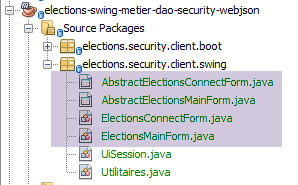 |
This project will use two views:
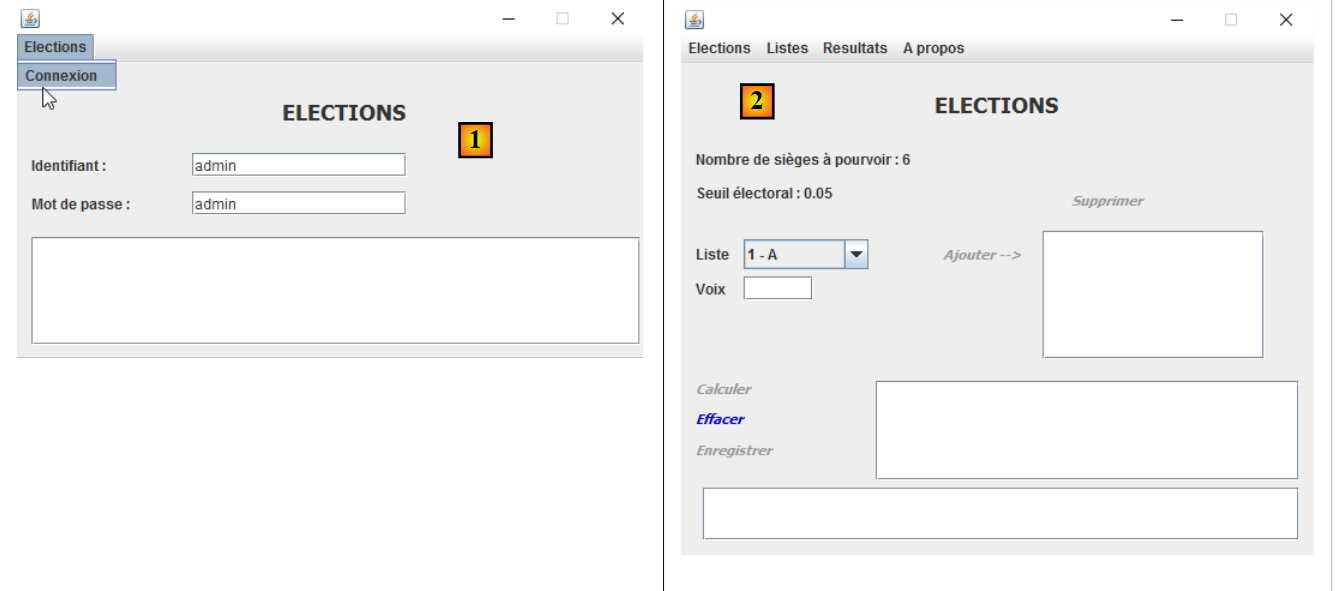 |
- the [1] login view is new. It is used to authenticate the user who wants to use the application. It uses the following classes:
- [AbstractElectionsConnectForm], which implements the view;
- [ElectionsConnectForm], which handles the view’s events;
- The [2] view is familiar. This is the one used so far. It uses the following classes:
- [AbstractElectionsMainForm], which implements the view;
- [ElectionsMainForm], which handles view events;
17.6.4. The session
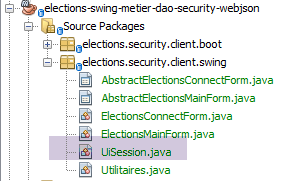 |
When a Swing application has multiple views, a mechanism is needed to allow one view to pass information to another view. We use a concept from web development: the session, which allows views associated with a specific user to share information. This concept will be implemented here using a Spring singleton that will be injected into the two classes that handle events for both views:
package elections.security.client.swing;

import elections.security.client.entities.User;
import org.springframework.stereotype.Component;

@Component
public class UiSession {

    // the connected user
  private User user;

  // getters and setters
...
}
- line 6: the [UiSession] class is a Spring component;
- line 10: it serves only one purpose: to store the user who logs in via the [1] view. The [2] view, which needs to know this user, will retrieve it from there;
17.6.5. The boot class
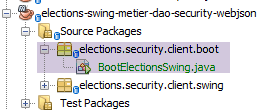 |
The boot class for the graphical application is as follows:
package elections.security.client.boot;

import elections.security.client.console.IElectionsUI;

public class BootElectionsSwing extends AbstractBootElections {
    public static void main(String[] arguments) {
        new BootElectionsSwing().run();
    }

    @Override
    protected IElectionsUI getUI() {
        return ctx.getBean("electionsConnectForm", IElectionsUI.class);
    }
}
- line 5: the class [BootElectionsSwing] extends the class [AbstractBootElections] defined in the console project present in the project dependencies;
- lines 10–13: the [BootElectionsSwing] class will display the [ElectionsConnectForm] login view;
- lines 6–8: the [run] method of this class will be executed;
17.6.6. The [ElectionsMainForm] class
The [ElectionsMainForm] class is the one that was previously called [ElectionsSwing]. It handles events for the [AbstractElectionsMainForm] view. Its code evolves as follows:
package elections.security.client.swing;

import elections.security.client.console.IElectionsUI;
import java.awt.Dimension;
import java.awt.Toolkit;
import java.util.ArrayList;
import java.util.List;

import javax.swing.DefaultListModel;
import javax.swing.JLabel;
import javax.swing.JMenuItem;
import javax.swing.JOptionPane;

import org.springframework.beans.factory.annotation.Autowired;
import org.springframework.stereotype.Component;

import elections.security.client.entities.ElectionsException;
import elections.security.client.entities.ListeElectorale;
import elections.security.client.entities.User;
import elections.security.client.metier.IElectionsMetier;

@Component
public class ElectionsMainForm extends AbstractElectionsMainForm implements IElectionsUI {

  private static final long serialVersionUID = 1L;

  // reference on the [business] layer
  @Autowired
  private IElectionsMetier metier;

  // session UI
  @Autowired
  private UiSession uiSession;

  // logged-in user
  private User user;

  // list templates JList
  private DefaultListModel<String> modèleNomsVoix = null;
  private DefaultListModel<String> modèleRésultats = null;

  // competing lists
  private ListeElectorale[] listes;

  // user-entered lists
  private final List<ListeElectorale> listesSaisies = new ArrayList<>();
  private ListeElectorale[] tListesSaisies;

  // initializations
  @Override
  protected void init() {
    // generation of components by the parent class
    super.init();
    // local initializations
    modèleNomsVoix = new DefaultListModel<>();
    jListNomsVoix.setModel(modèleNomsVoix);
    modèleRésultats = new DefaultListModel<>();
    jListResultats.setModel(modèleRésultats);
    String info;
    boolean erreur = false;
    try {
      // lists are requested from the [business] layer
      listes = metier.getListesElectorales(user);
      // associate list names with the jComboBoxNomsListes combo
      for (int i = 0; i < listes.length; i++) {
        jComboBoxNomsListes.addItem(String.format("%s - %s", listes[i].getId(), listes[i].getNom()));
      }
      // and election parameters
      int nbSiegesAPourvoir = metier.getNbSiegesAPourvoir(user);
      double seuilElectoral = metier.getSeuilElectoral(user);
      // on initialise les labels liés à ces deux informations
      jLabelSAP.setText(jLabelSAP.getText() + nbSiegesAPourvoir);
      jLabelSE.setText(jLabelSE.getText() + seuilElectoral);
      // message of success
      info = "Source de données lue avec succès";
    } catch (ElectionsException ex1) {
      // we note the error
      info = getInfoForException("Les erreurs suivantes se sont produites :", ex1);
      erreur = true;
    } catch (RuntimeException ex2) {
      // we note the error
      info = getInfoForException("Les erreurs suivantes se sont produites :", ex2);
      erreur = true;
    }
    // mistake?
    if (erreur) {
      // display info
      jTextPaneMessages.setText(info);
      jTextPaneMessages.setCaretPosition(0);
      return;
    } else {
      jTextPaneMessages.setText("");
    }
    // form status
    Utilitaires.setEnabled(new JLabel[]{jLabelAjouter, jLabelCalculer, jLabelEnregistrer, jLabelSupprimer}, false);
    Utilitaires.setEnabled(
            new JMenuItem[]{jMenuItemAjouter, jMenuItemCalculer, jMenuItemEnregistrer, jMenuItemSupprimer}, false);
    // center window
    Dimension screenSize = Toolkit.getDefaultToolkit().getScreenSize();
    Dimension frameSize = getSize();
    if (frameSize.height > screenSize.height) {
      frameSize.height = screenSize.height;
    }
    if (frameSize.width > screenSize.width) {
      frameSize.width = screenSize.width;
    }
    setLocation((screenSize.width - frameSize.width) / 2, (screenSize.height - frameSize.height) / 2);

  }
...

  @Override
  public void run() {
    // user memory
    user = uiSession.getUser();
    // window initialization
    init();
    setVisible(true);
  }
}
- lines 32-33: inject the application session;
- lines 112-119: the view will be activated as before using its method [run];
- line 115: the user is retrieved from the session. The user was placed there by the code in the [ElectionsConnectForm] login view. The code is then modified so that the first parameter of calls to the [métier] layer is this user (lines 63, 69–70, for example);
17.6.7. The [AbstractElectionsConnectForm] view
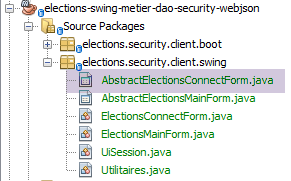 |
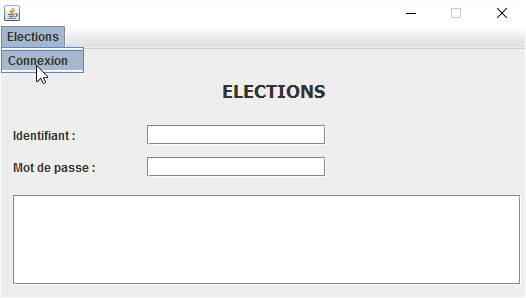
Use Netbeans to build the following form:
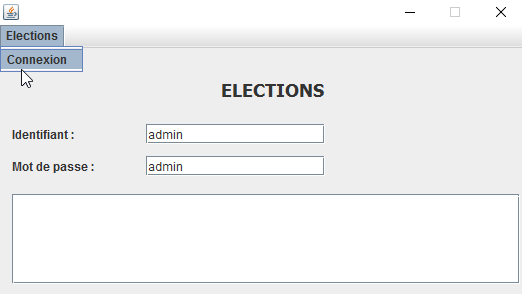 |
The class will not implement the method handling the click on the option menu item [Connexion] itself. It will call an abstract method [doConnecter], and the view class will itself be declared abstract. We will remove the static method [main] that was automatically generated.
17.6.8. Event Handling for the Login View
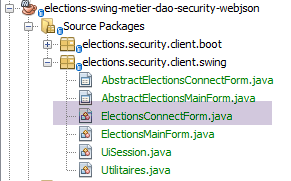 |
The [ElectionsConnectForm] class implements event handling for the login view as follows:
package elections.security.client.swing;

import elections.security.client.console.IElectionsUI;
import elections.security.client.entities.ElectionsException;
import elections.security.client.entities.User;
import elections.security.client.metier.IElectionsMetier;
import java.awt.Dimension;
import java.awt.Toolkit;
import javax.swing.SwingUtilities;
import org.springframework.beans.factory.annotation.Autowired;
import org.springframework.stereotype.Component;

@Component
public class ElectionsConnectForm extends AbstractElectionsConnectForm implements IElectionsUI {

    private static final long serialVersionUID = 1L;

    // reference on the [business] layer
  @Autowired
  private IElectionsMetier metier;

  // logged-in user
  private User user;

  // main form
  @Autowired
  private ElectionsMainForm electionsMainForm;

  // session UI
  @Autowired
  private UiSession uiSession;

  @Override
  protected void doConnect() {
    String info = null;
    try {
      if (isPageValid()) {
        // user authentication
        metier.authenticate(user);
        // the user is stored in the session
        uiSession.setUser(user);
        // connection view is hidden
        setVisible(false);
        // the main view is displayed
        electionsMainForm.run();
      }
    } catch (ElectionsException ex1) {
      // we note the error
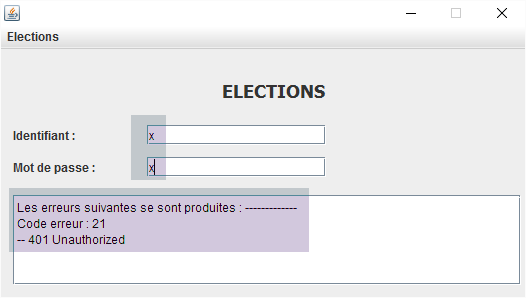
      info = getInfoForException("Les erreurs suivantes se sont produites :", ex1);
    } catch (RuntimeException ex2) {
      // we note the error
      info = getInfoForException("Les erreurs suivantes se sont produites :", ex2);
    }
    // mistake?
    if (info != null) {
      // display info
      jTextPaneErreurs.setText(info);
      jTextPaneErreurs.setCaretPosition(0);
    }
  }

  // initializations
  @Override
  protected void init() {
    // generation of components by the parent class
    super.init();
    // local initializations
...
    // center window
...
  }

  @Override
  public void run() {
    // the graphical interface is displayed
    SwingUtilities.invokeLater(new Runnable() {
      public void run() {
        init();
        setVisible(true);
      }
    });
  }

  private boolean isPageValid() {
    ...
  }

  private String getInfoForException(String message, ElectionsException ex) {
...
  }

  private String getInfoForException(String message, RuntimeException ex) {
...
  }

}
- lines 73–82: the [run] method, which will be called by the [BootElectionsSwing] boot class;
- lines 26-27: injection of a reference to view #2, which should be displayed if the user is recognized;
- lines 30-31: injection of the application session;
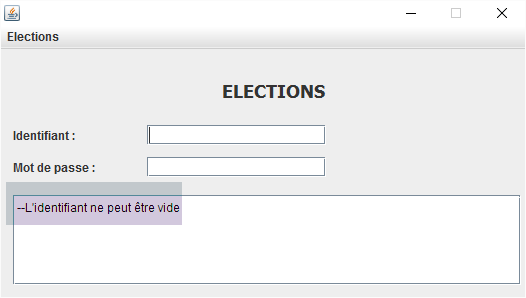
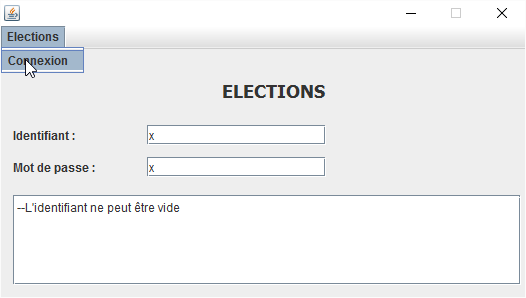
- line 84: the [isPageValid] method does two things:
- it checks that the username is not empty (the password may be empty);
- instantiates the User field on line 23 with the entered values;
 |  |
 |  |
Task: Complete the class code.
Task: Test the application.