12. [TD]: Implementation of the [DAO] layer of the TD using [Spring Data]
Keywords: multi-layer architecture, Spring, dependency injection, JPA (Java Persistence API), Spring Data.
We will follow the same approach as before to implement the [DAO] layer of the TD.
12.1. Support
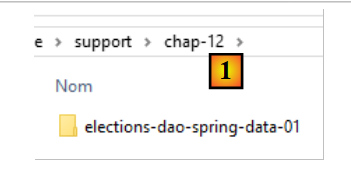 |
- In [1], the [support / chap-12] folder contains the Eclipse project for this chapter;
12.2. The Eclipse project
The Eclipse project will be as follows:
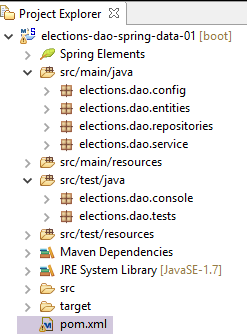 |
- [elections.dao.config]: contains the Spring project configuration class;
- [elections.dao.entities]: contains the JPA entities as well as the project’s exception class;
- [elections.dao.repositories]: contains the [CrudRepository] interfaces for the [CONF] and [LISTES] tables;
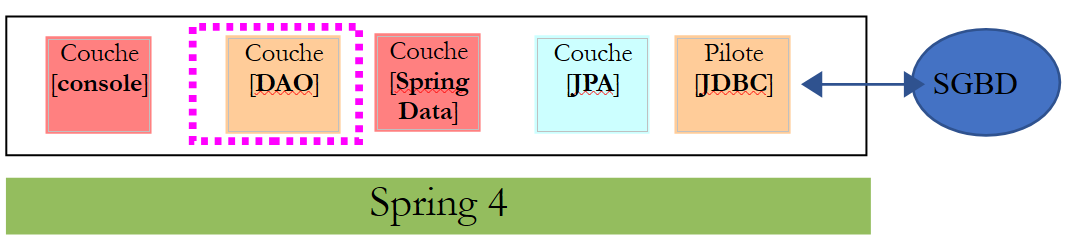
- [elections.dao.service]: contains the implementation of the [DAO] layer. This is what we need to write;
- [elections.dao.console]: contains a [console] test class;
- [pom.xml]: the Maven project configuration file;
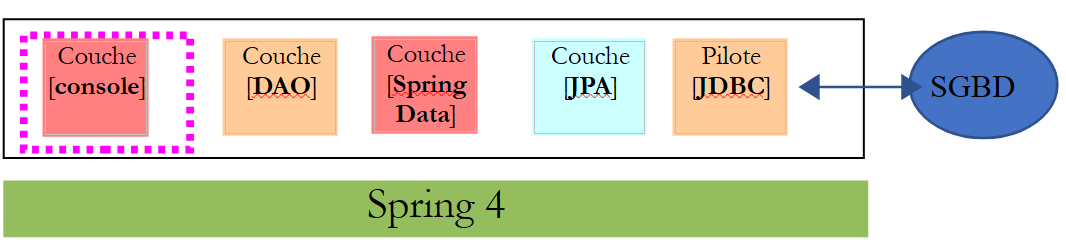
This project implements the following architecture:
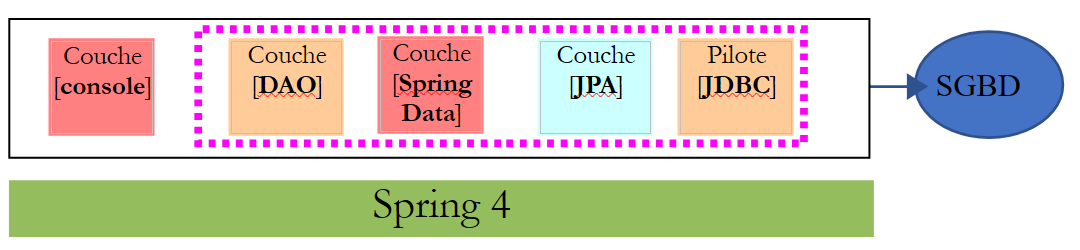 |
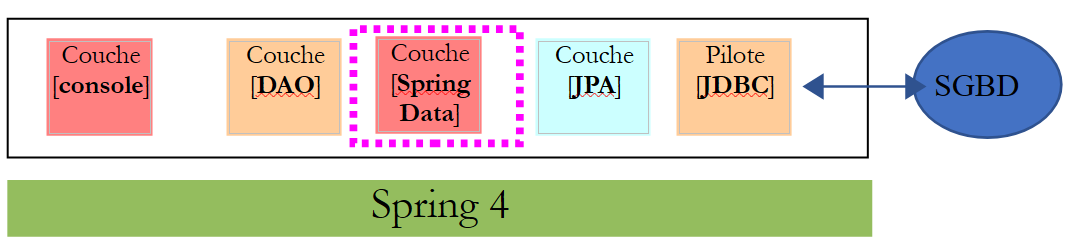
The [DAO] layer only sees the layer implemented by [Spring Data].
12.3. Maven Configuration
Task: Build the project's [pom.xml] file.
12.4. The entities of the [JPA] layer
 |
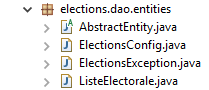 |
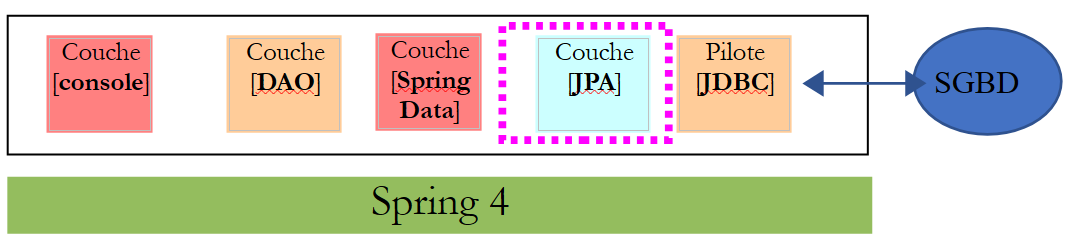
- [ElectionsConfig] is the object model associated with a row in the [CONF] table;
- [VoterList] is the object model associated with a row in the [LISTS] table;
- [AbstractEntity] is the parent class of the two preceding classes. It factors out the [id, version] fields common to both classes;
- [ElectionsException] is the project’s exception class;
12.4.1. The [ElectionsException] class
 |
The [ElectionsException] class is the unhandled exception described in section 4.3.
12.4.2. The [AbstractEntity] class
 |
The [AbstractEntity] class is as follows:
package elections.dao.entities;

import java.io.Serializable;

import javax.persistence.Column;
import javax.persistence.GeneratedValue;
import javax.persistence.GenerationType;
import javax.persistence.Id;
import javax.persistence.MappedSuperclass;
import javax.persistence.Version;

import com.fasterxml.jackson.core.JsonProcessingException;
import com.fasterxml.jackson.databind.ObjectMapper;

@MappedSuperclass
public abstract class AbstractEntity implements Serializable{
    private static final long serialVersionUID = 1L;

    // properties
    @Id
    @GeneratedValue(strategy = GenerationType.IDENTITY)
    @Column(name = "ID")
    protected Long id;
    @Version
    @Column(name = "VERSION")
    protected Long version;

    // manufacturers
    public AbstractEntity() {

    }

    public AbstractEntity(Long id, Long version) {
        this.id = id;
        this.version = version;
    }

    // redefine [equals] and [hashcode]
    @Override
    public int hashCode() {
        return (id != null ? id.hashCode() : 0);
    }

    @Override
    public boolean equals(Object entity) {
        if (!(entity instanceof AbstractEntity)) {
            return false;
        }
        String class1 = this.getClass().getName();
        String class2 = entity.getClass().getName();
        if (!class2.equals(class1)) {
            return false;
        }
        AbstractEntity other = (AbstractEntity) entity;
        return id != null && this.id == other.id;
    }

    // signature jSON
    public String toString() {
        ObjectMapper mapper = new ObjectMapper();
        try {
            return mapper.writeValueAsString(this);
        } catch (JsonProcessingException e) {
            e.printStackTrace();
            return null;
        }
    }

    // getters and setters
...
}
This is the class described in section 11.3.5.2, without the JSON filters. Here, the [CONF] and [LISTES] tables are not linked by a foreign key relationship. However, it is the existence of such a relationship with the [lazy loading] mode that necessitates JSON filters.
12.4.3. The [ElectionsConfig] class
 |
The [ElectionsConfig] class is the JPA entity associated with the [CONF] table;
Task: Implement the [ElectionsConfig] class.
12.4.4. The [VoterList] class
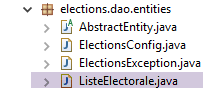 |
The [VoterList] class is the JPA entity associated with the [LISTS] table;
Task: Implement the [VoterList] class.
12.5. The [Spring Data] layer
 |
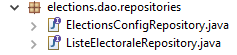 |
Task: Write the two [Spring Data] interfaces to manage the two tables [CONF] and [LISTES];
12.6. The [DAO] layer
 |
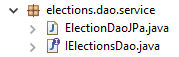 |
The [IElectionsDao] interface of the [DAO] layer is as follows:
package dao.service;

import dao.entities.ElectionsConfig;
import dao.entities.ListeElectorale;

public interface IElectionsDao {

    // election configuration
    public ElectionsConfig getElectionsConfig();

    // candidate lists
    public ListeElectorale[] getListesElectorales();

    // updating candidate lists
    public void setListesElectorales(ListeElectorale[] listesElectorales);
}
Task: Write the [ElectionsDaoJpa] implementation of the [IElectionsDao] interface.
12.7. Spring Project Configuration
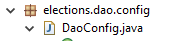 |
The [DaoConfig] class configures the Spring project.
Task: Write the [DaoConfig] class
12.8. The [console] layer
 |
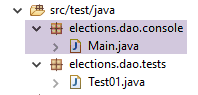 |
The [Main] class is the following executable class:
package dao.console;

import org.springframework.context.annotation.AnnotationConfigApplicationContext;

import dao.config.AppConfig;
import dao.entities.ElectionsConfig;
import dao.entities.ListeElectorale;
import dao.service.IElectionsDao;

public class Main {

    // data source
    private static IElectionsDao dao;

    public static void main(String[] args) {
        // spring context retrieval
        AnnotationConfigApplicationContext ctx = new AnnotationConfigApplicationContext(AppConfig.class);
        // data source recovery
        dao = ctx.getBean(IElectionsDao.class);
        // contents of both tables
        ElectionsConfig electionsConfig = dao.getElectionsConfig();
        ListeElectorale[] listes = dao.getListesElectorales();
        // display
        System.out.println(String.format("Nombre de sièges à pourvoir : %d", electionsConfig.getNbSiegesAPourvoir()));
        System.out.println(String.format("Seuil électoral : %5.2f", electionsConfig.getSeuilElectoral()));
        System.out.println("Listes candidates----------------");
        for (ListeElectorale liste : listes) {
            System.out.println(liste);
        }
        // closing Spring context
        ctx.close();
    }

}
The [Test01] class is a JUnit test:
package dao.tests;

import org.junit.Assert;
import org.junit.Before;
import org.junit.Test;
import org.junit.runner.RunWith;
import org.springframework.beans.factory.annotation.Autowired;
import org.springframework.boot.test.SpringApplicationConfiguration;
import org.springframework.test.context.junit4.SpringJUnit4ClassRunner;

import dao.config.AppConfig;
import dao.entities.ElectionsConfig;
import dao.entities.ListeElectorale;
import dao.service.IElectionsDao;

@SpringApplicationConfiguration(classes = AppConfig.class)
@RunWith(SpringJUnit4ClassRunner.class)
public class Test01 {

    // layer [DAO]
    @Autowired
    private IElectionsDao electionsDao;

    @Before
    public void init() {
        // the table is cleaned [LISTES]
        // competing lists
        ListeElectorale[] listes = electionsDao.getListesElectorales();
        // set votes and seats to 0 and eliminate false
        int voix = 0;
        int sièges = 0;
        boolean elimine = false;
        for (ListeElectorale liste : listes) {
            liste.setVoix(voix);
            liste.setSieges(sièges);
            liste.setElimine(elimine);
        }
        // we make this data persistent using the [dao] layer
        electionsDao.setListesElectorales(listes);
    }

    @Test
    public void testElections01() {
        System.out.println("testElections01-------------------------------------");
        // election configuration recovery
        ElectionsConfig electionsConfig = electionsDao.getElectionsConfig();
        int nbSiegesAPourvoir = electionsConfig.getNbSiegesAPourvoir();
        double seuilElectoral = electionsConfig.getSeuilElectoral();
        Assert.assertEquals(6, nbSiegesAPourvoir);
        Assert.assertEquals(0.05, seuilElectoral, 1E-6);

        // competing lists
        ListeElectorale[] listes = electionsDao.getListesElectorales();
        // display read values
        System.out.println("Nombre de sièges à pourvoir : " + nbSiegesAPourvoir);
        System.out.println("Seuil électoral : " + seuilElectoral);
        System.out.println("Listes en compétition ---------------------");
        for (int i = 0; i < listes.length; i++) {
            System.out.println(listes[i]);
        }

        // votes and seats are allocated to lists
        int voix = 0;
        int sièges = 0;
        boolean elimine = false;
        for (ListeElectorale liste : listes) {
            liste.setVoix(voix);
            liste.setSieges(sièges);
            liste.setElimine(elimine);
            voix += 10;
            sièges += 1;
            elimine = !elimine;
        }

        // we make this data persistent using the [dao] layer
        electionsDao.setListesElectorales(listes);

        // data re-reading
        ListeElectorale[] listesElectorales2 = electionsDao.getListesElectorales();
        // check data read
        Assert.assertEquals(7, listesElectorales2.length);
        voix = 0;
        sièges = 0;
        elimine = false;
        for (ListeElectorale liste : listes) {
            Assert.assertEquals(voix, liste.getVoix());
            Assert.assertEquals(sièges, liste.getSieges());
            Assert.assertEquals(elimine, liste.isElimine());
            voix += 10;
            sièges += 1;
            elimine = !elimine;
        }
        System.out.println("Listes en compétition ---------------------");
        for (int i = 0; i < listes.length; i++) {
            System.out.println(listes[i]);
        }
    }
}
Task: Run the [console] and [JUnit] tests on your [DAO] layer.
12.9. Generating the project's Maven archive
Following the example in Section 11.3.12, generate the project's Maven archive.