2. [Assignment]: The Problem
Keywords: algorithms, Java basics: arrays, I/O, loops, testing, exception handling
Recommended reading: Chapter 1 of [ref1]: The Basics of the Java Language
2.1. Support
The folder [support / chap-02] contains the algorithm to be implemented in C# and Java.
2.2. The problem to be solved
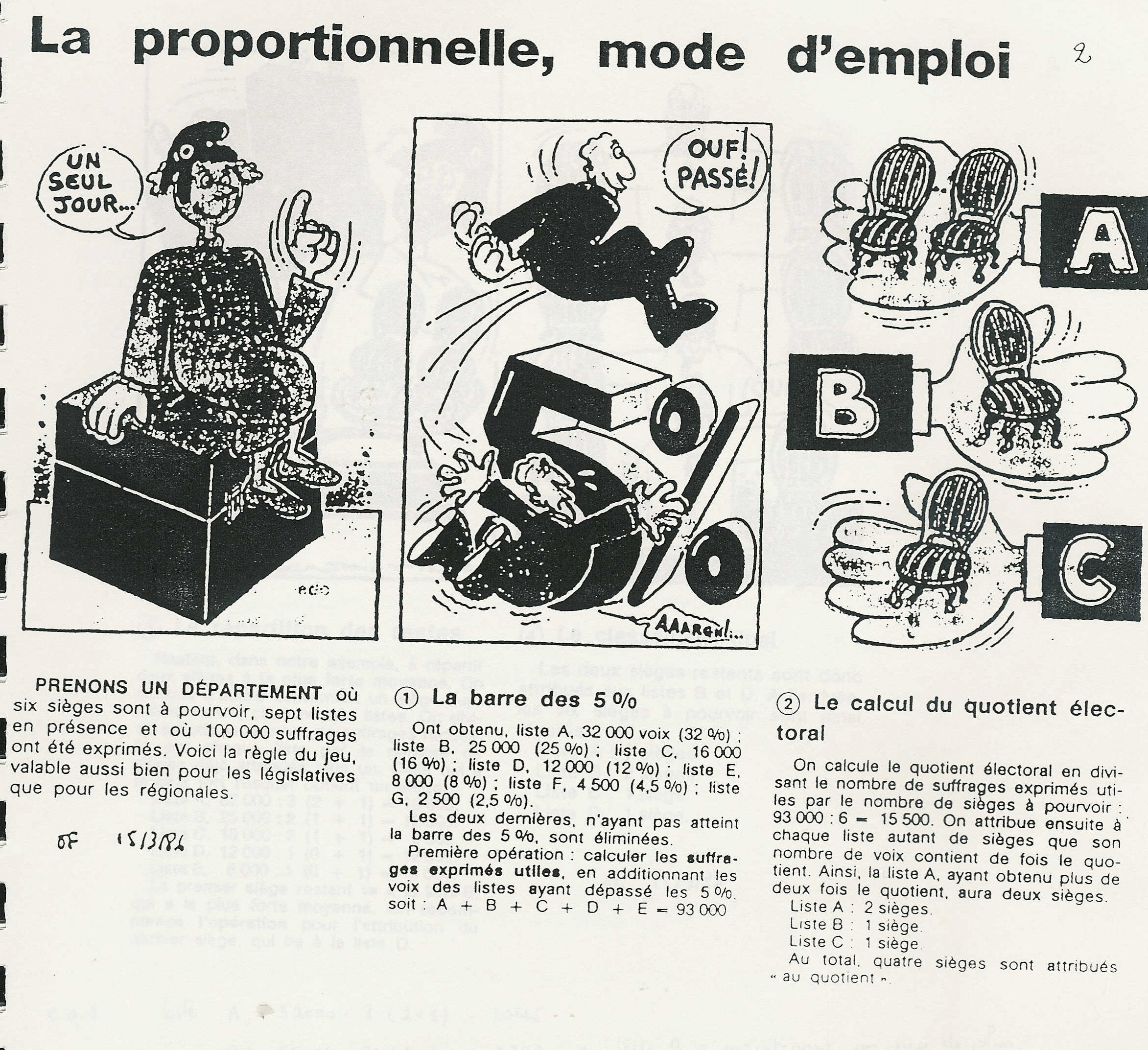
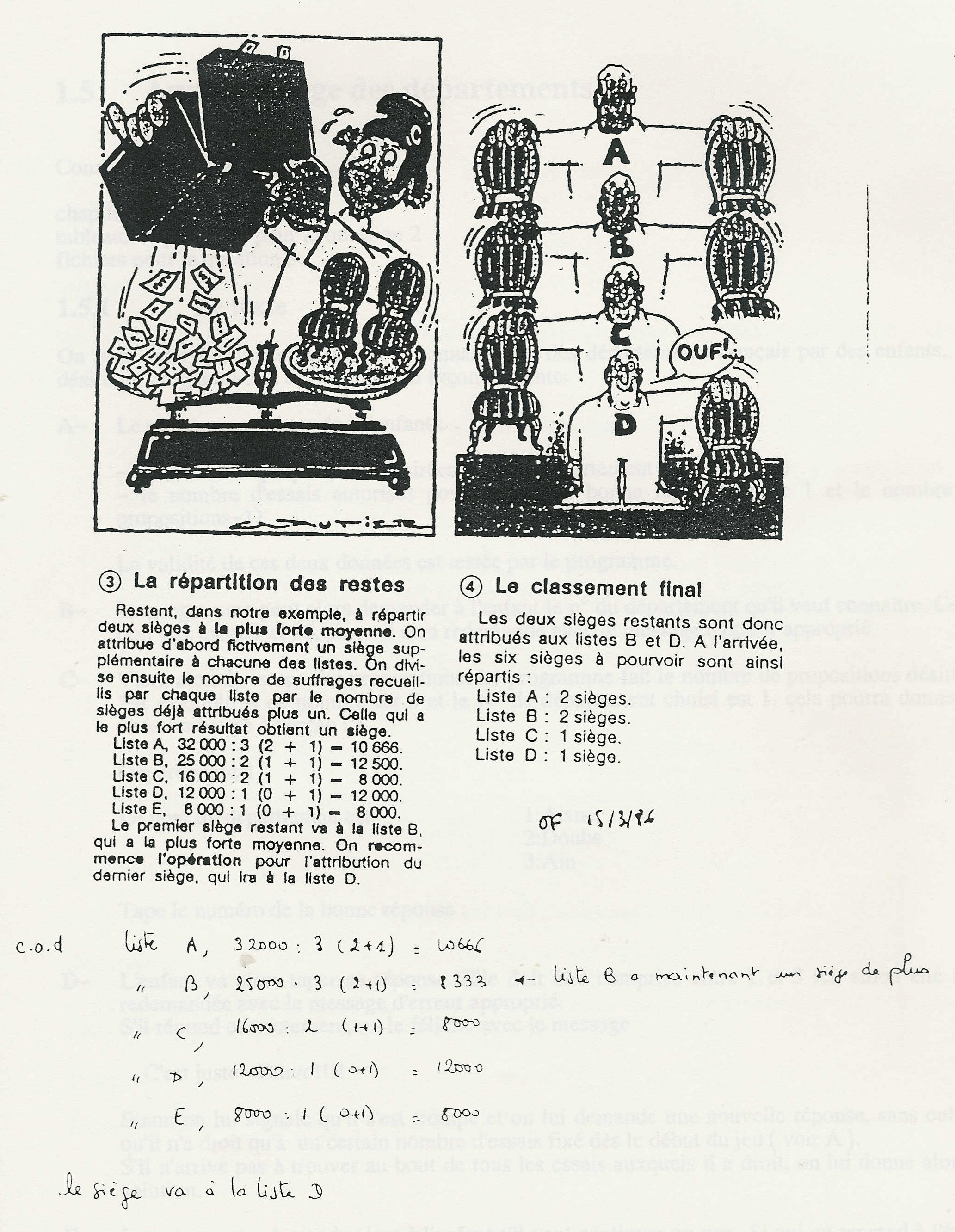
We want to write a program that, on election night, can calculate the number of seats won by the various candidate lists. Further on, we will find the method for calculating seats for a proportional representation election using the highest average, as explained in an article in the Ouest-France newspaper on March 15, 1986.
We will write a Java "console" application, i.e., an application that uses the keyboard and screen to interact with the user. It will ask the user for the following information (entered via the keyboard):
- number of seats to be filled
- number of competing lists
- for each list: its name and number of votes
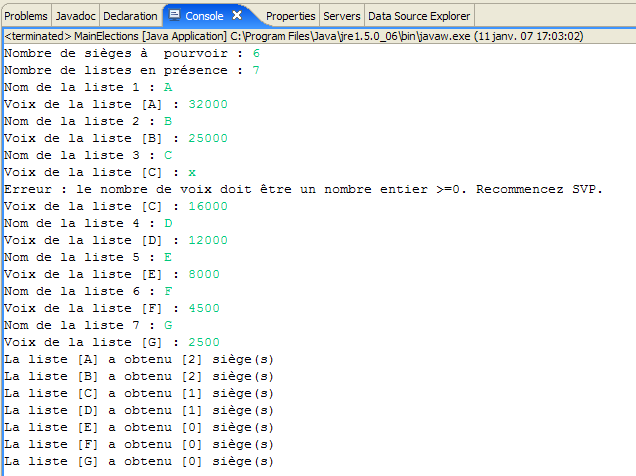
Using this information, the application calculates the number of seats won by each list and displays them on the screen in the following format:
where [Xi] is the name of list No. i and [Ni] is the number of seats it won.
The Ouest-France article of March 15, 1986:
2.3. The algorithmic solution
An algorithmic solution could be as follows:
| début-programme
// données
saisieOK : booléen
nbSiègesAPourvoir : entier
nbListes : entier
nomListe[] : chaînes de caractères
voixListe[] : entier
elimineListe[] : booléen
siegesListe[] : entier
moyenneListe[] : réel
i : entier
nbVoixUtiles : entier
quotientElectoral : réel
nbSiègesPourvus : entier
moyenneMax : réel
Max : entier iSiège : entier
// code
// nbre de sièges à pourvoir
saisieOK<-faux
tant que non saisieOK
écrire "Nombre de sièges à pourvoir : "
lire nbSiègesAPourvoir
si nbSiègesAPourvoir n'is not an integer >0 then
écrire "Erreur : tapez un nombre entier >0"
sinon
saisieOK<-vrai
finsi
fintantque
// nbre de listes en compétition
saisieOK<-faux
tant que non saisieOK
écrire "Nombre de listes en compétition : "
lire nbListes
si nbListes n'is not an integer >0 then
écrire "Erreur : tapez un nombre entier >0"
sinon
saisieOK<-vrai
finsi
fintantque
// dimensionnement des tableaux
dimensionner les tableau nomListe, voixListe, elimineListe, siegesListe, moyenneListe à nbListes éléments
// saisie des noms et voix des listes
totalVoix<-0
pour i variant de 0 à nbListes-1
// saisie du nom de la liste i
saisieOK<-faux
tantque non saisieOK
écrire "Nom de la liste n° ", i, " : "
lire nomListe[i]
si nomListe[i] est vide alors
écrire "Erreur : Tapez un nom non vide"
sinon
saisieOK<-vrai
finsi
fintantque
// saisie du nombre de voix de la liste i
saisieOK<-faux
tantque non saisieOK
écrire "Nombre de voix de la liste ", nomListe[i] , " : "
lire voixListe[i]
si voixListe[i] n'is not an integer >=0 then
écrire "Erreur : tapez un nombre entier >=0"
sinon
saisieOK<-vrai
finsi
fintantque
// on incrémente le total des voix
totalVoix<- totalVoix+voixListe[i]79.finpour 80.
// calcul des voix utiles
nbVoixUtiles<-0
pour i variant de 0 à nbListes-1
si (voixListe[i]/totalVoix)<0.05 alors
elimineListe[i]<-vrai
sinon
elimineListe[i]<-faux
nbVoixUtiles<-nbVoixUtiles+voixListe[i]
finsi
finpour
// y-a-t-il des listes non éliminées ?
si nbVoixUtiles=0 alors
écrire "Erreur : toutes les listes ont été éliminées"
arrêt du programme
finsi
// répartition des sièges au quotient
quotientElectoral <- nbVoixUtiles / nbSiègesAPourvoir
nbSiègesPourvus<- 0
pour i variant de 0 à nbListes-1
si non elimineListe[i] alors
siegesListe[i]<- partie entière de (voixListe[i]/quotientElectoral)
moyenneListe[i] <- voixListe[i] / (siegesListe[i]+1)
nbSiègesPourvus<-nbSiègesPourvus+siegesListe[i]
sinon
siegesListe[i]<-0
finsi
finpour
// répartition des sièges restants à la plus forte moyenne
// 1 siège est attribué à chaque tour de boucle
pour iSiège variant de 0 à nbSiègesAPourvoir - nbSiègesPourvus - 1
// recherche de la liste ayant la + forte moyenne
moyenneMax<- (-1)
pour i variant de 0 à nbListes-1
si non elimineListe[i] alors
si moyenneListe[i] > moyenneMax alors
moyenneMax <- moyenneListe[i]
iMax <- i
finsi
finsi
finpour
// on attribue 1 siège à la liste de + forte moyenne
siegeListe[iMax] <- siegeListe[iMax]+1
// et on change sa moyenne
moyenneListe[iMax] <- voixListe[iMax]/(siegeListe[iMax]+1)
finpour
// affichage résultats sans tri
pour i variant de 0 à nbListes-1
si elimineListe[i] alors
écrire "La liste ", nomListe[i], " a été éliminée"
sinon
écrire "La liste ", nomListe[i], " a obtenu ",
siegesListe[i], " siège(s)"
finsi
finpour
fin-programme
|
2.4. Work to be done
Q1: Translate the algorithm into C#. Implement it using Visual Studio.
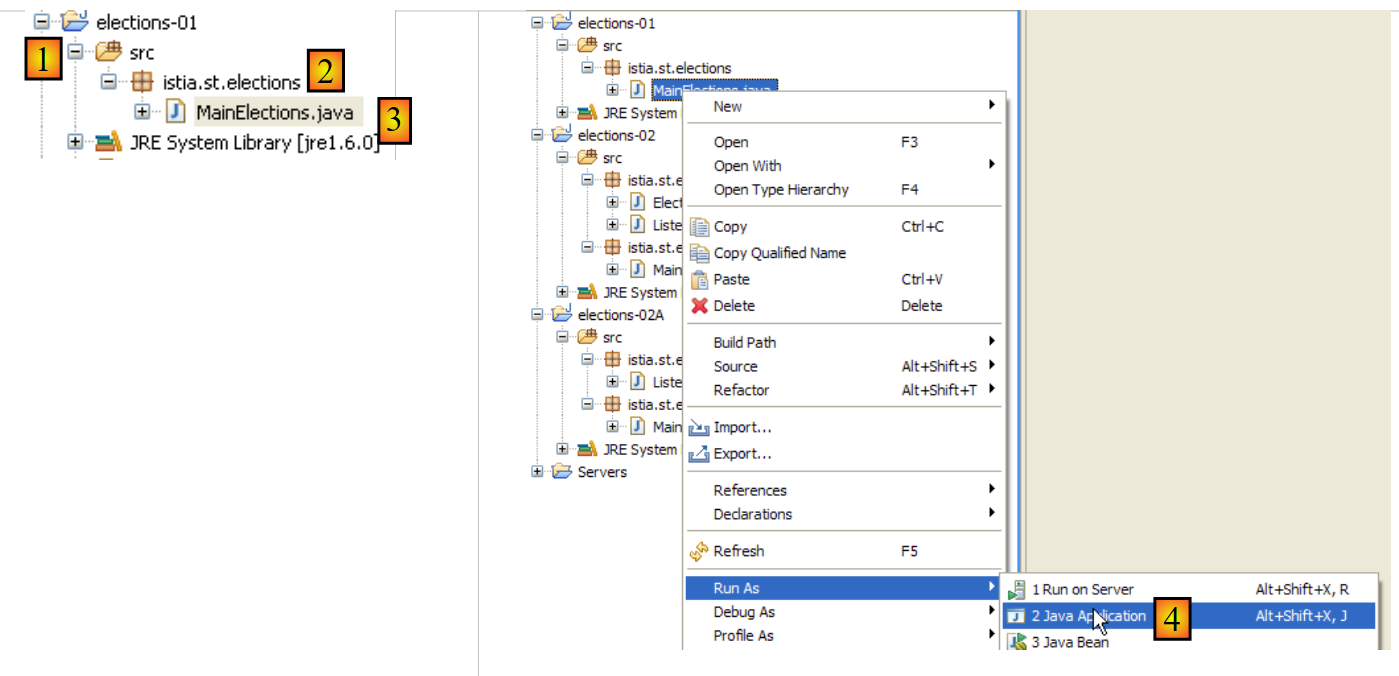
Q2: Translate the algorithm into Java, drawing inspiration from the C# code. Implement the Java program in an Eclipse environment similar to the following:
- [1]: The project is named [elections-01]
- [2]: The application will be placed in a package, here [istia.st.elections]
- [3]: [MainElections.java] is the source code for the application written in the previous section
- [4]: the [MainElections] class is executed
An example of execution could be as follows: