9. Traits
Traits are structures analogous to classes. However, they cannot be instantiated. They are intended to be included in classes. Including a Trait in a class has the same effect as if the Trait’s code had been copied into the class. We put code in a Trait that is likely to be reused in multiple classes.
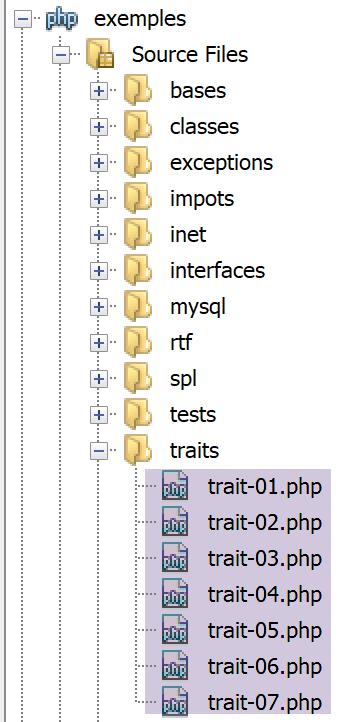
9.1. The script tree
9.2. Including a feature in a class
The script [traits-01.php] demonstrates a basic use of a trait in a class:
<?php

class Class04 {
  // attribute
  private $name;

  // manufacturer
  public function __construct(string $name) {
    $this->name = $name;
  }

  // getters and setters
  public function getName(): string {
    return $this->name;
  }

  public function setName(string $name): void {
    $this->name = $name;
  }

}

trait Trait04 {
  // attribute
  private $name;

  // getters and setters
  public function getName(): string {
    return $this->name;
  }

  public function setName(string $name): void {
    $this->name = $name;
  }

}

class Class05 {
  // trait inclusion
  use Trait04;

  // manufacturer
  public function __construct(string $name) {
    $this->name = $name;
  }

}

// test --------------
$class04 = new Class04("Tim");
$class05 = new Class05("Burton");
print $class04->getName() . "\n";
print $class05->getName() . "\n";
// display of both classes
print_r($class04);
print_r($class05);
Code comments
- lines 3-21: definition of the [Class04] class with an attribute, its get / set, and a constructor;
- lines 23-36: we take the code from [Class04] without its constructor and transfer it to the trait [Trait04] as-is. We do not include the constructor since a trait is not instantiable;
- line 23: the keyword [trait] is what makes [Trait04] a trait rather than a class;
- lines 38–45: we define a class [Class05] that takes the code from the trait [Trait04] (line 40) and adds a constructor (lines 43–45), identical to that of the class [Class04], to make the class instantiable;
- line 40: the keyword [use] allows a trait to be included in a class;
- lines 50–56: Tests show that the classes [Class04] and [Class05] behave identically;
Results
The results in lines 3–10 show that the classes [Class04] and [Class05] have the same content;
Conclusion
Using the [use Trait] statement in a class is equivalent to including the code from [Trait] in the class.
9.3. Using the Same Trait in Different Classes
One of the primary benefits of a trait appears to be the reuse of the same code (attributes + methods) across different classes. We will see, however, that the same goal can be achieved using simple classes.
Sharing a trait between classes is illustrated by the following [trait-02.php] script:
<?php

trait Trait01 {
  // attribute
  private $id = 0;

  // method
  public function doSomething() {
    print "Trait01::doSomething… ($this->id)\n";
  }

}

class Class02 {
  // inclusion Trait01
  use Trait01 {
    // method [Trait01::doSomething] is accessible
    // in the class under the name [doSomethingInTrait]
    Trait01::doSomething as doSomethingInTrait;
  }

  // class-specific method
  public function doSomething(): void {
    // attribute id
    $this->id += 10;
    // using the Trait01 method
    $this->doSomethingInTrait();
    // local display
    print "Class02->doSomething\n";
  }

}

class Class03 {
  // inclusion Trait01
  use Trait01;

  // method local to the class
  public function doSomethingElse(): void {
    // attribute id
    $this->id += 10;
    // using the Trait01 method
    $this->doSomething();
    // local display
    print "Class03->doSomethingElse\n";
  }

}

// test01 ----------------
function test01(): void {
  $class02 = new Class02();
  $class03 = new Class03();
  $class02->doSomething();
  $class03->doSomethingElse();
}

// test01
print "test01-----------------\n";
test01();
Comments
- lines 3-10: a class defining an attribute (line 5) and a method (lines 8-10).
- The trait [Trait01] is injected into two classes: [Class02] (lines 14-32) and [Class03] (lines 34-46).
- Lines 16–20: Injection of [Trait01] into [Class02];
- Line 19 aims to resolve a conflict: [Trait01] and [Class02] both have a method named [doSomething]. There are two cases to consider:
- The [Class02::doSomething] method is called from outside the class. In this case, the [Class02::doSomething] method takes precedence over the [Trait01::doSomething] method, and it is the one that is called;
- The method [Class02::doSomething] is called from within the class. In this case, there is a conflict: the PHP interpreter does not know which method to call;
Line 19 renames the method [Trait01::doSomething] to [doSomethingInTrait]. Thus, within [Class02], the following notations will be used:
- [doSomethingInTrait] to call the method [Trait01::doSomething];
- [doSomething] to call the method [Class02::doSomething];
- Lines 25, 27: The class [Class02] uses the attribute and method of [Trait01] as if they were its own;
- lines 34–48: the class [Class03] is identical to the class [Class02]. The inclusion of [Trait01] is simpler here because there is no conflict between the methods of [Trait01] and [Class03];
Results
Note that the trait [Trait01] is not shared between the classes [Class02] and [Class03]. Thus, theattribute [Trait01::i] becomes, through the inclusion of [Trait01] in the classes [Class02] and [Class03], two different attributes: [Class02::i] and [Class03::i]. This is shown in lines 2 and 4 of the results. If the attribute [Trait01::i] had been shared between the classes [Class02] and [Class03], we would have had 20 in line 4 instead of 10.
The script [trait-03.php] shows that we can achieve the same result by using a class instead of the trait:
<?php

// class that replaces the
class Class01 {
  // attribute
  private $id = 0;

  // setter
  public function setId(int $id) {
    $this->id = $id;
  }

  // getter
  public function getId(): int {
    return $this->id;
  }

  // method
  public function doSomething(): void {
    print "Class01::doSomething… ($this->id)\n";
  }

}

class Class02 {
  // class01 inclusion
  private $class01;

  // setter
  public function setClass01(Class01 $class01) {
    $this->class01 = $class01;
  }

  // class-specific method
  public function doSomething(): void {
    // chgt Class01 attribute
    $id = $this->class01->getId();
    $id += 10;
    $this->class01->setId($id);
    // using the Class01 method
    $this->class01->doSomething();
    // local display
    print "Class02->doSomething\n";
  }

}

class Class03 {
  // class01 inclusion
  private $class01;

  // setter
  public function setClass01(Class01 $class01) {
    $this->class01 = $class01;
  }

  // method local to the class
  public function doSomethingElse(): void {
    // chgt Class01 attribute
    $id = $this->class01->getId();
    $id += 10;
    $this->class01->setId($id);
    // using the Class01 method
    $this->class01->doSomething();
    // local display
    print "Class03->doSomethingElse\n";
  }

}

// test01 ----------------
function test01(): void {
  // two objects
  $class02 = new Class02();
  $class03 = new Class03();
  // will access two different instances of [Class01]
  $class02->setClass01(new Class01());
  $class03->setClass01(new Class01());
  // check
  $class02->doSomething();
  $class03->doSomethingElse();
}

// test02 ----------------
function test02(): void {
  // shared instance of [Class01]
  $class01 = new Class01();
  // two objects
  $class02 = new Class02();
  $class03 = new Class03();
  // will access the same instance of [Class01]
  $class02->setClass01($class01);
  $class03->setClass01($class01);
  // check
  $class02->doSomething();
  $class03->doSomethingElse();
}

// test01
print "test01-----------------\n";
test01();
// test02
print "test02-----------------\n";
test02();
Comments
- lines 4-23: the class [Class01] replaces the feature [Trait01]. The code for [Trait01] was incorporated into the code for classes [Class02] and [Class03]. Here, that will not be the case. Instead, a reference to the code of class [Class01] will be injected into classes [Class02] and [Class03]. This means that the attributes of the [Class01] class will be external to the code of [Class02] and [Class03]. Since the [id] attribute is private (line 6), a getter (lines 14–16) and a setter (lines 9–11) must be provided. This is the first difference from the trait: code must be created to access the class’s private attributes. We could have changed the visibility of the attribute [id] to [public], but it is never advisable to do so. Using a setter to set an attribute’s value allows us to verify its validity;
- line 27: inclusion in the code for [Class02] of a reference to the class [Class01]. Because this attribute is private, we need to create a setter (lines 30–32) to initialize it;
- lines 37–41: for any use of the code in [Class01], we must go through the [$this→class01] attribute;
- lines 48–69: the [Class03] class is a clone of the [Classe02] class, except that its method has a different name;
- lines 72–82: the first test. This involves injecting two different instances of the [Class01] class into the [Class02] and [Class03] classes (lines 77 and 78);
- lines 85–97: the second test injects the same instance of the [Class01] class into the [Class02] and [Class03] classes (lines 97, 92, 93);
- lines 100–101: execution of test [test01];
- lines 103-104: execution of test [test02];
Results
Comments on the results
- Lines 2–5: We get the same results as with the trait [Trait01]. We can conclude that using the trait is not essential here, but it does reduce the amount of code because there is no need for methods to access the trait’s attributes: these are an integral part of the code into which the trait has been incorporated;
- Lines 7–10: Since the same reference to [Class01] was injected into the classes [Class02] and [Class03], the [Class01::id] attribute has been shared between the two classes. This is why line 9 of the results displays 20 instead of 10 with the trait. We can conclude that if a trait’s attributes must be shared between classes, then the trait is not usable and a class must be used instead;
9.4. Grouping methods into a trait
In the previous example, the trait contained both attributes and methods. Here, we consider the case where it contains only methods. In this case, the trait resembles a factorization of methods that can then be used in different classes. Since the trait has no attributes here, we will consider the case where the methods it groups work solely on the parameters passed to them. In fact, this is not mandatory: a trait can operate on an attribute [$this→attribut1] without having that attribute itself. It is then up to the classes that use this trait to provide the attribute [$this→attribut1].
In the case where the trait has only methods that operate solely on parameters passed to them, we will show that the trait can then be replaced by a class having the same methods as the trait and declared static.
The use of the trait is illustrated by the script [trait-04.php], which reuses the trait from the previous example while removing all attributes:
<?php

trait Trait01 {

  // method to share
  public function doSomething() {
    print "Trait01::doSomething ….\n";
  }

}

class Class02 {
  // inclusion Trait01
  use Trait01 {
    // method [Trait01::doSomething] is accessible
    // in the class under the name [doSomethingInTrait]
    Trait01::doSomething as doSomethingInTrait;
  }

  public function doSomething(): void {
    // trait01 method call
    $this->doSomethingInTrait();
    // local display
    print "Class02->doSomething\n";
  }

}

class Class03 {
  // inclusion Trait01
  use Trait01;

  // method local to the class
  public function doSomethingElse(): void {
    // trait01 method call
    $this->doSomething();
    // local display
    print "Class03->doSomethingElse\n";
  }

}

// test ----------------
(new Class02())->doSomething();
(new Class03())->doSomethingElse();
Comments
- lines 3-10: the [Trait01] feature no longer has any attributes;
- lines 14-18: inclusion of [Trait01] in [Class02]. The method of [Trait01] is used on line 22;
- line 31: inclusion of [Trait01] in [Class03]. The method of [Trait01] is used on line 36;
Results
In this use case, the trait [Trait01] can easily be replaced by a class. This is demonstrated by the following script [trait-05.php]:
<?php

abstract class Class01 {

  // static method to share
  public static function doSomething() {
    print "Class01::doSomething ….\n";
  }

}

class Class02 {

  public function doSomething(): void {
    // calling the Class01 method
    Class01::doSomething();
    // local display
    print "Class02->doSomething\n";
  }

}

class Class03 {

  // method local to the class
  public function doSomethingElse(): void {
    // calling the Class01 method
    Class01::doSomething();
    // local display
    print "Class03->doSomethingElse\n";
  }

}

// test ----------------
(new Class02())->doSomething();
(new Class03())->doSomethingElse();
Comments
- lines 3-10: the trait [Trait01] is replaced by an abstract class [Class01] in which all methods are declared static. The class is declared abstract solely to prevent its instantiation. We would have also liked to write [final] to prevent its derivation, but PHP does not accept the prefix [final abstract] for a class. It is one or the other, but not both;
- line 16: instead of writing [$this→doSomethingInTrait], we now write [Class01::doSomething], i.e., we call the static method [doSomething] of the class [Class01];
- line 28: repeat the same process in [Class03];
Results
We get the same result as with the trait [Trait01], which shows that using it can be avoided. We noted that a trait’s methods can operate on an attribute [$this→attribut1] without the trait having that attribute. It is then up to the classes that use this trait to provide the [$this→attribut1] attribute. This is an exotic case: it is just as well to “pass up” the [$this→attribut1] attribute—which the classes using the trait must have—into the trait itself. That way, it will necessarily be part of the attributes of the class using the trait.
9.5. Multiple inheritance with a trait
It is common to read in the PHP literature that traits enable multiple inheritance: the ability for a class to inherit from multiple classes. The C++ language supports this feature, but Java and C# do not, as they only support single inheritance. We will show that while using a trait in a derived class does allow for the implementation of something resembling multiple inheritance, this use case can also be implemented using simple classes.
The [trait-06.php] script implements a derived class and a trait:
<?php

trait Trait01 {
  // attribute
  private $i;

  // method to share
  public function doSomethingInTrait01() {
    // modification Trait01::$i
    $this->i++;
    // display
    print "Trait01::doSomethingInTrait01… i=$this->i\n";
  }

}

class Class02 {
  // attribute
  protected $j = 0;

  // method
  public function doSomethingInClass02(): void {
    // modification Class02::j
    $this->j += 10;
    // display
    print "Class02->doSomethingInClass02… j=$this->j\n";
  }

}

// derived class
class Class03 extends Class02 {
  // inherits Class02:j and Trait01::i
  // inclusion Trait01
  use Trait01;

  // method
  public function doSomethingInClass03(): void {
    // using the Trait01 method
    $this->doSomethingInTrait01();
    // modification Trait01::i
    $this->i += 100;
    // modification Class03::j (==Class02::j)
    $this->j += 1000;
    // display
    print "Class03->doSomethingInClass03… i=$this->i, j=$this->j\n";
  }

}

// test ----------------
(new Class02())->doSomethingInClass02();
(new Class03())->doSomethingInClass03();
Comments
- lines 3-15: we return to a trait [Trait01] with an attribute and a method that manipulates it;
- lines 17-29: a class [Class02] that has nothing to do with the trait [Trait01]. It does not use it;
- line 19: we have declared the single attribute of [Class02] with visibility [protected] so that it is accessible in derived classes;
- line 32: the class [Class03] extends the class [Class02]. Additionally, it incorporates the trait [Trait01] (line 35). Finally, it inherits the attributes and methods of [Class02] and incorporates the attributes and methods of [Trait01]. We therefore have something analogous to multiple inheritance;
Results
Just as we did in a previous example, we will show that:
- the trait can be replaced by a class;
- instead of incorporating the trait into the derived class, we incorporate a reference to an instance of the class;
The script [trait-07.php] is as follows:
<?php

class Class01 {
  // attribute
  protected $i;

  // getter and setter
  public function getI(): int {
    return $this->i;
  }

  public function setI(int $i): void {
    $this->i = $i;
  }

  // method
  public function doSomethingInClass01(): void {
    // modification Class01::$i
    $this->i++;
    // display
    print "Class01::doSomething in Class01… i=$this->i\n";
  }

}

class Class02 {
  // attribute
  protected $j = 0;

  // class-specific method
  public function doSomethingInClass02(): void {
    // modification Class02::j
    $this->j += 10;
    // display
    print "Class02->doSomethingInClass02… j=$this->j\n";
  }

}

class Class03 extends Class02 {
  // class01 inclusion
  private $class01;

  // setter
  public function setClass01(Class01 $class01) {
    $this->class01 = $class01;
  }

  // method local to the class
  public function doSomethingInClass03(): void {
    // using the Class01 method
    $this->class01->doSomethingInClass01();
    // modification Class01::i
    $i = $this->class01->getI();
    $i += 100;
    $this->class01->setI($i);
    // modification Class03::j
    $this->j += 1000;
    // display
    print "Class03->doSomethingInClass03… i=$i, j=$this->j\n";
  }

}

// test ----------------
$class01 = new Class01();
$class02 = new Class02();
$class03 = new Class03();
$class03->setClass01($class01);
$class02->doSomethingInClass02();
$class03->doSomethingInClass03();
Comments
- Lines 3–24: The class [Class01] replaces the trait [Trait01]. Since the [Class01] class will be incorporated into the classes via a reference, we have provided get / set for the [$i] attribute;
- lines 26–38: the [Classe02] class remains unchanged;
- line 40: the class [Class03] extends the class [Classe02];
- line 42: the class [Classe01] is incorporated into [Classe03] via a reference;
- lines 45–47: a setter is provided to initialize the reference to the class [Classe01];
- lines 50–61: the method [doSomethingInClass03] does the same thing as before, but with more complex code;
Results
From this example, we can conclude that once again the trait is not essential, but we must acknowledge that it allows for writing shorter code in the derived class.
9.6. Using a trait instead of an abstract class
We often encounter the following use case: we create a fairly general interface I that can give rise to several implementations. These share common code but differ in other methods. We can implement this use case in two ways:
- We create an abstract class C that contains the code common to the derived classes. Class C implements interface I, but certain methods that must be declared in the derived classes are declared as abstract in class C; therefore, class C itself is abstract. We then create classes C1 and C2 derived from C, each of which implements the undefined (abstract) methods of their parent class C in their own way;
- we create a trait T that is nearly identical to the abstract class C from the previous solution. This trait does not implement the interface I because, syntactically, it cannot. We then create classes C1 and C2 that implement interface I and use trait T. All that remains for these classes is to implement the methods of interface I that are not implemented by the trait T they import;
Here is an example that illustrates how similar these two solutions are.
Application 1 implements solution 1 described previously [trait-08.php]:
<?php

interface Interface1 {

  public function doSomething(): void;

  public function doSomethingElse(): void;
}

abstract class AbstractClass implements Interface1 {
  // attributes
  protected $attr1 = 11;
  protected $attr2 = 12;

  // getters and setters
  public function getAttr1() {
    return $this->attr1;
  }

  public function getAttr2() {
    return $this->attr2;
  }

  public function setAttr1($attr1) {
    $this->attr1 = $attr1;
    return $this;
  }

  public function setAttr2($attr2) {
    $this->attr2 = $attr2;
    return $this;
  }

  // implemented method
  public function doSomething(): void {
    print "AbstractClass::doSomething [$this->attr1,$this->attr2]\n";
  }

  // method not implemented
  abstract public function doSomethingElse(): void;
}

// derived class 1
class Class1 extends AbstractClass {
  // attribute
  private $attr3 = 13;

  // getter and setter
  public function getAttr3() {
    return $this->attr3;
  }

  public function setAttr3($attr3) {
    $this->attr3 = $attr3;
    return $this;
  }

  // implementation doSomethingElse
  public function doSomethingElse(): void {
    print "Class1::doSomethingElse [$this->attr1,$this->attr2,$this->attr3]\n";
  }

}

// derived class 2
class Class2 extends AbstractClass {
  // attribute
  private $attr4 = 14;

  public function getAttr4() {
    return $this->attr4;
  }

  public function setAttr4($attr4) {
    $this->attr4 = $attr4;
    return $this;
  }

  // implementation doSomethingElse
  public function doSomethingElse(): void {
    print "Class2::doSomethingElse [$this->attr1,$this->attr2,$this->attr4]\n";
  }

}

// external function
function useInterfaceWith(Interface1 $interface):void{
  $interface->doSomething();
  $interface->doSomethingElse();
}

// tests
useInterfaceWith(new Class1());
useInterfaceWith(new Class2());
Comments
- lines 3-8: the interface [Interface1] has two methods;
- lines 10–41: The abstract class [AbstractClass] implements the interface [Interface1] (line 10). It has two attributes with their getters and setters (lines 12–32), implements the [doSomething] method of the [Interface1] interface (lines 35–37) but does not implement the [doSomethingElse] method. This method is therefore declared abstract (line 40). The abstract class [AbstractClass] cannot be instantiated and, to be useful, must be derived from;
- Lines 44–63: The Class1 class extends the abstract class [AbstractClass] and therefore implements the interface [Interface1] (line 14). It provides a body for the method [doSomethingElse], which its parent class had not defined (lines 59–61). It also adds an attribute to those of its parent class (lines 46–56);
- lines 66–82: The Class2 class extends the abstract class [AbstractClass] and therefore implements the interface [Interface1] (line 66). It provides a body for the [doSomethingElse] method that its parent class had not defined (lines 80–82). It also adds an attribute to those of its parent class (lines 68–77);
- lines 87–90: the function [useInterfaceWith] takes a [Interface1] type as a parameter and calls the two methods of this interface;
- lines 93–94: the function [useInterfaceWith] is called the first time with a type [Class1] and the second time with a type [Class2]. This is correct since both types implement the [Interface1] interface;
Results
AbstractClass::doSomething [11,12]
Class1::doSomethingElse [11,12,13]
AbstractClass::doSomething [11,12]
Class2::doSomethingElse [11,12,14]
Now we implement Solution 2 using the [trait-09.php] script. This involves replacing the abstract class with a trait:
<?php

interface Interface1 {

  public function doSomething(): void;

  public function doSomethingElse(): void;
}

trait Trait1 {
  // attributes
  private $attr1 = 11;
  private $attr2 = 12;

  // getters and setters
  public function getAttr1() {
    return $this->attr1;
  }

  public function getAttr2() {
    return $this->attr2;
  }

  public function setAttr1($attr1) {
    $this->attr1 = $attr1;
    return $this;
  }

  public function setAttr2($attr2) {
    $this->attr2 = $attr2;
    return $this;
  }

  // implemented method
  public function doSomething(): void {
    print "Trait::doSomething [$this->attr1,$this->attr2]\n";
  }
}

// derived class 1
class Class1 implements Interface1 {
  // line usage
  use Trait1;
  // attribute
  private $attr3 = 13;

  // getter and setter
  public function getAttr3() {
    return $this->attr3;
  }

  public function setAttr3($attr3) {
    $this->attr3 = $attr3;
    return $this;
  }

  // implementation doSomethingElse
  public function doSomethingElse(): void {
    print "Class1::doSomethingElse [$this->attr1,$this->attr2,$this->attr3]\n";
  }

}

// derived class 2
class Class2 implements Interface1 {
  // line usage
  use Trait1;
  // attribute
  private $attr4 = 14;

  public function getAttr4() {
    return $this->attr4;
  }

  public function setAttr4($attr4) {
    $this->attr4 = $attr4;
    return $this;
  }

  // implementation doSomethingElse
  public function doSomethingElse(): void {
    print "Class2::doSomethingElse [$this->attr1,$this->attr2,$this->attr4]\n";
  }

}

// external function using the
function useInterfaceWith(Interface1 $interface): void {
  $interface->doSomething();
  $interface->doSomethingElse();
}

// tests
useInterfaceWith(new Class1());
useInterfaceWith(new Class2());
Comments
- lines 3–8: the [Interface1] interface has not changed;
- Lines 10–41: The [Trait1] trait replaces the [AbstractClass] abstract class from Solution 1. The code is identical except for the following details:
- line 10: the trait [Trait1] does not implement the interface [Interface1]. This is syntactically impossible;
- lines 12–13: the visibility attribute [protected] of the abstract class [AbstractClass] becomes [private] here. These two attributes are intended to give derived classes direct access to the attributes of the parent class (protected) or the (private) trait without having to go through getters and setters;
- the trait [Trait1] does not declare the abstract method [doSomethingElse];
- Lines 41–62: The class [Class1] in Solution 2 is identical to the class [Class1] in Solution 1, with the following minor differences:
- line 41: the class [Class1] implements the interface [Interface1], whereas in Solution 1, it extended the abstract class [AbstractClass];
- line 43: it uses the trait [Trait1] to implement part of the interface;
- lines 65–85: the same comments apply as for [Class1];
- lines 87–95: the rest of the code remains unchanged;
Results
Trait::doSomething [11,12]
Class1::doSomethingElse [11,12,13]
Trait::doSomething [11,12]
Class2::doSomethingElse [11,12,14]
We do indeed get the same results.
9.7. Conclusion
From the previous examples, it is clear that the use cases where using a trait would provide an advantage are not clear. In our examples, we can always do without it by replacing it with a class. However, it seems that using a trait is practical for factoring out code across different derived classes, as if that code belonged to a parent class. This is what we will do in the following example.