16. MVC Web Application in a 3-Tier Architecture – Example 2
16.1. Introduction
We wrote the application [personnes-01] with the following structure:
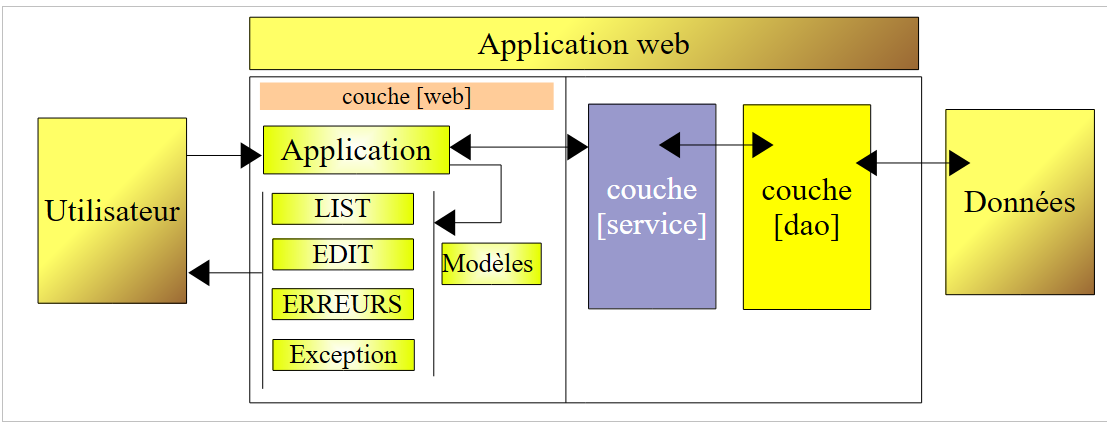 |
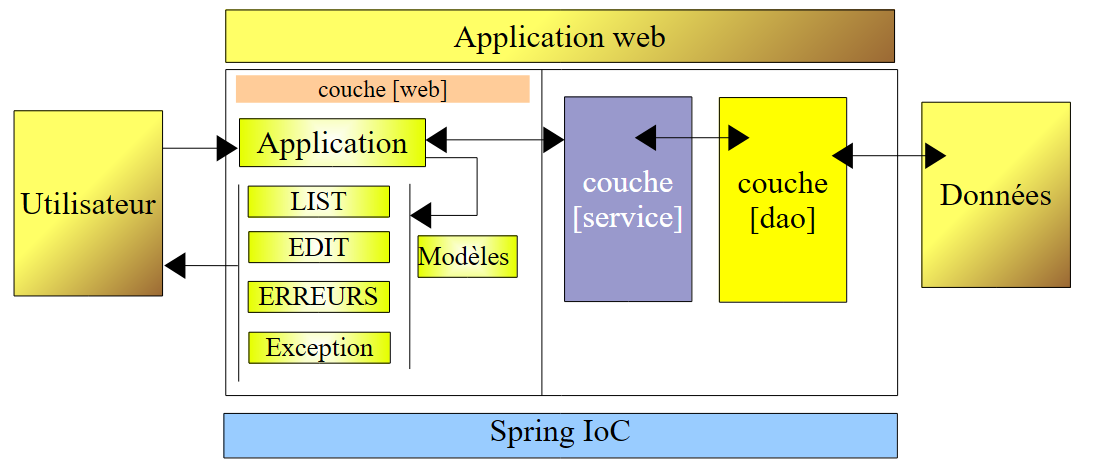
The [dao] layer implemented the list of people managed using a [ArrayList] object. This allowed us to avoid focusing on the [dao] and [service] layers so we could concentrate on the [web] layer. We want to evolve the application toward a more realistic environment where the list of people would be stored in a database table. This will require us to change the [dao] layer. This will impact the other two layers. To take advantage of the layer independence provided by Spring IoC, we will take the [personnes-01] application and configure it with Spring IoC:
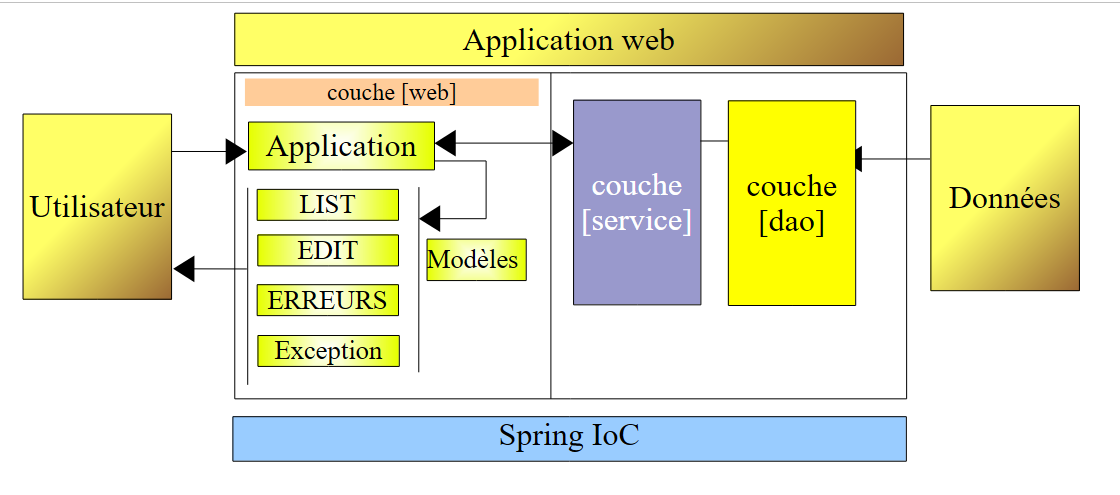 |
The new application will be named [personnes-02]. Once it has been written, we know that we will be able to change the [dao] and [service] layers without changing the code in the [web] layer. That is what we are looking for.
We create a new Eclipse project, [personnes-02], by copying and pasting the [personnes-01] project as explained in section 6.2:
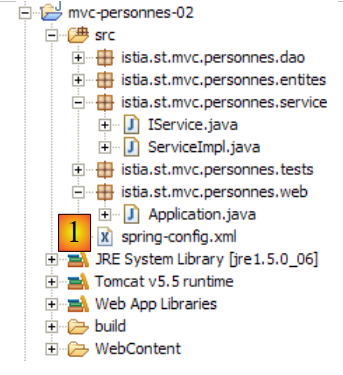 |
In [1], we see the configuration file appear, in which we will define the beans for the [dao] and [service] layers. Its content is as follows:
<?xml version="1.0" encoding="UTF-8"?>
<!DOCTYPE beans PUBLIC "-//SPRING//DTD BEAN//EN" "http://www.springframework.org/dtd/spring-beans.dtd">
<beans>
    <!-- the dao class -->
    <bean id="dao" class="istia.st.mvc.personnes.dao.DaoImpl" init-method="init"/>
    <!-- service class -->
    <bean id="service" class="istia.st.mvc.personnes.service.ServiceImpl">
        <property name="dao">
            <ref local="dao" />
        </property>
    </bean>
</beans>
- line 5: defines the bean named [dao] as an instance of the class [DaoImpl]. After instantiation, the method [init] of the instance is executed.
- lines 7–10: define the bean named [service] as an instance of the [ServiceImpl] class.
- Lines 8–10: The [dao] property of the [DaoImpl] instance is initialized with the reference to the [dao] layer created on line 5. Recall that the [ServiceImpl] class does indeed have the [dao] property and the corresponding setter:
Of course, this file alone does nothing. The [Application] controller will use it in its [init] method to instantiate the [service] layer. Recall the previous version from the controller’s [init] method:
In line 5, we had to explicitly name the implementation class of the [service] layer, and in line 12, that of the [dao] layer. With Spring IoC, the [init] method becomes the following:
- line 7: the private field [service] is no longer of type [ServiceImpl] but of type [IService], c.a.d. of the type of the [service] layer interface. The [web] layer is therefore no longer bound to a specific implementation of this interface.
- Line 14: Initialization of the [service] field from the [spring-config.xml] configuration file.
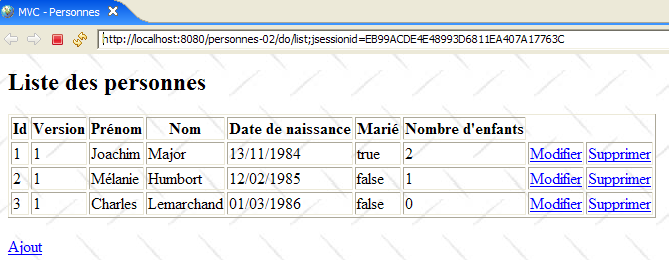
These are the only changes to be made. Let’s integrate this new application into Tomcat, start it, and then request the Url [http://localhost:8080/personnes-02]:
16.2. Archiving the web application
We have developed an Eclipse/Tomcat project for a 3-tier application:
 |
In a future version, the group of people will be placed in a database table.
- This will require a rewrite of the [dao] layer. This is easy to understand.
- The [service] layer will also be modified. Currently, its sole role is to ensure synchronized access to the data managed by the [dao] layer. To this end, we have synchronized all methods in the [service] layer. We have explained why this synchronization was placed in this layer rather than in the [dao] layer. In the new version, the [service] layer will still have the sole role of synchronizing access, but this will be handled by database transactions rather than by synchronizing Java methods.
- The [web] layer will remain unchanged.
To facilitate the transition from one version to the other, we are creating a new Eclipse project [mvc-personnes-02B], a copy of the previous project [mvc-personnes-02], but where the [web, service, dao, entites] layers have been placed in .jar archives:
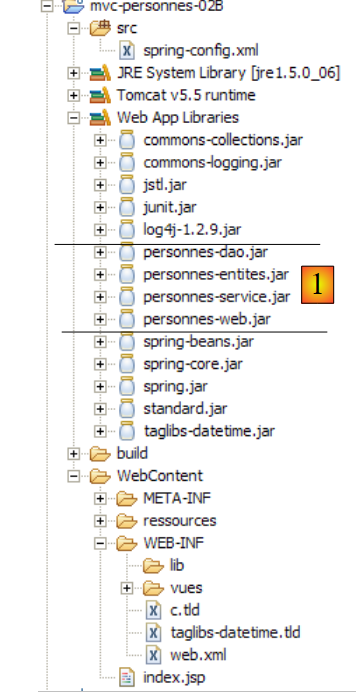 |
The [src] folder now contains only the Spring configuration file [spring-config.xml]. It previously also contained the source code for the Java classes. These elements have been removed and replaced by their compiled versions, which are stored in the [personnes-*.jar] archives shown in [1]:
 |
The [mvc-personnes-02B] project has been configured to include the [personnes-*.jar ] archives in its ClassPath.
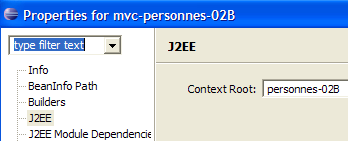
We deploy the [mvc-personnes-02B] web project within Tomcat:
 | 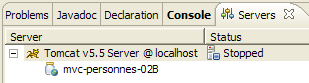 |
To test the project, we start Tomcat and then request the url [http://localhost:8080/personnes02B]:
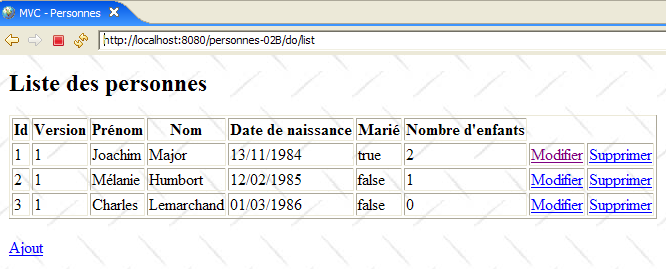
The reader is invited to perform additional tests.
In the version project with a database, we will change the [service] and [dao] layers. We want to demonstrate that it will then suffice to replace the [personnes-dao.jar] and [personnes-service.jar] archives in the previous project with the new archives so that our application now works with a database. We will not need to modify the archives for the [web] layer or the [entites] layer.