8. The functions
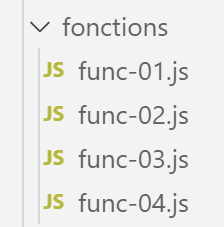
8.1. [func-01] script
The script focuses on how function parameters are passed:
- pass-by-value for numbers, strings, and booleans;
- pass-by-reference for arrays, literal objects, and functions;
'use strict';
// how to pass function parameters
// -----------------------nombre - passing by value
function doSomethingWithNumber(param) {
  param++;
  console.log("[param inside function]=", param, "[type]=", typeof (param), "[passage par référence]=", param === count);
}
// call code
let count = 10;
doSomethingWithNumber(count);
console.log("[count outside function]=", count);

// --------------------- chain - passing by value
function doSomethingWithString(param) {
  param += " xyz"
  console.log("[param inside function]=", param, "[type]=", typeof (param), "[passage par référence]=", param === text);
}
// call code
let text = "abcd";
doSomethingWithString(text);
console.log("[text outside function]=", text);

// --------------------- Boolean - passing by value
function doSomethingWithBoolean(param) {
  param = !param;
  console.log("[param inside function]=", param, "[type]=", typeof (param), "[passage par référence]=", param === bool);
}
// call code
let bool = true;
doSomethingWithBoolean(bool);
console.log("bool [outside function]=", bool);

// --------------------- table - passing by reference
function doSomethingWithArray(param) {
  param.push(1000);
  console.log("[param inside function]=", param, "[type]=", typeof (param), "[passage par référence]=", param === tab);
}
// call code
const tab = [10, 20, 30];
doSomethingWithArray(tab);
console.log("[tab outside function]=", tab);

// --------------------- object - passage by reference
function doSomethingWithObject(param) {
  param.unePropriétéNouvelle = "xyz";
  console.log("[param inside function]=", param, "[type]=", typeof (param), "[passage par référence]=", param === obj);
}
// call code
const obj = [10, 20, 30];
doSomethingWithObject(obj);
console.log("[obj outside function]=", obj);

// --------------------- function - pass by reference
function doSomethingWithFunction(param) {
  // a rather bizarre thing that works
  param.unePropriétéNouvelle = "xyz";
  console.log("[param inside function]=", param, "[type]=", typeof (param), "[passage par référence]=", param === f);
}
// call code
const f = x => x + 4;
doSomethingWithFunction(f);
console.log("[f outside function]=", f, f.unePropriétéNouvelle, typeof (f));
Execution
[Running] C:\myprograms\laragon-lite\bin\nodejs\node-v10\node.exe -r esm "c:\Data\st-2019\dev\es6\javascript\fonctions\func-01.js"
[param inside function]= 11 [type]= number [passage par référence]= false
[count outside function]= 10
[param inside function]= abcd xyz [type]= string [passage par référence]= false
[text outside function]= abcd
[param inside function]= false [type]= boolean [passage par référence]= false
bool [outside function]= true
[param inside function]= [ 10, 20, 30, 1000 ] [type]= object [passage par référence]= true
[tab outside function]= [ 10, 20, 30, 1000 ]
[param inside function]= [ 10, 20, 30, 'unePropriétéNouvelle': 'xyz' ] [type]= object [pass by reference]= true
[obj outside function]= [ 10, 20, 30, 'unePropriétéNouvelle': 'xyz' ]
[param inside function]= x => x + 4 [type]= function [passage par référence]= true
[f outside function]= x => x + 4 xyz function
8.2. script [func-02]
The following script shows that the type [function] is a data type like any other and that a variable can have this type. It also shows two ways to define a function:
- one using the keyword [function];
- the other using the "arrow" notation =>;
'use strict';
// you can assign a function to a variable
const variable1 = function (a, b) {
  return a + b;
};
console.log("typeof(variable1)=", typeof (variable1));
// the variable can then be used as a function
console.log("variable1(10,12)=", variable1(10, 12));
// the function can be defined using the notation =>
const variable2 = (a, b, c) => {
  return a - b + c;
};
console.log("variable2(10,12,14)=", variable2(10, 12, 14));
// braces can be omitted if there is only one expression in the function code
// this expression is then the return value of the
const variable3 = (a, b, c) => a + b + c;
console.log("variable3(10,12,14)=", variable3(10, 12, 14));
Execution
[Running] C:\myprograms\laragon-lite\bin\nodejs\node-v10\node.exe -r esm "c:\Data\st-2019\dev\es6\javascript\fonctions\func-02.js"
typeof(variable1)= function
variable1(10,12)= 22
variable2(10,12,14)= 12
variable3(10,12,14)= 36
8.3. script [func-03]
This script demonstrates the ability to pass a function as a parameter to another function. This technique is widely used in Javascript frameworks.
'use strict';
// function parameters can be of type [function]

// function f1
function f1(param1, param2) {
  return param1 + param2 + 10;
}
// function f2
function f2(param1, param2) {
  return param1 + param2 + 20;
}
// function g with a function f as parameter
function g(param1, param2, f) {
  return f(param1, param2) + 100;
}
// uses of g
console.log(g(0, 10, f1));
console.log(g(0, 10, f2));
// the function-type effective parameter can be passed directly - form 1
console.log(g(0, 10, (param1, param2) => {
  return param1 + param2 + 30;
}));
// the function-type effective parameter can be passed directly - form 2
console.log(g(0, 10, function (param1, param2) {
  return param1 + param2 + 40;
}));
Execution
[Running] C:\myprograms\laragon-lite\bin\nodejs\node-v10\node.exe -r esm "c:\Data\st-2019\dev\es6\javascript\fonctions\func-03.js"
120
130
140
150
8.4. script [func-04]
The following script demonstrates that a Javascript function can behave like a class:
'use strict';
// a function can be used as an object

// an empty shell
function f() {

}
// to which external properties are attributed
f.prop1 = "val1";
f.show = function () {
  console.log(this.prop1);
}
// use of f
f.show();

// a function g operating as a class
function g() {
  this.prop2 = "val2";
  this.show = function () {
    console.log(this.prop2);
  }
}
// instantiate the function with [new]
new g().show();
Comments
- lines 5–7: the body of function f does not define any properties;
- lines 9–12: properties are assigned to function f from outside;
- line 14: use of the function (object) f. Note that we do not write [f()] but simply [f]. This is the notation for an object;
- lines 17–22: we define a function [g] as if it were a class with properties and methods;
- line 24: the function [g] is instantiated by [new g()];
Execution results
[Running] C:\myprograms\laragon-lite\bin\nodejs\node-v10\node.exe -r esm "c:\Data\st-2019\dev\es6\javascript\classes\class-00.js"
val1
val2
ES6 introduced the concept of classes, which now allows us to avoid using functions to create classes.
8.5. script [func-05]
The script [func-05] demonstrates the use of an operator called [rest operator]:
'use strict';
// rest operator
function f(arg1, ...otherArgs) {
  // 1st argument
  console.log("arg1=", arg1);
  // other arguments
  let i = 0;
  otherArgs.forEach(element => {
    console.log("otherArguments[", i, "]=", element);
    i++;
  });
}

// call
f(1, "deux", "trois", { x: 2, y: 3 })
- line 3: the notation [...otherArgs] means that with a call of the type f(param1, param2, param3), we will have line 3:
- arg1=param1
- otherArgs=[param2, param3]. [otherArgs] is therefore an array that contains all the actual parameters passed to [param1];
The results of the application are as follows: