18. 案例研究:Struts 2 / Tiles / Spring / Hibernate / MySQL
我们将通过一个案例研究来结束对 Struts 的学习。为了更贴近实际,本案例将比之前研究的案例复杂得多。对于初学者来说,在着手本案例研究之前,最好先通过个人项目深入掌握 Struts 2 的基础知识。
该应用程序将采用分层架构:
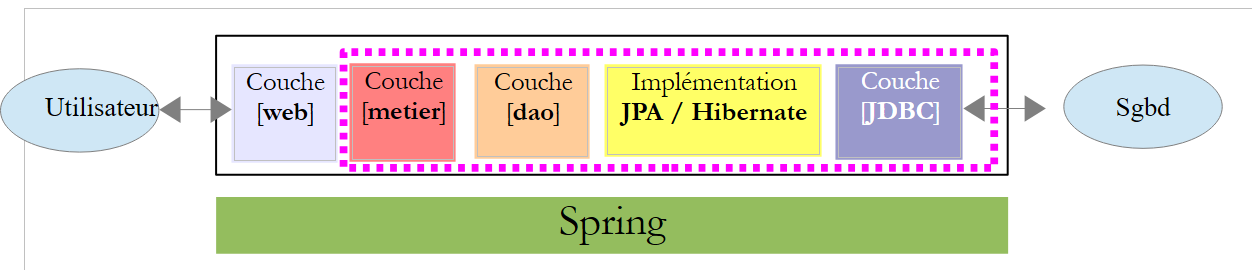 |
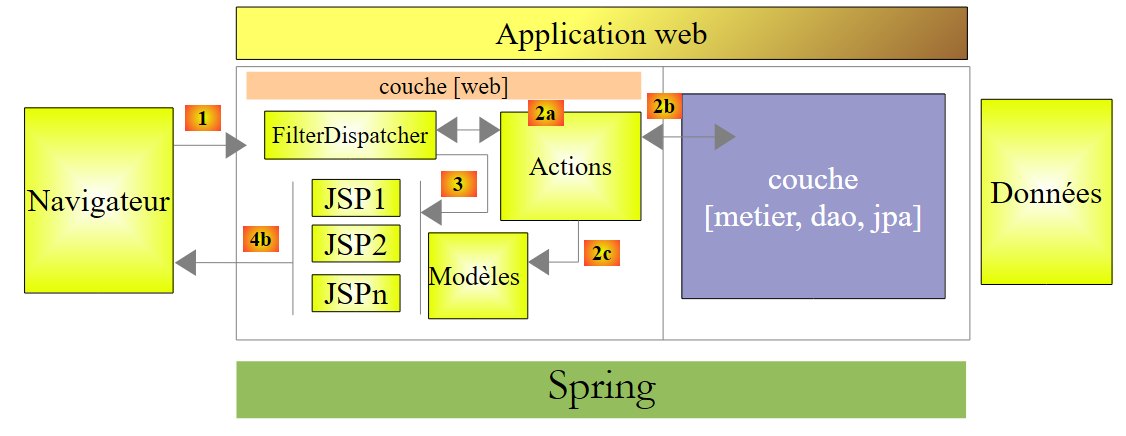
[metier]、[dao]、[jpa/hibernate]这三个层将以JAR压缩包的形式提供,我们将详细介绍其功能。 各层的集成将由 Spring 负责。[web] 层将由 Struts 2 实现。
 |
18.1. 问题
我们计划开发一个Web应用程序,用于为某市镇“幼儿之家”雇佣的保育员制作工资单。
本案例研究详见文档:
《Java入门》EE 5,可通过以下网址获取:[http://tahe.developpez.com/java/javaee]
在该文档中,该案例采用以下多层架构进行实现:
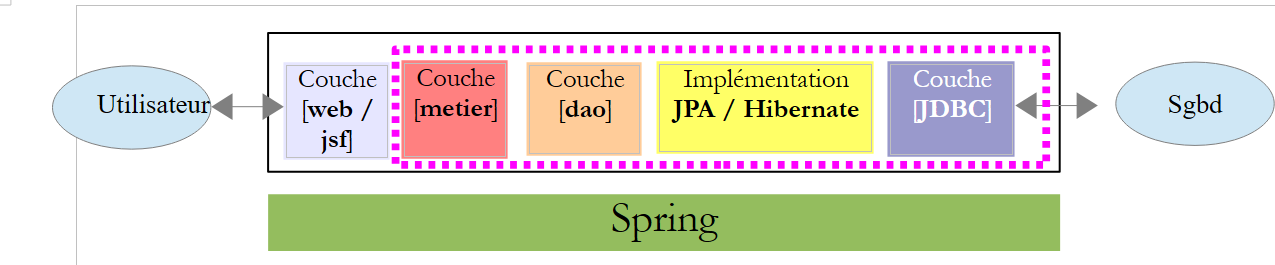 |
[web] 层是利用 JSF 框架(Java Server Faces)实现的。我们将采用相同的架构,使用 Struts 2 来实现 [web] 层。 为了展示分层架构的优势,我们将使用 JSF 版本的 [metier, dao, jpa] 层 jar 包,并将其连接到 [web / struts2] 层:
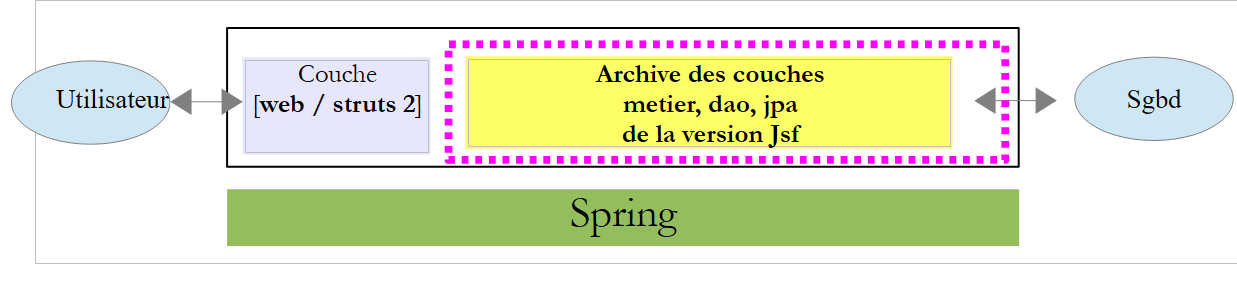 |
我们将介绍[metier, dao, jpa]层的以下内容:
- [web] 层面向 [métier] 层的接口。我们将介绍该接口。
- [jpa] 层访问数据库。我们将对此进行介绍。
- [jpa] 层将数据库表中的行转换为 JPA 实体,这些实体由应用程序的所有层进行操作。我们将介绍它们。
- [metier, dao, jpa] 层由 Spring 进行实例化。我们将介绍实现该实例化和集成的配置文件。
18.2. 数据库
我们将使用以下数据库:
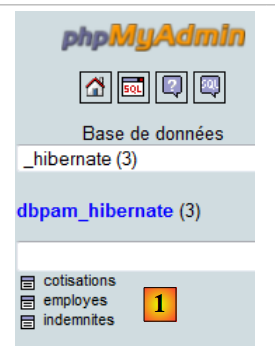
- 在 [1] 中,该数据库包含三个表:
- [employes]:记录托儿所员工的表
- [cotisations]:记录社会保险缴费率的表
- [indemnites]:用于记录计算员工工资所需信息的表
表 [employes]
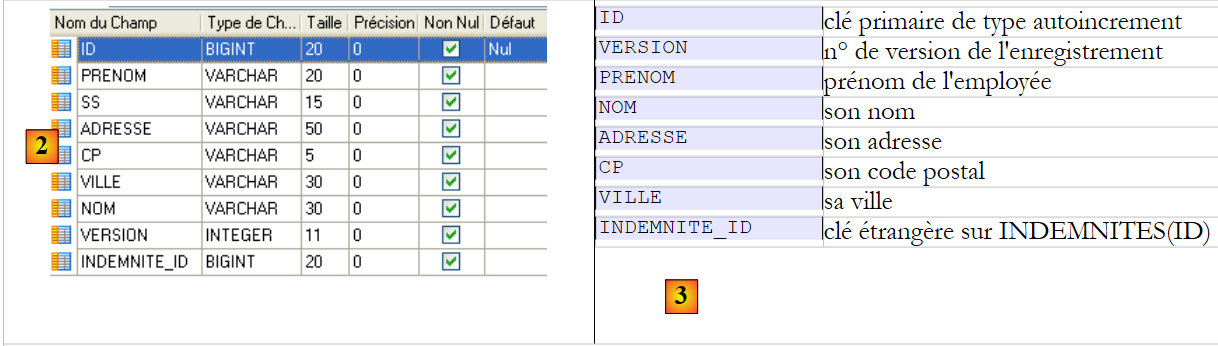 |
- [2] 为员工表,[3] 为其字段说明
该表的内容可能如下:

表 [cotisations]
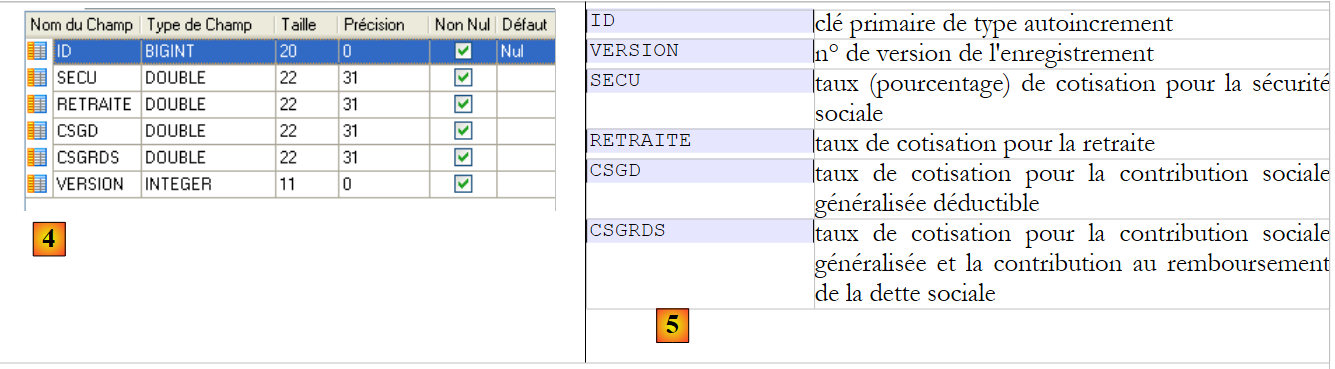 |
- 在 [4] 中,是缴费表;而在 [5] 中,是其字段的含义
该表的内容可能如下:

表 [indemnites]
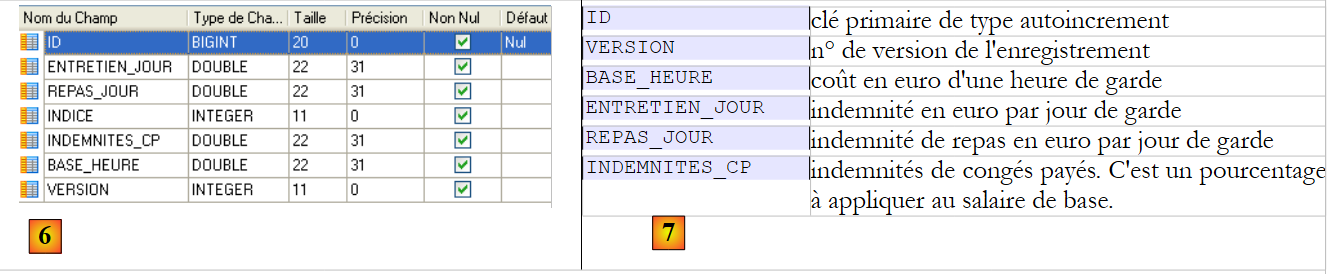 |
- 在 [6] 中,是津贴表;而在 [7] 中,是其字段的含义
该表的内容可能如下:

将数据库结构导出到文件 SQL 后,结果如下:
18.3. JPA 实体
在以下架构中
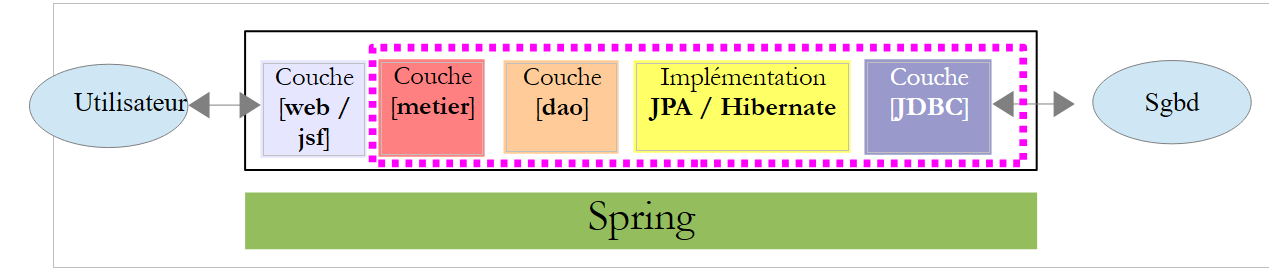 |
[Jpa]层在[dao]层处理的对象与Jdbc驱动程序处理的数据库表行之间起着桥梁作用。从数据库中读取的表行被转换为称为Jpa实体的对象。 反之,在写入操作中,JPA 实体会被转换为表中的行。这些实体由所有层(尤其是 Web 层)进行操作。因此,我们需要了解它们:
实体 [Employe] 代表表 [Employes] 中的一个行
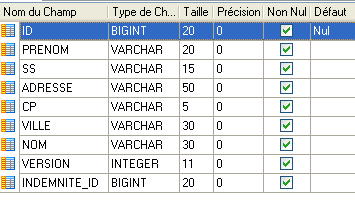
ID:自增型主键VERSION:记录的版本号PRENOM:员工的名字NOM:员工的姓氏ADRESSE:员工的地址CP:邮政编码VILLE:所在城市INDEMNITE_ID:指向 INDEMNITES(ID)
实体 [Employe] 如下:
package jpa;

...

@Entity
@Table(name="EMPLOYES")
public class Employe implements Serializable {

  @Id
  @GeneratedValue(strategy = GenerationType.AUTO)
  private Long id;
  @Version
  @Column(name="VERSION",nullable=false)
  private int version;
  @Column(name="SS", nullable=false, unique=true, length=15)
  private String SS;
  @Column(name="NOM", nullable=false, length=30)
  private String nom;
  @Column(name="PRENOM", nullable=false, length=20)
  private String prenom;
  @Column(name="ADRESSE", nullable=false, length=50)
  private String adresse;
  @Column(name="VILLE", nullable=false, length=30)
  private String ville;
  @Column(name="CP", nullable=false, length=5)
  private String codePostal;
  @ManyToOne
  @JoinColumn(name="INDEMNITE_ID",nullable=false)
  private Indemnite indemnite;


  public Employe() {
  }

  public Employe(String SS, String nom, String prenom, String adresse, String ville, String codePostal, Indemnite indemnite){
    setSS(SS);
    setNom(nom);
    setPrenom(prenom);
    setAdresse(adresse);
    setVille(ville);
    setCodePostal(codePostal);
    setIndemnite(indemnite);
  }

  @Override
  public String toString() {
    return "jpa.Employe[id=" + getId()
    + ",version="+getVersion()
    +",SS="+getSS()
    + ",nom="+getNom()
    + ",prenom="+getPrenom()
    + ",adresse="+getAdresse()
    +",ville="+getVille()
    +",code postal="+getCodePostal()
    +",indice="+getIndemnite().getIndice()
    +"]";
  }

  // 获取器和设置器
   ...
}
我们将忽略针对 [Jpa] 层级的 @ 注释。该类的各个字段对应于 [EMPLOYES] 表中的不同列。 indemnites 字段(第 29 行)反映了 [EMPLOYES] 表对 [INDEMNITES] 表具有外键。当操作某位员工时,其津贴信息也会被同步操作。
实体 [Indemnite] 是表 [INDEMNITES] 中某一行对象的表达式:
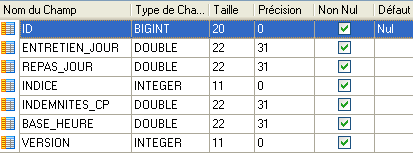
ID 自增型主键VERSIONn° 记录的版本号BASE_HEURE 每小时值班的欧元成本ENTRETIEN_JOUR 每天值班的欧元津贴REPAS_JOUR 每天值班的欧元餐费津贴INDEMNITES_CP 带薪休假津贴。这是一个应用于基本工资的百分比。
实体 [Indemnite] 如下:
package jpa;

...

@Entity
@Table(name="INDEMNITES")
public class Indemnite implements Serializable {

  @Id
  @GeneratedValue(strategy = GenerationType.AUTO)
  private Long id;
  @Version
  @Column(name="VERSION",nullable=false)
  private int version;
  @Column(name="INDICE", nullable=false,unique=true)
  private int indice;
  @Column(name="BASE_HEURE",nullable=false)
  private double baseHeure;
  @Column(name="ENTRETIEN_JOUR",nullable=false)
  private double entretienJour;
  @Column(name="REPAS_JOUR",nullable=false)
  private double repasJour;
  @Column(name="INDEMNITES_CP",nullable=false)
  private double indemnitesCP;

  public Indemnite() {
  }

  public Indemnite(int indice, double baseHeure, double entretienJour, double repasJour, double indemnitesCP){
    setIndice(indice);
    setBaseHeure(baseHeure);
    setEntretienJour(entretienJour);
    setRepasJour(repasJour);
    setIndemnitesCP(indemnitesCP);
  }

  @Override
  public String toString() {
    return "jpa.Indemnite[id=" + getId()
    + ",version="+getVersion()
    +",indice="+getIndice()
    +",base heure="+getBaseHeure()
    +",entretien jour"+getEntretienJour()
    +",repas jour="+getRepasJour()
    +",indemnités CP="+getIndemnitesCP()
    + "]";
  }

  // 获取器和设置器
....
}
该类的各个字段对应于表 [INDEMNITES] 的不同列。
实体 [Cotisation] 是表 [COTISATIONS] 中某一行对应的表达式:
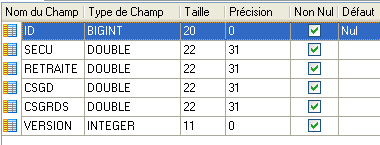
ID自增型主键VERSION记录版本号SECU (百分比)社会保险缴费率RETRAITE养老保险缴费率CSGD可抵扣的通用社会缴费率CSGRD通用社会缴费率及社会债务偿还缴费率
实体 [Cotisation] 如下:
package jpa;

...

@Entity
@Table(name="COTISATIONS")
public class Cotisation implements Serializable {

  @Id
  @GeneratedValue(strategy = GenerationType.AUTO)
  private Long id;
  @Version
  @Column(name="VERSION",nullable=false)
  private int version;
  @Column(name="CSGRDS",nullable=false)
  private double csgrds;
  @Column(name="CSGD",nullable=false)
  private double csgd;
  @Column(name="SECU",nullable=false)
  private double secu;
  @Column(name="RETRAITE",nullable=false)
  private double retraite;

  public Cotisation() {
  }

  public Cotisation(double csgrds, double csgd, double secu, double retraite){
    setCsgrds(csgrds);
    setCsgd(csgd);
    setSecu(secu);
    setRetraite(retraite);
  }

  @Override
  public String toString() {
    return "jpa.Cotisation[id=" + getId() + ",version=" + getVersion()+",csgrds="+getCsgrds()+"" +
      ",csgd="+getCsgd()+",secu="+getSecu()+",retraite="+getRetraite()+"]";
  }

  // 获取器和设置器
  ...
}
该类别的各个字段对应于表 [INDEMNITES] 的不同列。
18.4. 保育员工资的计算方式
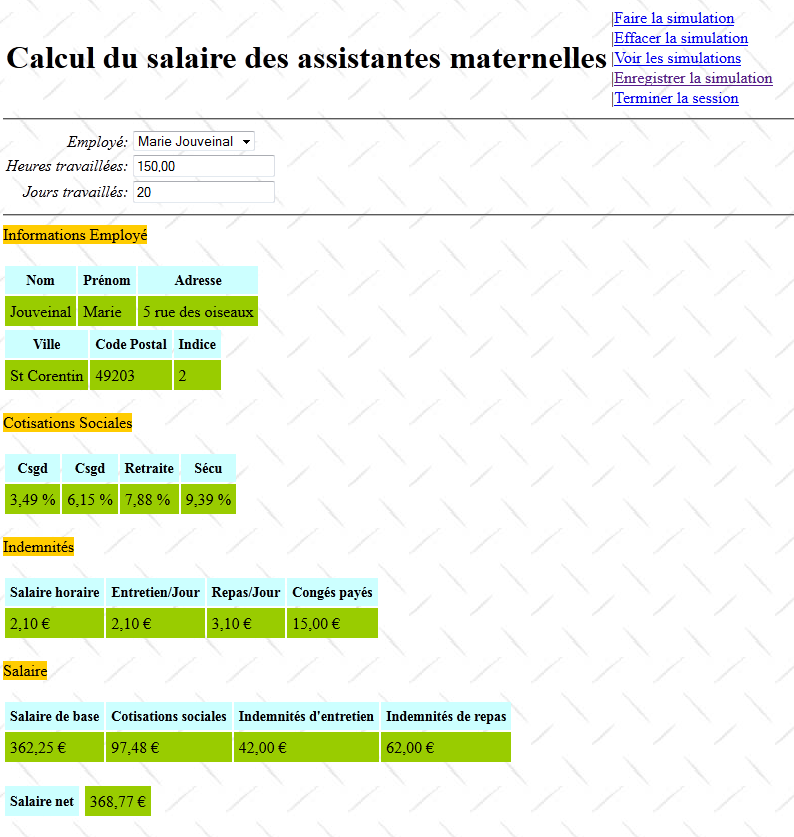
我们将编写的Web应用程序将允许我们根据三项信息计算员工的工资:
- 员工的指数
- 工作天数
- 工作小时数
以下是薪资计算的屏幕截图:
下面介绍家庭保姆月薪的计算方法。此方法并非实际使用的计算方式。我们以玛丽·朱维纳尔女士为例,她在当月工作了20天,共计150小时。
计算中考虑了以下要素: | | |
幼儿园助理的 由以下公式给出 : | | |
需从该工资中扣除一定数额的社会保险费 需从该 : | | |
社会保险费总额: | | |
此外,保育员有权 每工作一天,可获得 生活津贴以及 。因此,她将获得 如下: | | |
最终,应支付给保育员的净工资如下: | |
18.5. [métier] 层的接口
让我们回顾一下我们正在构建的应用程序架构:
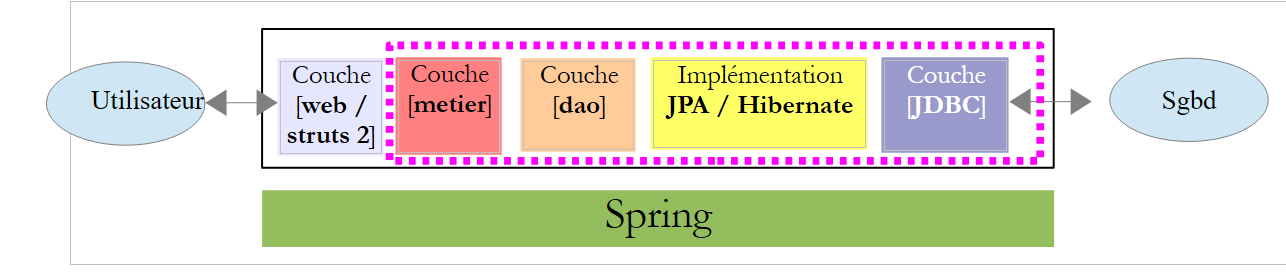 |
[web / struts 2] 层与 [métier] 层的接口进行通信。该接口如下:
package metier;

import java.util.List;
import jpa.Employe;

public interface IMetier {
  // 获取工资单
  FeuilleSalaire calculerFeuilleSalaire(String SS, double nbHeuresTravaillées, int nbJoursTravaillés );
  // 员工列表
  List<Employe> findAllEmployes();
}
- 第 8 行:用于计算员工工资的方法
- 第 10 行:用于填充员工下拉列表的方法
方法 calculerFeuillesalaire 返回以下 [FeuilleSalaire] 类的实例:
package metier;

import java.io.Serializable;
import jpa.Cotisation;
import jpa.Employe;

public class FeuilleSalaire implements Serializable {
  // 私有字段

  private Employe employe;
  private Cotisation cotisation;
  private ElementsSalaire elementsSalaire;

  // 构造函数
  public FeuilleSalaire() {
  }

  public FeuilleSalaire(Employe employe, Cotisation cotisation,
          ElementsSalaire elementsSalaire) {
    setEmploye(employe);
    setCotisation(cotisation);
    setElementsSalaire(elementsSalaire);
  }

  // toString
  @Override
  public String toString() {
    return "[" + employe + "," + cotisation + ","
            + elementsSalaire + "]";
  }

  // 获取器和设置器
  ...
}
工资单包含以下信息:
- 第 10 行:待计算工资的员工信息
- 第 11 行:各种缴费率
- 第 12 行:工资构成要素
类 [ElementsSalaire] 如下所示:
package metier;

import java.io.Serializable;

public class ElementsSalaire implements Serializable{

  // 私有字段
  private double salaireBase;
  private double cotisationsSociales;
  private double indemnitesEntretien;
  private double indemnitesRepas;
  private double salaireNet;

  // 构造函数
  public ElementsSalaire() {

  }

  public ElementsSalaire(double salaireBase, double cotisationsSociales,
    double indemnitesEntretien, double indemnitesRepas,
    double salaireNet) {
    setSalaireBase(salaireBase);
    setCotisationsSociales(cotisationsSociales);
    setIndemnitesEntretien(indemnitesEntretien);
    setIndemnitesRepas(indemnitesRepas);
    setSalaireNet(salaireNet);
  }

  // toString
  @Override
  public String toString() {
    return "[salaire base=" + salaireBase + ",cotisations sociales=" + cotisationsSociales + ",indemnités d'entretien="
      + indemnitesEntretien + ",indemnités de repas=" + indemnitesRepas + ",salaire net="
      + salaireNet + "]";
  }

  // getter 和 setter
  ...
}
- 第8-12行:工资构成
18.6. Spring配置文件
[métier, dao, jpa] 层的集成由以下 Spring 配置文件实现:
<?xml version="1.0" encoding="UTF-8"?>
<beans xmlns="http://www.springframework.org/schema/beans" xmlns:xsi="http://www.w3.org/2001/XMLSchema-instance"
       xmlns:tx="http://www.springframework.org/schema/tx"
       xsi:schemaLocation="http://www.springframework.org/schema/beans http://www.springframework.org/schema/beans/spring-beans-2.0.xsd http://www.springframework.org/schema/tx http://www.springframework.org/schema/tx/spring-tx-2.0.xsd">

  <!-- 应用层 -->

<!-- 业务 -->
  <bean id="metier" class="metier.Metier">
    <property name="employeDao" ref="employeDao"/>
    <property name="cotisationDao" ref="cotisationDao"/>
  </bean>
  <!-- DAO -->
  <bean id="employeDao" class="dao.EmployeDao" />
  <bean id="indemniteDao" class="dao.IndemniteDao" />
  <bean id="cotisationDao" class="dao.CotisationDao" />

  <!-- 配置JPA -->
  <bean id="entityManagerFactory" class="org.springframework.orm.jpa.LocalContainerEntityManagerFactoryBean">
    <property name="dataSource" ref="dataSource" />
    <property name="jpaVendorAdapter">
      <bean class="org.springframework.orm.jpa.vendor.HibernateJpaVendorAdapter">
        <property name="databasePlatform" value="org.hibernate.dialect.MySQL5InnoDBDialect" />
      </bean>
    </property>
    <property name="loadTimeWeaver">
      <bean class="org.springframework.instrument.classloading.InstrumentationLoadTimeWeaver" />
    </property>
  </bean>

  <!-- 数据源DBCP -->
  <bean id="dataSource" class="org.apache.commons.dbcp.BasicDataSource" destroy-method="close">
    <property name="driverClassName" value="com.mysql.jdbc.Driver" />
    <property name="url" value="jdbc:mysql://localhost:3306/dbpam_hibernate" />
    <property name="username" value="root" />
    <property name="password" value="" />
  </bean>

  <!-- 事务管理器 -->
  <tx:annotation-driven transaction-manager="txManager" />
  <bean id="txManager" class="org.springframework.orm.jpa.JpaTransactionManager">
    <property name="entityManagerFactory" ref="entityManagerFactory" />
  </bean>

  <!-- 异常转换 -->
  <bean class="org.springframework.dao.annotation.PersistenceExceptionTranslationPostProcessor" />

  <!-- 持久化 -->
  <bean class="org.springframework.orm.jpa.support.PersistenceAnnotationBeanPostProcessor" />

</beans>
我们不会在此解释该配置。它是实例化和集成[métier, dao, jpa]层所必需的。 因此,将基于这些层的Web应用程序必须采用此配置。请注意,第32至37行配置了数据库的JDBC属性。若读者希望更换数据库,则需修改这些行。
有关此配置的更多信息,请参阅文档《Java EE 5 入门》,该文档可通过网址 [http://tahe.developpez.com/java/javaee] 获取。