4. Java 8 Lambda Expressions
4.1. Example-01 - Functional Interfaces and Lambdas
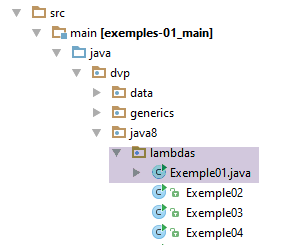 |
Consider the following code:
package dvp.java8.lambdas;

public class Exemple01 {
  public static void main(String[] args) {

    // anonymous classes
    I1 ia1 = new I1() {
      @Override
      public void doSomething() {
        System.out.println("ia1.doSomething");
      }
    };

    I2 ia2 = new I2() {
      @Override
      public String getSomething(double value) {
        return String.format("ia2.getSomething(%s)", value);
      }
    };

    // lambdas
    I1 ib1 = () -> System.out.println("ib1.lambda");
    I2 ib2 = (value) -> String.format("ib2.lambda(%s)", value);
    I1 ib3 = () -> {
      System.out.println("ib3.lambda");
    };
    I2 ib4 = (double value) -> {
      return String.format("ib4.lambda(%s)", value);
    };

    // app
    ia1.doSomething();
    System.out.println(ia2.getSomething(4.3));
    ib1.doSomething();
    System.out.println(ib2.getSomething(5.8));
    ib3.doSomething();
    System.out.println(ib4.getSomething(10.1));
  }
}

@FunctionalInterface
interface I1 {
  void doSomething();
}

@FunctionalInterface
interface I2 {
  String getSomething(double value);
}
- lines 41–44: define a functional interface I1. A functional interface is an interface with only one method. It is not dependent on the presence of the [@FunctionalInterface] annotation on line 41, which is optional;
- lines 46–49: a second functional interface I2;
- lines 6–19: interfaces I1 and I2 are implemented using anonymous classes, the most common solution prior to the introduction of lambda functions;
- lines 21–29: interfaces I1 and I2 are implemented using lambda functions;
- lines 7–12: implementation of interface I1 with an anonymous class. The syntax for implementing an interface I with an anonymous class is as follows:
where m1, m2, ... are the methods defined by the I interface.
- lines 14–19: implementation of interface I2 with an anonymous class;
- line 22: implementation of interface I1 with a lambda function. Here, we take advantage of the fact that the functional interface has only one method. The lambda function then implements this single method M. Its syntax is as follows:
The types T1, T2, Tn can be omitted if the compiler can infer them from the context (type inference).
- line 22: implementation of method [I1.doSomething] with signature:
void doSomething();
[doSomething] is a method that has no parameters and returns no result. Its lambda implementation can be written as in line 22 or as in lines 24–26, i.e., curly braces can be placed around the lambda function’s code. If this code contains only a single statement, as here, these curly braces can be omitted;
- line 23: implementation of the [I1.getSomething] method with the following signature:
String getSomething(double value);
[getSomething] accepts a parameter of type [double] and returns a result of type [String]. Its lambda implementation can be that of line 23 or that of lines 27–29. In the implementation on line 23:
- the type of the parameter [value] is omitted. In that case, the type [double] found in the signature of [getSomething] will be used;
- The lambda code is not enclosed in parentheses. The result of the lambda is therefore the value of the single expression in that code, in this case: String.format("ib2.lambda(%s)", value);
In the implementation on lines 27–29:
- the type of the parameter [value] is explicitly declared;
- we use a [return] to return the result of the lambda. In this case, curly braces must be used;
- Lines 32–37: we call the various anonymous functions and lambdas;
The result obtained is as follows:
4.2. Example-02 - The Predicate<T> functional interface
 |
Most of the time, we deal with functional interfaces from libraries rather than functional interfaces that we define ourselves. Here, we are interested in the functional interface [Predicate] defined in the [java.util.function] package, which contains most of the functional interfaces in Java 8. It is defined as follows:
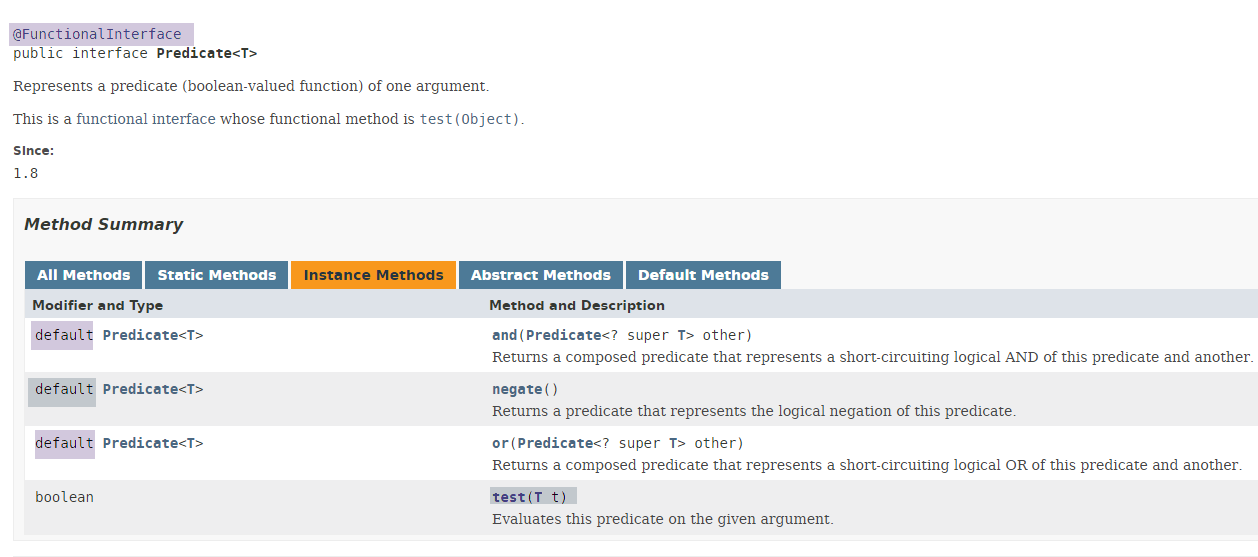
We said that a functional interface has only one method. Here, however, there are four. Another innovation introduced by Java 8 was the concept of a default method in an interface, denoted by the keyword [default]. Here, we have three such methods. These methods are characterized by having a default implementation. There is therefore no requirement for a class implementing an interface with default methods to implement those methods. Thus, a class wishing to implement the [Predicate] interface has only one method it must implement: the [test] method. The [Predicate] interface is therefore indeed a functional interface. We can thus say that a functional interface is an interface whose implementation contains only one mandatory method. If it has more than one method, the others must have the [default] keyword.
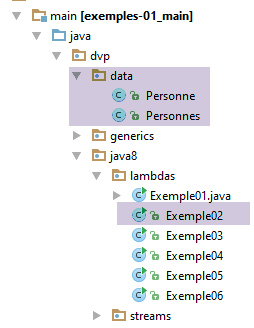
The method [Predicate<T>.test] takes a parameter of type T and returns a boolean. This interface is generally used to filter collections. To illustrate its use, we will use the following data:
package dvp.data;

import com.fasterxml.jackson.core.JsonProcessingException;
import com.fasterxml.jackson.databind.ObjectMapper;

public class Personne {

  public enum Sexe {HOMME,FEMME};

  // data
  private String nom;
  private int age;
  private double poids;
  private Sexe sexe;

  // manufacturers
  public Personne() {

  }

  public Personne(String nom, Sexe sexe, int age, double poids) {
    this.nom = nom;
    this.sexe=sexe;
    this.age = age;
    this.poids = poids;
  }

  // getters and setters
...

  // toString
  @Override
  public String toString(){
    try {
      return new ObjectMapper().writeValueAsString(this);
    } catch (JsonProcessingException e) {
      return e.getMessage();
    }
  }
}
- lines 32–38: the [toString] method returns the jSON string for the person;
The [Personnes] class defines a list of 3 people:
package dvp.data;

import com.fasterxml.jackson.core.JsonProcessingException;
import com.fasterxml.jackson.databind.ObjectMapper;

import java.util.Arrays;
import java.util.List;

public class Personnes {
  private static List<Personne> personnes = Arrays.asList(new Personne("jean", Personne.Sexe.HOMME, 20, 70),
    new Personne("marie", Personne.Sexe.FEMME, 10, 30), new Personne("camille", Personne.Sexe.FEMME, 30, 55));

  public static List<Personne> get() {
    return personnes;
  }

  public static String toString(List<Personne> liste) {
    try {
      return new ObjectMapper().writeValueAsString(liste);
    } catch (JsonProcessingException e) {
      return e.getMessage();
    }
  }
}
- lines 10–11: the list of 3 people;
- lines 13–15: a static method to obtain this list;
- lines 17–23: a static method to retrieve the string jSON from a list of people passed as a parameter;
This data will be used by the following code:
package dvp.java8.lambdas;

import java.util.ArrayList;
import java.util.List;
import java.util.function.Predicate;

import dvp.data.Personne;
import dvp.data.Personnes;

public class Exemple02 {
  public static void main(String[] args) {
    // predicate implemented by anonymous class
    Predicate<Personne> filterPoids=new Predicate<Personne>() {
      @Override
      public boolean test(Personne personne) {
        return personne.getPoids()<50;
      }
    };
// predicate implemented by a lambda
    Predicate<Personne> filterAge = p -> p.getAge() < 28;
    // list of persons
    List<Personne> personnes = Personnes.get();
    // displays
    System.out.println(Personnes.toString(filterPersonnes(personnes, filterAge)));
    System.out.println(Personnes.toString(filterPersonnes(personnes, filterPoids)));
  }

  private static List<Personne> filterPersonnes(List<Personne> personnes, Predicate<Personne> filter) {
      // [filter] filtre la liste [personnes]
    List<Personne> personnesFiltrées = new ArrayList<>();
    for (Personne p : personnes) {
      if (filter.test(p)) {
        personnesFiltrées.add(p);
      }
    }
    return personnesFiltrées;  }
}
- lines 13–18: implementation of the Predicate<Person> interface using an anonymous class. This is a filter based on the person’s weight;
- line 20: implementation of the Predicate<Person> interface using a lambda function. This is a filter based on the person's age. Based on what has been said, it could also have been written as follows:
        Predicate<Personne> filterAge = (Personne p) -> {
            return (p.getAge() < 28);
        };
but the version in line 20 is more concise. The type of the parameter p is inferred from the context. Here, a type [Predicate<Personne>] is constructed. The implemented method then has the signature [boolean test(Personne param)]. Therefore, the implicit type of p on line 20 is the type [Personne];
- line 22: we retrieve a predefined list of people;
- line 24: we filter them by age;
- line 25: we filter them by weight. In both cases, we display the string jSON from the filtered list;
- lines 28–37: a static method that
- takes as parameters: a list of people to filter and the filter. The filter is an instance of the [Predicate<Personne>] interface. For convenience, we refer to an instance of an interface I, here and elsewhere in the document, as an instance of a class C that implements I;
- returns the filtered list as the result;
- line 32: the method [test] of the interface [Predicate] is used. Depending on the filter passed to the method, the method [test] will be:
return personne.getPoids()<50;
or
return p.getAge() < 28
Executing the [Exemple02] class yields the following result:
4.3. Example-03 - The Functional Interface Function<T,R>
 |
The functional interface Function<T,R> is defined as follows:
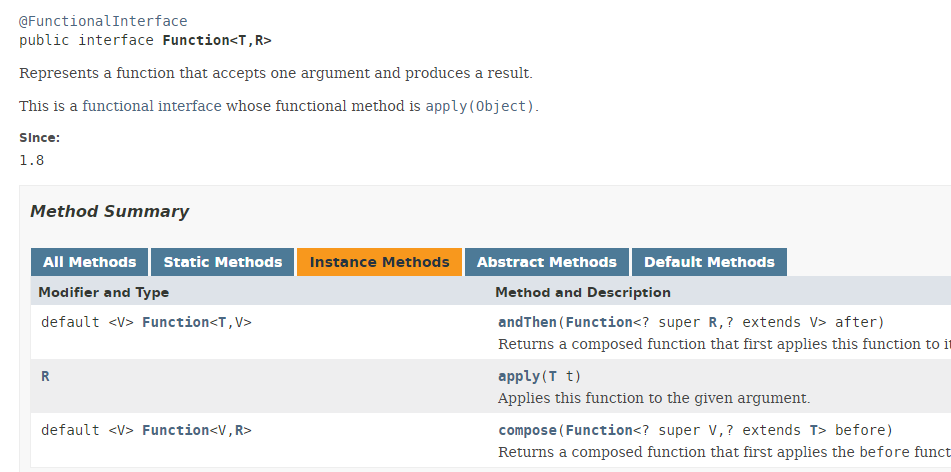
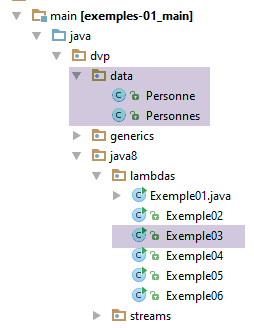
The interface’s only method has the signature R apply(T t). It is generally used to create a new Collection<R> type from a Collection<T> type. To illustrate this interface, we will use the following code:
package dvp.java8.lambdas;

import com.fasterxml.jackson.core.JsonProcessingException;
import com.fasterxml.jackson.databind.ObjectMapper;
import dvp.data.Personne;
import dvp.data.Personnes;

import java.util.ArrayList;
import java.util.List;
import java.util.function.Function;

public class Exemple03 {
  public static void main(String[] args) throws JsonProcessingException {
    // implementation with anonymous class
    Function<Personne, String> mapToName = new Function<Personne, String>() {
      @Override
      public String apply(Personne personne) {
        return personne.getNom();
      }
    };
    // implementation with lambda
    Function<Personne, Integer> mapToAge = p -> p.getAge();
    // list of persons
    List<Personne> personnes = Personnes.get();
    // jSON
    ObjectMapper jsonMapper = new ObjectMapper();
    // displays
    System.out.println(jsonMapper.writeValueAsString(mapPersonnes(personnes, mapToName)));
    System.out.println(jsonMapper.writeValueAsString(mapPersonnes(personnes, mapToAge)));
  }

  // transformation List<Person> --> List<T>
  private static <T> List<T> mapPersonnes(List<Personne> personnes, Function<Personne, T> mapper) {
    List<T> maps = new ArrayList<>();
    for (Personne p : personnes) {
      maps.add(mapper.apply(p));
    }
    return maps;
  }
}
- lines 15–20: we implement the [Function<Personne, String>] interface with an anonymous class that will perform the Person → String transformation;
- line 22: we implement the [Function<Personne, Integer>] interface with a lambda function that will perform the transformation Person --> Integer;
- lines 33–39: a static method that
- takes two parameters: the first, of type List<Person>, is a list of people to be transformed. The second, of type Function<Person, T>, is a function that creates an object of type T from each person in the list;
- returns a List<T> where each element results from the Person -> T transformation;
- Lines 35–37: The Person -> T transformation is applied. If the second parameter of the method is the object [mapToName], a Person -> String transformation will be performed. If it is the object [mapToAge], a Person -> Integer transformation will be performed;
The result is as follows:
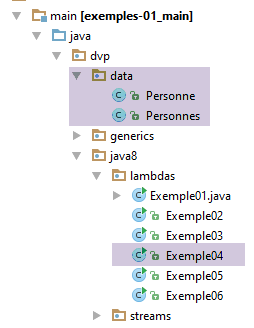
4.4. Example-04 - The Consumer<T> functional interface
 |
The functional interface Consumer<T> is defined as follows:
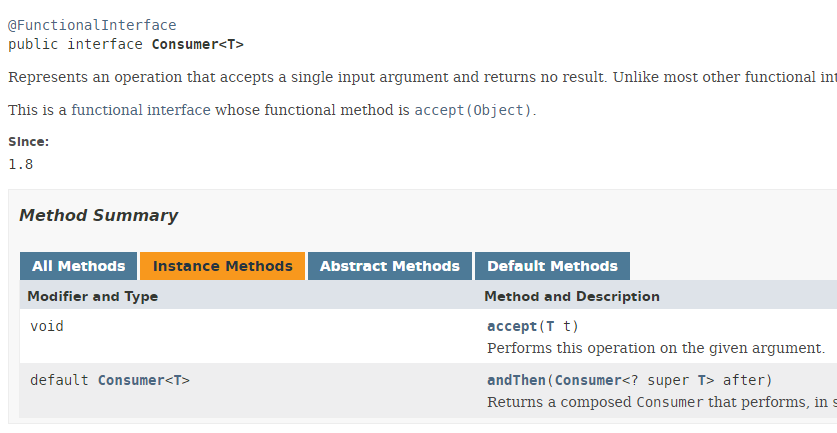
The interface’s only method has the signature: void accept(T t). This method processes (consumes) its parameter and returns no result. To illustrate this, we will use the following code:
package dvp.java8.lambdas;

import java.util.List;
import java.util.function.Consumer;

import dvp.data.Personne;
import dvp.data.Personnes;

public class Exemple04 {
    public static void main(String[] args) {
        // list of persons
        List<Personne> personnes = Personnes.get();
        // anonymous implementation
        Consumer<Personne> consumerAge = new Consumer<Personne>() {
            @Override
            public void accept(Personne personne) {
                System.out.printf(" age de %s = %s%n", personne.getNom(), personne.getAge());
            }
        };
        // immplémentaton lambda
        Consumer<Personne> consumerPoids = p -> System.out.printf(" poids de %s = %s%n", p.getNom(), p.getPoids());
        // displays
        for (Personne p : personnes) {
            consumerAge.accept(p);
        }
        System.out.println("--------");
        for (Personne p : personnes) {
            consumerPoids.accept(p);
        }
    }
}
- lines 14–19: the interface [Consumer<Personne>] is implemented by an anonymous class whose method [accept] displays the person’s name and age;
- line 21: the [Consumer<Personne>] interface is implemented by a lambda function whose implicit [accept] method displays the person's name and weight;
- lines 23–25: the list of people is consumed by the implementation [consumerAge];
- lines 27–29: the list of people is consumed by the implementation [consumerPoids];
The results are as follows:
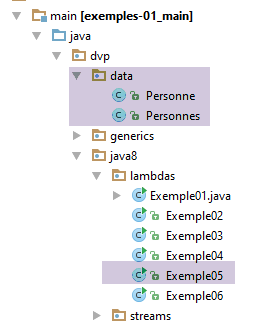
4.5. Example-05 - Functional Interface BiConsumer<T,U>
 |
The functional interface BiConsumer<T,U> is defined as follows:
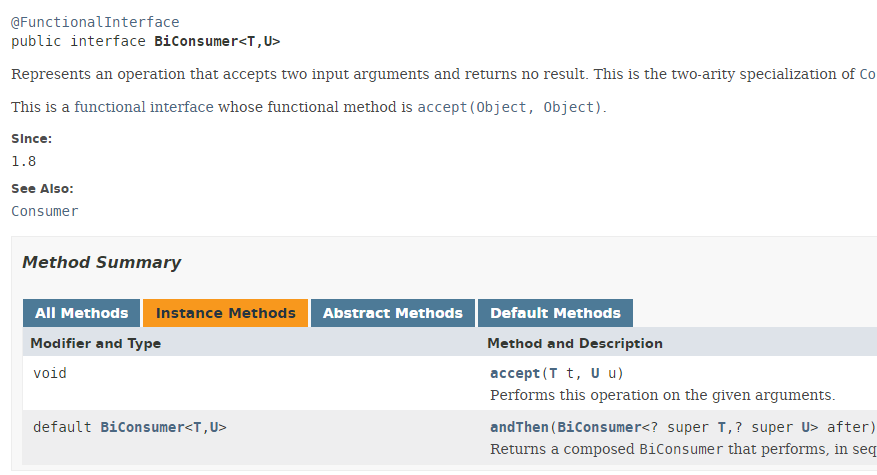
The interface’s single method has the signature: void accept(T t, U u). It takes a T object along with the additional information U u. We will illustrate its use with the following code:
package dvp.java8.lambdas;

import dvp.data.Personne;
import dvp.data.Personnes;

import java.util.List;
import java.util.function.BiConsumer;

public class Exemple05 {
  public static void main(String[] args) {
    // list of persons
    List<Personne> personnes = Personnes.get();
    // anonymous implementation
    BiConsumer<Personne, Integer> biconsumerAge = new BiConsumer<Personne, Integer>() {
      @Override
      public void accept(Personne personne, Integer integer) {
        personne.setAge(personne.getAge() + integer);
        System.out.printf("age de %s = %s%n", personne.getNom(), personne.getAge());
      }
    };
    // lambda implementation
    BiConsumer<Personne, Integer> biconsumerPoids = (p, i) -> {
      p.setPoids(p.getPoids() + i);
      System.out.printf("poids de %s = %s%n", p.getNom(), p.getPoids());
    };
    // displays
    for (Personne p : personnes) {
      biconsumerAge.accept(p, 100);
    }
    System.out.println("--------");
    for (Personne p : personnes) {
      biconsumerPoids.accept(p, 200);
    }
  }
}
- lines 14–20: implementation of the BiConsumer<T,U> interface using an anonymous class. The [apply] method uses its second parameter to update the age of the person passed as the first parameter. It then displays the result;
- lines 22–25: implementation of the BiConsumer<T,U> interface using a lambda function. The implicit [apply] method uses its second parameter to update the weight of the person passed as the first parameter. It then displays the result;
- lines 27–29: the list of people is processed using the [biconsumerAge] implementation;
- lines 31–33: the list of people is processed using the [biconsumerPoids] implementation;
The results obtained are as follows:
4.6. Example-06 - Functional Interface BiFunction<T,U,R>
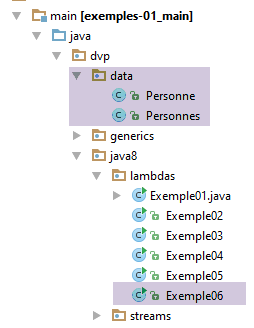 |
The functional interface BiFunction<T,U,R> is defined as follows:
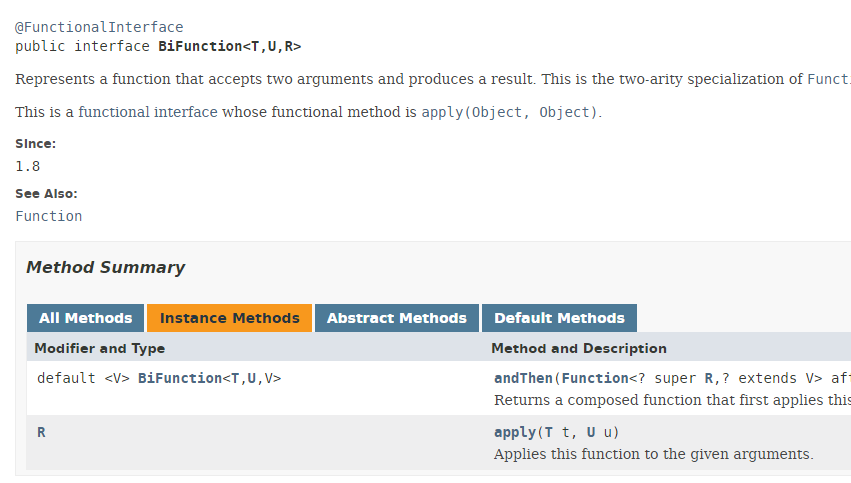
The interface’s single method has the signature: R apply(T t, U u). This method is similar to the [BiConsumer.apply] method, but while the latter does not return a result, the [BiFunction.apply] method does return a result. We will illustrate its use with the following code:
package dvp.java8.lambdas;
import java.util.List;
import java.util.function.BiFunction;
import dvp.data.Personne;
import dvp.data.Personnes;
public class Exemple06 {
public static void main(String[] args) {
// list of persons
List<Personne> personnes = Personnes.get();
// anonymous implementation
BiFunction<Personne, Integer, Integer> biFunctionAge = new BiFunction<Personne, Integer, Integer>() {
@Override
public Integer apply(Personne personne, Integer integer) {
return personne.getAge() + integer;
}
};
// lambda implementation
BiFunction<Personne, Integer, Double> biFunctionPoids = (p, i) -> {
return p.getPoids() + i;
};
// displays
for (Personne p : personnes) {
System.out.printf("age de %s = %s%n", p.getNom(), biFunctionAge.apply(p, 100));
}
System.out.println("--------");
for (Personne p : personnes) {
System.out.printf("poids de %s = %s%n", p.getNom(), biFunctionPoids.apply(p, 200));
}
}
}
- lines 14–19: the interface BiFunction<Person, Integer, Integer> is implemented with an anonymous class. Its method [apply] returns the age of the person passed as the first parameter, increased by the value of the second parameter;
- lines 21–23: The interface BiFunction<Person, Integer, Double> is implemented with a lambda function. The method [apply] returns the weight of the person passed as the first parameter, increased by the value of the second parameter;
- lines 25–27: the implementation [biFunctionAge] is applied to the people;
- Lines 29–31: Apply the [biFunctionPoids] implementation to the individuals;
The results obtained are as follows:
age de jean = 120
age de marie = 110
age de camille = 130
--------
poids de jean = 270.0
poids de marie = 230.0
poids de camille = 255.0
In addition to lambda functions, Java 8 introduced the Stream<T> type, which models a stream of elements of type T. These elements can undergo successive transformations implemented by lambda functions. When possible, and when there are multiple processors, these transformations can sometimes be performed in parallel.
4.7. Example-07 - The Supplier<T> functional interface
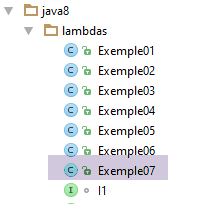 |
The functional interface Supplier<T> is defined as follows:
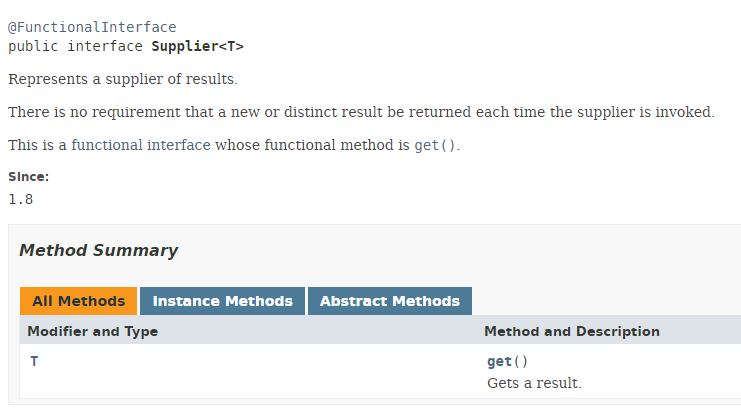
The interface’s sole method has the signature: T get(), whose role is to return an object of type T.
We will illustrate this functional interface with the following code:
package dvp.java8.lambdas;

import java.util.List;
import java.util.Random;
import java.util.function.Supplier;

import dvp.data.Personne;
import dvp.data.Personnes;

public class Exemple07 {
    public static void main(String[] args) {
        // anonymous implementation
        Supplier<Personne> supplier = new Supplier<Personne>() {
            // list of persons
            List<Personne> personnes = Personnes.get();

            // interface implementation
            @Override
            public Personne get() {
                int i = new Random().nextInt(personnes.size());
                return personnes.get(i);
            }
        };
        // operation
        for (int i = 0; i < 5; i++) {
            affiche(supplier);
        }
    }

    // person display
    public static void affiche(Supplier<Personne> supplier) {
        System.out.println(supplier.get());
    }
}
- lines 13–28: implementation of a Supplier<Person> type;
- lines 31–33: the static method [affiche] expects a parameter of type Supplier<Person>;
- lines 25–27: using the Supplier<Person> instance;
The following results are obtained: