8. Interim conclusion
This concludes the presentation of the ASP.NET MVC framework. We will continue with a case study illustrating the use of this framework in a layered architecture:
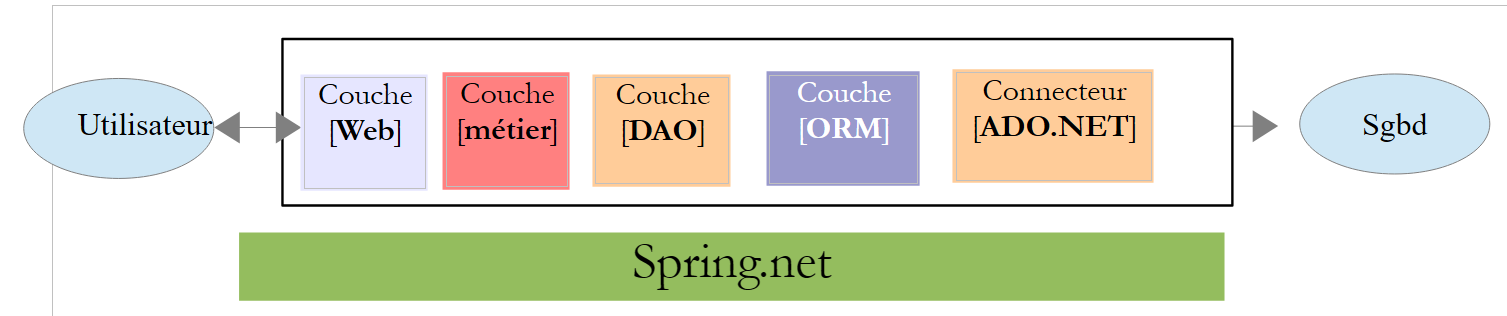 |
- The [Web] layer is the layer in contact with the web application user. The user interacts with the web application through web pages viewed in a browser. It is in this layer that ASP.NET MVC is located, and only in this layer.
- The [métier] layer implements the application's business rules, such as calculating a salary or an invoice. This layer uses data from the user via the [Web] layer and from SGBD via the [DAO] layer.
- The [DAO] layer (Data Access Objects), the [ORM] layer (Object Relational Mapper), and the ADO connector.NET manages access to the data in SGBD. The [ORM] layer bridges the objects handled by the [DAO] layer and the rows and columns of tables in a relational database. We will use the ORM Entity Framework (http://msdn.microsoft.com/en-us/data/ef.aspx ).
- Layer integration can be achieved using a dependency injection container. We will use Spring.net (http://www.springframework.net/ ).
Although this document is already quite extensive, it is incomplete. Readers can supplement their learning with the book "Pro ASP.NET MVC 4" written by Adam Freeman and published by Apress. It is an excellent book. Its 800 pages will satisfy even the most demanding readers.