19. Practice Exercise – Version 9
In this version, we will improve the server as follows:
- Currently, with each request, the tax administration data is retrieved from the database. We’ll use a session:
- When a user makes their first request, the tax authority data is retrieved from the database and stored in the session;
- for subsequent requests from the same user, the tax authority data is retrieved from the session. We can expect a slight improvement in execution time since database queries are resource-intensive;
- the session will also ensure that the user is authenticated only once;
- The server will log important events in a text file (logs):
- successful or failed authentication;
- whether the parameters sent by the client are valid;
- the result of the tax calculation;
- various error cases;
- in the event of a fatal error, an email will be sent to the application administrator.
The client will also need to be modified to handle the session cookie that the server will send to it.
19.1. The server
We are focusing on the server-side of the application.
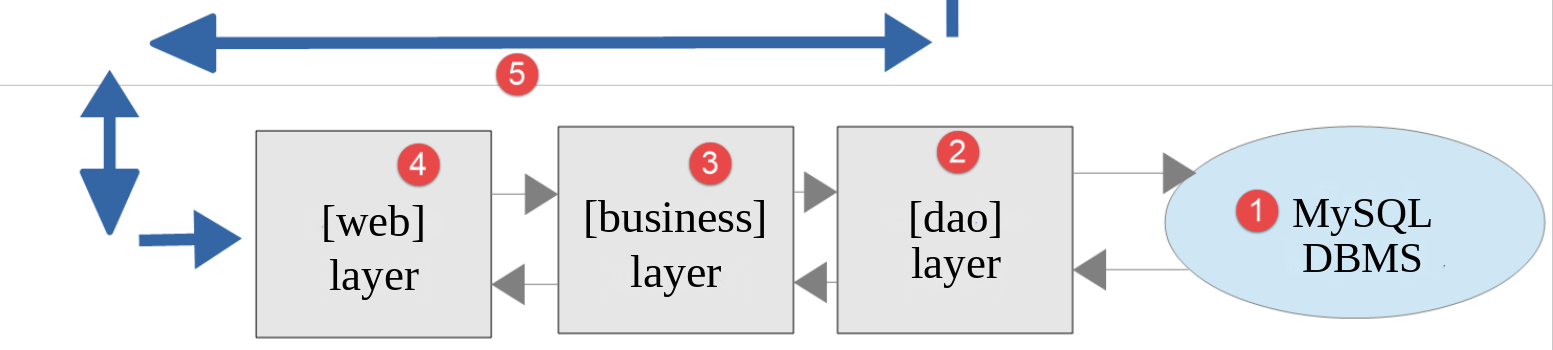
This architecture will be implemented by the following files:
| scripts-web/tax/version-09
├── Dao
│ └── ServerDaoWithSession.php
├── Data
│ ├── .htaccess
│ ├── config-server.json
│ └── logs.txt
├── Tests
│ └── ServerDaoTest.php
├── Utilities
│ ├── Logger.php
│ └── SendAdminMail.php
└── tax-server.php
|
The other files are from versions 5 and 8.
19.1.1. Utilities
19.1.1.1. The [Logger] class
The [Logger] class will be used to write logs to a text file:
| <?php
declare(strict_types=1);
// namespace
namespace Application;
// a log in a text file
final readonly class Logger
{
// constructor: the log file is created if it does not exist
public function __construct(private string $logsFilename)
{
// we check that we can write to the file (appending an empty string)
if (@file_put_contents($logsFilename, "", FILE_APPEND) === false) {
throw new TaxException("Failed to create the log file [$logsFilename]", 50);
}
}
// writing a message to the logs, preceded by the date and time
public function write(string $message): void
{
$date = (new \DateTimeImmutable())->format("d/m/y H:i:s.v");
// FILE_APPEND: we write at the end of the file
// LOCK_EX: the file is locked during the write
file_put_contents($this->logsFilename, "$date : $message\n", FILE_APPEND | LOCK_EX);
}
}
|
Comments
- Line 9: The class is [final] (it cannot be derived from) and [readonly]: its only attribute, the name of the log file, cannot be modified after the object is created;
- line 12: The class constructor takes the log file name as a parameter;
- line 15: We verify that we can write to the file by appending an empty string to it. The flag [FILE_APPEND] ensures that the file is created if it does not exist and that its contents are preserved otherwise. The [@] operator prevents PHP from displaying a warning in case of failure: we handle the error ourselves;
- line 16: if the write operation failed, an exception is thrown;
- line 21: the [write] method writes the [$message] message to the log file, preceded by the date and time. The [d/m/y H:i:s.v] format specifies the day, month, and year (as two digits), followed by the hours, minutes, seconds, and milliseconds;
- Line 26: The function [file_put_contents] opens the file, adds the line to it, and closes it. Therefore, there is no longer a method [close] as in version PHP 7 of the class, which kept the file open between two writes.
The server application may serve multiple clients simultaneously. However, there is only one log file for all of them. There is therefore a risk of concurrent access when writing to the file. The PHP 7 course ignored this problem. Here, the [LOCK_EX] flag instructs [file_put_contents] to lock the file during writing: if another request attempts to write at the same time, it waits until the lock is released. Therefore, a single log line is never mixed with another. However, lines written by two simultaneous requests may be interleaved with one another.
19.1.1.2. The [SendAdminMail] class
The [SendAdminMail] class allows you to send an email to the application administrator in the event of a crash:
| <?php
declare(strict_types=1);
// namespace
namespace Application;
// Symfony Mailer dependencies
use Symfony\Component\Mailer\Mailer;
use Symfony\Component\Mailer\Transport;
use Symfony\Component\Mime\Email;
// sending an email to the application's administrator
final readonly class SendAdminMail
{
// $config: the information needed to send the email
// $logger: an optional log to record the result of the sending
public function __construct(private array $config, private ?Logger $logger = null)
{
}
// sending the message [$message] to the administrator
// the method does not throw an exception: a sending failure is only recorded in the logs
public function send(string $message): void
{
// the email is sent to the SMTP server $this->config["smtp-server"] on port $this->config["smtp-port"]
// from $this->config["from"] to the recipient $this->config["to"]
// with the subject $this->config["subject"] and the attachments $this->config["attachments"]
// if $this->config["tls"] is true, the connection is secure and authenticated
$config = $this->config;
try {
// creating the message
$email = (new Email())
->from($config["from"])
->to($config["to"])
->subject($config["subject"])
->text($message);
// attachments
foreach ($config["attachments"] as $attachment) {
if (file_exists($attachment)) {
$email->attachFromPath($attachment);
} else {
$this->logger?->write("The attachment [$attachment] does not exist");
}
}
// the message transport
$dsn = "smtp://{$config["smtp-server"]}:{$config["smtp-port"]}";
if ($config["tls"]) {
// secure (STARTTLS) and authenticated connection
$verifyPeer = ($config["verify-peer"] ?? true) ? 1 : 0;
$dsn = sprintf("smtp://%s:%s@%s:%d?require_tls=1&verify_peer=%d",
rawurlencode($config["user"]), rawurlencode($config["password"]),
$config["smtp-server"], $config["smtp-port"], $verifyPeer);
}
// sending the message
(new Mailer(Transport::fromDsn($dsn)))->send($email);
$this->logger?->write("Message [$message] sent to {$config["to"]}");
} catch (\Throwable $ex) {
// sending failure
$this->logger?->write("Error while sending the message [$message]: {$ex->getMessage()}");
}
}
}
|
Comments
- Lines 9–11: The PHP 7 course used the [SwiftMailer] library, which is no longer maintained. We use [Symfony Mailer], introduced in the chapter on network functions;
- Line 18: The constructor takes two parameters:
- [$config]: an associative array containing all the information needed to send the email;
- [$logger]: a log for recording the result of the email send. This parameter is optional; its default value is [null];
- line 24: the method [send] sends the message [$message]. The code is that of the function [sendmail] from the script [smtp-02.php] in the chapter on network functions;
- Line 43: The null-safe operator [?->] (PHP 8.0) calls the [write] method only if [$this->logger] is not [null]. It replaces the [if ($this->logger !== NULL)] test in the PHP 7 script;
- line 58: the [send] method catches all errors: a failure to send the email is only logged. An error in error handling must not prevent the server from responding to its client.
The associative array [$config] will have the following form:
| "adminMail": {
"smtp-server": "localhost",
"smtp-port": 1025,
"from": "guest@localhost",
"to": "guest@localhost",
"subject": "tax calculation server crash",
"tls": false,
"attachments": []
},
|
The email is sent to the [Mailpit] server described in the chapter on network functions, which listens on port 1025 of the [localhost] machine and stores all emails it receives. It must be started (file [mailpit.bat] in the [scripts-console/inet/mailpit] folder).
19.1.2. The [dao] layer
The [dao] layer in version 9 is implemented by the following [ServerDaoWithSession] class:
| <?php
declare(strict_types=1);
// namespace
namespace Application;
// a [dao] layer that can be built from tax data already acquired
class ServerDaoWithSession extends ServerDao
{
// the constructor receives:
// - either the name of the JSON file describing the database: the tax data are read from the database
// - or the tax data themselves, already acquired (in the session for example)
public function __construct(string|TaxAdminData $source)
{
if ($source instanceof TaxAdminData) {
// simplest case: the data are already there
$this->taxAdminData = $source;
} else {
// we hand over to the parent class which knows how to use the database
parent::__construct($source);
}
}
}
|
Comments
- Line 9: The [ServerDaoWithSession] class in version 9 extends the [ServerDao] class from version 8. This is because the [ServerDao] class is capable of using the database. All that remains is to handle the case where the tax administration data has already been retrieved;
- line 14: the constructor receives a parameter that can be of two types. The union type [string|TaxAdminData] (PHP 8.0) defines it as follows:
- a string: the name of the file containing the information needed to connect to the database, if the tax authority data has not yet been retrieved;
- a [TaxAdminData] object: the tax authority data, if it has already been retrieved;
- lines 16–18: the [instanceof] operator determines which of the two types was received. If it is tax data, it is stored in the [taxAdminData] attribute, inherited from the [ServerDao] class. This is why this attribute was declared as [protected readonly] in version 8. The PHP class in version 7 had a constructor with two parameters, one of which had to be [NULL];
- line 21: otherwise, control is passed to the parent class’s constructor, which retrieves the data from the database.
When a web session starts, the [dao] layer will be constructed using the database file name. The tax administration data will then be retrieved from the database and stored in the session. For subsequent requests within the same session, the [dao] layer will be constructed using the [TaxAdminData] object from the session. Therefore, no database lookup will occur.
19.1.3. The server script
The server script [tax-server.php] is configured by the following file: JSON [config-server.json]:
| {
"databaseFilename": "../version-08/Data/database-mysql.json",
"dependencies": [
"../../../scripts-console/tax/version-05/Entities/TaxException.php",
"../../../scripts-console/tax/version-05/Entities/TaxAdminData.php",
"../../../scripts-console/tax/version-05/Entities/Database.php",
"../../../scripts-console/tax/version-05/Utilities/Utilities.php",
"../version-08/Dao/InterfaceServerDao.php",
"../version-08/Dao/ServerDao.php",
"Dao/ServerDaoWithSession.php",
"../version-08/Business/InterfaceServerBusiness.php",
"../version-08/Business/ServerBusiness.php",
"Utilities/Logger.php",
"Utilities/SendAdminMail.php"
],
"users": [
{
"login": "admin",
"passwd": "admin"
}
],
    "adminMail": {
        "smtp-server": "localhost",
        "smtp-port": 1025,
        "from": "guest@localhost",
        "to": "guest@localhost",
        "subject": "tax calculation server crash",
        "tls": false,
        "attachments": []
    },
"logsFilename": "Data/logs.txt"
}
|
- line 2: the database description MySQL from version 8 is used;
- lines 3–15: the files from versions 5 and 8, and the three new files from version 9;
- lines 22–30: the information needed to send an email to the administrator. These now have appropriate JSON types: a number for the port, a Boolean for [tls]. The PHP 7 file used strings (["25"], ["FALSE"]);
- line 31: the log file, related to the [version-09] folder on the server. It is located in the [Data] folder, protected by the [.htaccess] file from version 8: the logs must not be readable by everyone.
The [tax-server.php] server script changes as follows:
| <?php
// strict compliance with the declared types of function parameters and results
declare(strict_types=1);
// namespace
namespace Application;
// Symfony dependencies
use Symfony\Component\HttpFoundation\JsonResponse;
use Symfony\Component\HttpFoundation\Request;
use Symfony\Component\HttpFoundation\Response;
use Symfony\Component\HttpFoundation\Session\Session;
// PHP errors are not sent to the client (they go to the web server's log)
ini_set("display_errors", "0");
// the server's root folder: the paths of the configuration file are relative to this folder
const ROOT_DIRECTORY = __DIR__;
// path of the configuration file
const CONFIG_FILENAME = ROOT_DIRECTORY . "/Data/config-server.json";
// we retrieve the configuration
$config = json_decode(file_get_contents(CONFIG_FILENAME), true, flags: JSON_THROW_ON_ERROR);
// we include the dependencies needed by the script
require_once ROOT_DIRECTORY . "/../../../vendor/autoload.php";
foreach ($config["dependencies"] as $dependency) {
require_once ROOT_DIRECTORY . "/$dependency";
}
// session (after loading the [TaxAdminData] class, an object of which may be in the session)
$session = new Session();
$session->start();
// creating the log file
try {
$logger = new Logger(ROOT_DIRECTORY . "/" . $config["logsFilename"]);
} catch (TaxException $ex) {
// error 500 without logs - the message must not reveal the server's file tree
$message = "Failed to create the log file [{$config["logsFilename"]}]";
doInternalServerError($message, $config["adminMail"]);
// done
exit;
}
// 1st log
$logger->write("---new request");
// we retrieve the current request
$request = Request::createFromGlobals();
// authentication only the 1st time
if (!$session->has("user")) {
// log
$logger->write("Authentication in progress…");
// the credentials sent by the client (null if it did not send any)
$requestUser = $request->getUser();
$requestPassword = $request->getPassword();
// is the user one of the authorized users?
$found = $requestUser !== null && $requestPassword !== null
&& array_any(
$config["users"],
fn(array $user): bool => $user["login"] === $requestUser && hash_equals($user["passwd"], $requestPassword)
);
if (!$found) {
// not found - code 401
sendResponse(
["error" => "Authentication failed [$requestUser]"],
Response::HTTP_UNAUTHORIZED,
["WWW-Authenticate" => 'Basic realm="Tax calculation server"'],
$logger
);
// done
exit;
}
// we note in the session that the user has been authenticated
$session->set("user", $requestUser);
// log
$logger->write("Authentication successful [$requestUser]");
} else {
// log
$logger->write("Authentication taken from the session…");
}
// we have a valid user - we check the parameters received
$errors = [];
// we must have a GET request with three parameters
if ($request->getMethod() !== "GET" || $request->query->count() !== 3) {
$errors[] = "GET method required with only the parameters [married, children, salary]";
}
// the marital status
if (!$request->query->has("married")) {
$errors[] = "missing married parameter";
} else {
$married = strtolower(trim($request->query->getString("married")));
if (!in_array($married, ["yes", "no"], true)) {
$errors[] = "invalid married parameter [$married]";
}
}
// the number of children and the salary: integers >= 0
$values = [];
foreach (["children", "salary"] as $parameter) {
if (!$request->query->has($parameter)) {
$errors[] = "missing $parameter parameter";
continue;
}
$value = trim($request->query->getString($parameter));
if (preg_match('/^\d+$/', $value) !== 1) {
$errors[] = "invalid $parameter parameter [$value]";
} else {
$values[$parameter] = (int) $value;
}
}
// other parameters in the request?
foreach (array_diff(array_keys($request->query->all()), ["married", "children", "salary"]) as $parameter) {
$errors[] = "invalid parameter [$parameter]";
}
// errors?
if ($errors !== []) {
// we send a 400 error code to the client
sendResponse(["errors" => $errors], Response::HTTP_BAD_REQUEST, [], $logger);
// done
exit;
}
// log
[$children, $salary] = [$values["children"], $values["salary"]];
$logger->write("valid parameters ['married'=>$married, 'children'=>$children, 'salary'=>$salary]");
// we have everything we need to work
// creating the [dao] layer
if (!$session->has("taxAdminData")) {
// the tax data are taken from the database
$logger->write("tax data taken from the database");
try {
// building the [dao] layer
$dao = new ServerDaoWithSession(ROOT_DIRECTORY . "/" . $config["databaseFilename"]);
// we put the tax data in the session
$session->set("taxAdminData", $dao->getTaxAdminData());
} catch (TaxException $ex) {
// error 500
doInternalServerError($ex->getMessage(), $config["adminMail"], $logger);
// done
exit;
}
} else {
// the tax data are taken from the session
$dao = new ServerDaoWithSession($session->get("taxAdminData"));
// log
$logger->write("tax data taken from the session");
}
// creating the [business] layer
$business = new ServerBusiness($dao);
// tax calculation
$result = $business->calculateTax($married, $children, $salary);
// we return the response
sendResponse($result, Response::HTTP_OK, [], $logger);
// end
exit;
// --------------------------------------------------------------------------
// fatal error: an email to the administrator and a 500 response to the client
function doInternalServerError(string $message, array $adminMail, ?Logger $logger = null): void
{
// the error message of a DBMS driver may not be UTF-8 encoded (Windows-1252 on Windows)
if (!mb_check_encoding($message, "UTF-8")) {
$message = mb_convert_encoding($message, "UTF-8", "Windows-1252");
}
// we send an email to the administrator
// [SendAdminMail] catches all the exceptions and logs them itself
(new SendAdminMail($adminMail, $logger))->send($message);
// we send a 500 error code to the client
sendResponse(["error" => $message], Response::HTTP_INTERNAL_SERVER_ERROR, [], $logger);
}
// sending the HTTP response to the client
// $result: the array to send, in the form ["response" => $result]
// $statusCode: the HTTP status of the response
// $headers: HTTP headers to add to the response
// $logger: the application's log (null if it could not be created)
function sendResponse(array $result, int $statusCode, array $headers = [], ?Logger $logger = null): void
{
// the JSON response
$response = new JsonResponse(null, $statusCode, $headers);
$response->setEncodingOptions(JSON_UNESCAPED_UNICODE | JSON_UNESCAPED_SLASHES | JSON_PRESERVE_ZERO_FRACTION);
$response->setData(["response" => $result]);
// sending
$response->send();
// log
$logger?->write($response->getContent());
}
|
Comments
- line 13: the [Session] class from [HttpFoundation], introduced in the previous chapter, is used;
- Line 16: Errors detected by PHP (warnings, fatal errors, etc.) are not displayed in the document sent to the client. They would corrupt the JSON response expected by the client. They are logged in the web server’s error log (Apache’s [error.log] file);
- lines 33–34: a session is started. It is started after the application files have been loaded: the session may contain a [TaxAdminData] object, and the [TaxAdminData] class must be known at the time PHP reconstructs the session objects;
- Lines 37–44: An attempt is made to create the log file. If an exception occurs, the [doInternalServerError] function is called without a log (the last parameter is missing). The error message includes the name of the log file specified in the configuration: the exception message contains the full path to the file, which would reveal the server’s folder structure to the client;
- Line 162: The [doInternalServerError] function accepts three parameters:
- [$message]: the error message;
- [$adminMail]: the information needed to send an email to the application administrator;
- [$logger]: the application log, if it could be created;
- lines 165–166: the error message may come from a DBMS driver and may not be encoded in UTF-8 (see version 8);
- line 170: an email is sent to the application administrator;
- line 172: the response is sent to the client using the [500 Internal Server Error] code;
- line 180: the function [sendResponse] sends all responses to the client. Its parameters are:
- [$result]: the array to send. The server sends the string JSON from the array [["response" => $result]];
- [$statusCode]: the response status HTTP;
- [$headers]: the headers HTTP to be added to the response. This is the case for the header [WWW-Authenticate] in the 401 response;
- [$logger]: the application log;
- line 183: the constructor of the [JsonResponse] class accepts the data, status, and headers of the response. The data is set later by [setData], after the options for [json_encode] have been selected, which are those of version 8;
- line 189: the JSON response sent is logged;
- line 48: the first log entry for the request;
- line 53: Thanks to the established session, the client will be authenticated only once:
- once the client is authenticated, the key [user] is stored in the session, with the user ID from line 77 as its value;
- during the next request from the same client, the check prevents unnecessary re-authentication;
- lines 67–72: if authentication fails, a 401 response is sent by the function [sendResponse], with the header [WWW-Authenticate];
- lines 86–118: Parameter validation follows the version 8 specification;
- line 126: the array unpacking function [[$a, $b] = [...]] assigns values to both variables [$children] and [$salary] in a single statement. It replaces function [list] with PHP 7;
- line 131: Thanks to the session, the data will be retrieved from the database only once:
- during the first query, the database search occurs on line 136. The retrieved data is then stored in the session, associated with the key [taxAdminData] on line 138;
- for subsequent requests, the key [taxAdminData] is found in the session, and the tax data is then directly transmitted to the [dao] layer on line 147;
- lines 139–143: The search for tax data in the database may fail. In this case, a code [500 Internal Server Error] is sent to the client, and an email is sent to the administrator;
- line 156: the rest of the code is the same as in the previous version, with the response being sent by the [sendResponse] function.
Note that the functions [doInternalServerError] and [sendResponse] are defined at the end of the script, after the [exit] statement: PHP is aware of all functions defined at the top level of a file before executing the first statement in that file.
19.1.4. [PHPUnit] Tests
We will only test the [dao] layer, which is the only one that has changed. The test code for [Tests/ServerDaoTest.php] is as follows:
| <?php
// strict compliance with the declared types of function parameters and results
declare(strict_types=1);
// namespace of the tests
namespace Application\Tests;
// the tested class
use Application\ServerDaoWithSession;
// the PHPUnit classes
use PHPUnit\Framework\TestCase;
final class ServerDaoTest extends TestCase
{
// the server's root folder
private const string ROOT_DIRECTORY = __DIR__ . "/..";
// the server's configuration
private static array $config;
// executed once, before the first test of the class
#[\Override]
public static function setUpBeforeClass(): void
{
// we retrieve the server's configuration
self::$config = json_decode(file_get_contents(self::ROOT_DIRECTORY . "/Data/config-server.json"), true, flags: JSON_THROW_ON_ERROR);
// we include the server's dependencies
foreach (self::$config["dependencies"] as $dependency) {
require_once self::ROOT_DIRECTORY . "/$dependency";
}
}
// the tax administration data read from the database (1st request of a session)
public function testTaxAdminData(): void
{
// creating the [dao] layer from the file describing the database
$dao = new ServerDaoWithSession(self::ROOT_DIRECTORY . "/" . self::$config["databaseFilename"]);
$taxAdminData = $dao->getTaxAdminData();
// calculation constants
$this->assertSame(1551.0, $taxAdminData->halfShareQfCeiling);
$this->assertSame(21037.0, $taxAdminData->singleIncomeCeilingForReduction);
$this->assertSame(42074.0, $taxAdminData->coupleIncomeCeilingForReduction);
$this->assertSame(3797.0, $taxAdminData->halfShareReductionValue);
$this->assertSame(1196.0, $taxAdminData->singleDiscountCeiling);
$this->assertSame(1970.0, $taxAdminData->coupleDiscountCeiling);
$this->assertSame(1595.0, $taxAdminData->singleTaxCeilingForDiscount);
$this->assertSame(2627.0, $taxAdminData->coupleTaxCeilingForDiscount);
$this->assertSame(12502.0, $taxAdminData->tenPercentAllowanceMax);
$this->assertSame(437.0, $taxAdminData->tenPercentAllowanceMin);
// tax brackets
$this->assertSame([9964.0, 27519.0, 73779.0, 156244.0, 0.0], $taxAdminData->limits);
$this->assertSame([0.0, 0.14, 0.30, 0.41, 0.45], $taxAdminData->coeffR);
$this->assertSame([0.0, 1394.96, 5798.0, 13913.69, 20163.45], $taxAdminData->coeffN);
}
// the tax administration data already acquired (following requests of the session)
public function testTaxAdminDataInSession(): void
{
// the data read from the database during the 1st request
$databaseFilename = self::ROOT_DIRECTORY . "/" . self::$config["databaseFilename"];
$taxAdminData = (new ServerDaoWithSession($databaseFilename))->getTaxAdminData();
// creating the [dao] layer from these data, as during the following requests of the session
$dao = new ServerDaoWithSession($taxAdminData);
// the [dao] layer returns the same object, without accessing the database
$this->assertSame($taxAdminData, $dao->getTaxAdminData());
}
}
|
- lines 23–31: we create a runtime environment identical to that of the server script [tax-server.php];
- line 37: To build the layer [dao], the class [ServerDaoWithSession] is instantiated with the name of the database file. The test then verifies version 8;
- Lines 57–65: A second test verifies the construction of the [dao] layer using previously acquired tax data: the [dao] layer must return the same object, which is verified by [assertSame].
The test results are as follows:
| > php vendor/bin/phpunit scripts-web/tax/version-09/Tests --testdox
PHPUnit 12.5.37 by Sebastian Bergmann and contributors.
Runtime: PHP 8.5.11
Configuration: .../php8-oct-2026/phpunit.xml
.. 2 / 2 (100%)
Time: 00:00.004, Memory: 16.00 MB
Server Dao (Application\Tests\ServerDao)
✔ Tax admin data
✔ Tax admin data in session
OK (2 tests, 14 assertions)
|
19.2. The client
We are focusing on the client-side portion of the application.
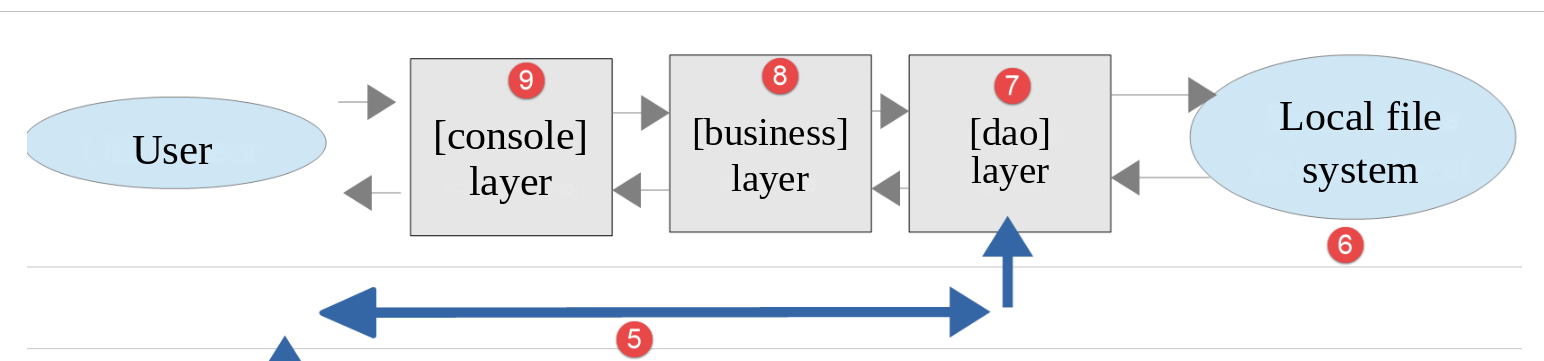
This architecture will be implemented by the following files:
| scripts-console/tax/version-09
├── Dao
│ └── ClientDao.php
├── Data
│ ├── config-client-ko.json
│ ├── config-client.json
│ ├── errors.json
│ ├── results.json
│ └── taxpayersdata.json
├── Main
│ └── MainTaxClient.php
└── Tests
└── ClientBusinessTest.php
|
In the new version, the only changes are:
- the configuration file [config-client.json];
- the client layer [dao].
The script [MainTaxClient.php] is the one from version 8.
19.2.1. The [dao] layer
The [dao] layer has changed as follows:
| <?php
declare(strict_types=1);
// namespace
namespace Application;
// Symfony dependencies
use Symfony\Component\HttpClient\HttpClient;
use Symfony\Contracts\HttpClient\Exception\ExceptionInterface;
use Symfony\Contracts\HttpClient\HttpClientInterface;
// the [dao] layer of the client: an HTTP client of the tax calculation server that manages a session
class ClientDao implements InterfaceClientDao
{
// the trait of version 5 implements the [getTaxPayersData] and [saveResults] methods of the interface
use TraitDao;
// the HTTP client
private readonly HttpClientInterface $httpClient;
// the session cookie (null as long as the server has not sent it)
private ?string $sessionCookie = null;
// constructor
// $urlServer: the URL of the tax calculation server
// $user: the user who makes the requests, array [login, passwd]
// $httpClientOptions: additional options of the HTTP client (verify_peer, verify_host...)
public function __construct(
private readonly string $urlServer,
#[\SensitiveParameter] private readonly array $user,
array $httpClientOptions = [],
) {
// the HTTP client: the credentials of the user will only be sent with the 1st request
$this->httpClient = HttpClient::create($httpClientOptions);
}
// tax calculation by the server
#[\Override]
public function calculateTax(string $married, int $children, int $salary): array
{
// the options of the request: the parameters expected by the server
$options = [
"query" => [
"married" => $married,
"children" => $children,
"salary" => $salary,
],
];
if ($this->sessionCookie === null) {
// no session yet: we send the credentials of the user
$options["auth_basic"] = [$this->user["login"], $this->user["passwd"]];
} else {
// we send the session cookie: the user is already authenticated in this session
$options["headers"] = ["Cookie" => $this->sessionCookie];
}
try {
// we make the request to the server
$response = $this->httpClient->request("GET", $this->urlServer, $options);
// the status, the headers and the JSON document of the response, even in case of error (parameter false)
$statusCode = $response->getStatusCode();
$headers = $response->getHeaders(false);
$json = $response->getContent(false);
} catch (ExceptionInterface $ex) {
// the server could not be reached
throw new TaxException("Error communicating with the server ({$ex->getMessage()})", 40, $ex);
}
// logs
// print "$json\n";
// the server sends the JSON string of an array ["response" => something]
try {
$serverResponse = json_decode($json, true, flags: JSON_THROW_ON_ERROR)["response"] ?? null;
} catch (\JsonException $ex) {
$serverResponse = null;
}
if (!is_array($serverResponse)) {
throw new TaxException("Invalid server response [$json]", 41);
}
// error?
if ($statusCode !== 200) {
// we throw an exception whose message is the server's response completed by its HTTP status
$message = json_encode(
["HTTP status" => $statusCode] + $serverResponse,
JSON_UNESCAPED_UNICODE | JSON_UNESCAPED_SLASHES | JSON_THROW_ON_ERROR
);
throw new TaxException($message, 42);
}
// we retrieve the session cookie if it is not known yet
if ($this->sessionCookie === null) {
foreach ($headers["set-cookie"] ?? [] as $cookie) {
if (preg_match('/^PHPSESSID=(.+?);/', $cookie, $fields) === 1) {
$this->sessionCookie = "PHPSESSID=$fields[1]";
}
}
}
// we return the response: the array [tax, surcharge, discount, reduction, rate]
return $serverResponse;
}
}
|
Comments
The change to the [dao] layer now involves managing a session:
- line 22: the session cookie. Its value is [null] until the server sends it. This attribute is not [readonly]: its value changes after the first request;
- line 30: the user’s credentials are now stored in an attribute, since they are no longer sent with every request;
- line 34: The client HTTP is created without the option [auth_basic];
- lines 49–51: During the first request, the cookie does not exist; therefore, the request is sent to the server along with the authentication information. The option [auth_basic] is now part of the request itself, rather than part of the client HTTP;
- lines 52–55: For subsequent requests, the session cookie is normally present. In this case, the authentication information is not sent; instead, the cookie is sent in the header HTTP [Cookie];
- line 61: We retrieve the response headers. As with [getContent], the parameter [false] prevents an exception if the response status indicates an error;
- Lines 88–94: The server’s response to the first request includes a session cookie in a [Set-Cookie] header. We retrieve it as described in the previous chapter and store it in the [$sessionCookie] attribute.
We could have kept the old version of the [dao] layer and performed authentication on every request, since the cost of doing so is negligible. For educational purposes, however, we wanted to demonstrate how a HTTP client can manage a session.
19.2.2. The configuration file
The JSON configuration file changes as follows:
| {
"urlServer": "http://localhost/php8-oct-2026/scripts-web/tax/version-09/tax-server.php",
"user": {
"login": "admin",
"passwd": "admin"
},
"httpClientOptions": {
"verify_peer": false,
"verify_host": false
},
"taxPayersDataFilename": "Data/taxpayersdata.json",
"resultsFilename": "Data/results.json",
"errorsFilename": "Data/errors.json",
"dependencies": [
"../version-05/Entities/TaxException.php",
"../version-05/Entities/TaxPayerData.php",
"../version-05/Utilities/Utilities.php",
"../version-05/Dao/TraitDao.php",
"../version-08/Dao/InterfaceClientDao.php",
"Dao/ClientDao.php",
"../version-08/Business/InterfaceClientBusiness.php",
"../version-08/Business/ClientBusiness.php"
]
}
|
- line 2: the URL from the version 9 server;
- lines 14–23: only the [dao] layer is new. The other files are from versions 5 and 8.
19.3. Some tests
For these tests, the Apache server, the MySQL DBMS, and the mail server [Mailpit] must be running.
19.3.1. Test 1
First, we run the client in an error-free environment:
| > php MainTaxClient.php
The results have been saved in the file [Data/results.json]
Done
|
The results are the same as in previous versions. But now, on the server side, there is a log file named [Data/logs.txt]:
| 01/10/26 18:08:11.971 : ---new request
01/10/26 18:08:11.972 : Authentication in progress…
01/10/26 18:08:11.972 : Authentication successful [admin]
01/10/26 18:08:11.972 : valid parameters ['married'=>yes, 'children'=>2, 'salary'=>55555]
01/10/26 18:08:11.972 : tax data taken from the database
01/10/26 18:08:11.973 : {"response":{"tax":2814,"surcharge":0,"discount":0,"reduction":0,"rate":0.14}}
01/10/26 18:08:11.976 : ---new request
01/10/26 18:08:11.977 : Authentication taken from the session…
01/10/26 18:08:11.977 : valid parameters ['married'=>yes, 'children'=>2, 'salary'=>50000]
01/10/26 18:08:11.977 : tax data taken from the session
01/10/26 18:08:11.977 : {"response":{"tax":1384,"surcharge":0,"discount":384,"reduction":347,"rate":0.14}}
01/10/26 18:08:11.979 : ---new request
01/10/26 18:08:11.979 : Authentication taken from the session…
01/10/26 18:08:11.979 : valid parameters ['married'=>yes, 'children'=>3, 'salary'=>50000]
01/10/26 18:08:11.980 : tax data taken from the session
01/10/26 18:08:11.980 : {"response":{"tax":0,"surcharge":0,"discount":720,"reduction":0,"rate":0.14}}
…
|
- Lines 1–6: During the first request, authentication occurs and data is retrieved from the database;
- Lines 7–11: During the next request, there is no authentication, and the data is retrieved from the session. This pattern repeats for subsequent requests (lines 12 and beyond).
19.3.2. Test 2
Now, let's simulate a failure of the MySQL DBMS as in version 8 (port 3307 in the [version-08/Data/database-mysql.json] file). On the client side, we get the following console output:
| > php MainTaxClient.php
Error no. 42: {"HTTP status":500,"error":"Database access error (SQLSTATE[HY000] [2002] Connection refused)"}
Done
|
On the server side, we see the following logs:
| 01/10/26 18:06:48.367 : ---new request
01/10/26 18:06:48.367 : Authentication in progress…
01/10/26 18:06:48.367 : Authentication successful [admin]
01/10/26 18:06:48.367 : valid parameters ['married'=>yes, 'children'=>2, 'salary'=>55555]
01/10/26 18:06:48.367 : tax data taken from the database
01/10/26 18:06:48.450 : Message [Database access error (SQLSTATE[HY000] [2002] Connection refused)] sent to guest@localhost
01/10/26 18:06:48.450 : {"response":{"error":"Database access error (SQLSTATE[HY000] [2002] Connection refused)"}}
|
- Line 6: the email sent to the administrator;
- line 7: the response sent to the client.
The web interface for [Mailpit] [http://localhost:8025] shows the email received by the administrator:
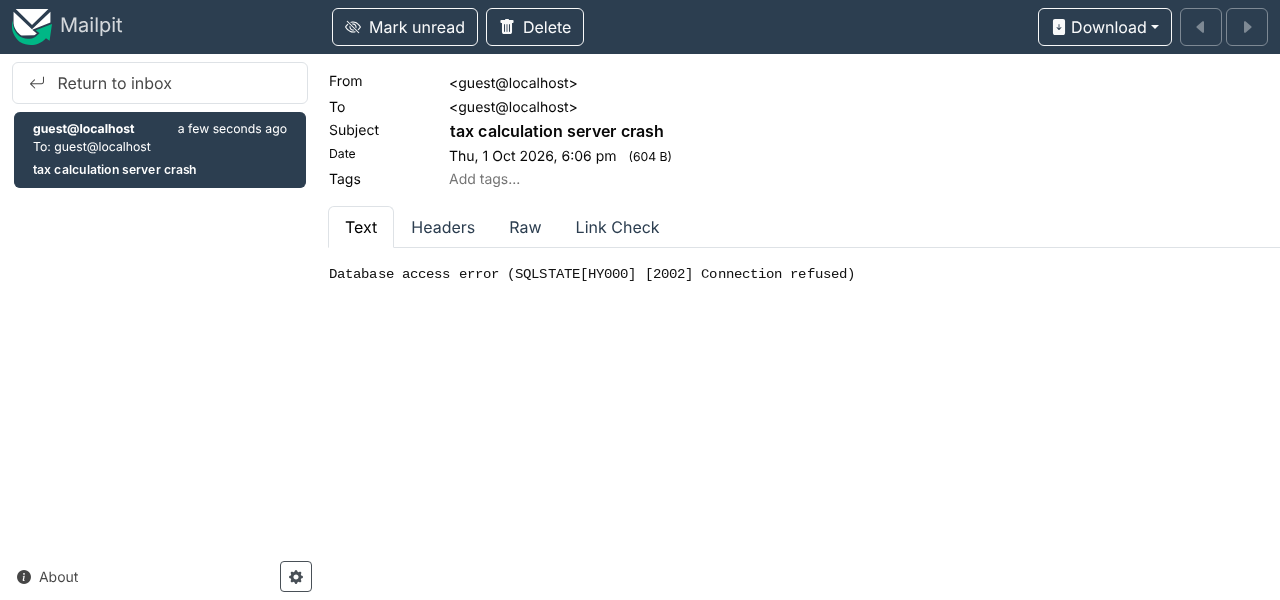
The PHP 7 course read this email using the [imap-03.php] script from the chapter on network functions. This can still be done using the POP3 server from [Mailpit]. The [Raw] tab in [Mailpit] displays the plain text of the email:
| Return-Path: <guest@localhost>
Received: from [127.0.0.1] (localhost [127.0.0.1])
by vm (Mailpit) with SMTP
for <guest@localhost>; Thu, 1 Oct 2026 18:06:48 +0200 (CEST)
From: guest@localhost
To: guest@localhost
Subject: tax calculation server crash
Message-ID: <abc3d7c0b4e68b2d5e70d6710a13a897@localhost>
MIME-Version: 1.0
Date: Thu, 01 Oct 2026 18:06:48 +0200
Content-Type: text/plain; charset=utf-8
Content-Transfer-Encoding: quoted-printable
Database access error (SQLSTATE[HY000] [2002] =
Connection refused)
|
- line 7: the subject contains only ASCII characters, so it is not encoded (a subject containing non-ASCII characters would be encoded according to RFC 2047);
- Lines 11–12: The email text is in UTF-8, encoded in [quoted-printable]: non-ASCII characters would be encoded (for example, [è] becomes [=C3=A8]), and the character [=] at the end of line 14 indicates that the line continues onto the next one.
19.3.3. Test 3
Now, let’s ensure that the file [logs.txt] cannot be created. To do this, simply delete the file [Data/logs.txt] and create a folder named [Data/logs.txt] in its place. Once that’s done, let’s run the client. On the client side, we get the following console output:
| > php MainTaxClient.php
Error no. 42: {"HTTP status":500,"error":"Failed to create the log file [Data/logs.txt]"}
Done
|
On the server side, there are no logs, but the administrator receives the following email:
| Return-Path: <guest@localhost>
Received: from [127.0.0.1] (localhost [127.0.0.1])
by vm (Mailpit) with SMTP
for <guest@localhost>; Thu, 1 Oct 2026 18:07:32 +0200 (CEST)
From: guest@localhost
To: guest@localhost
Subject: tax calculation server crash
Message-ID: <4ec9aec48972386b80bbcbb0e2967dfd@localhost>
MIME-Version: 1.0
Date: Thu, 01 Oct 2026 18:07:32 +0200
Content-Type: text/plain; charset=utf-8
Content-Transfer-Encoding: quoted-printable
Failed to create the log file [Data/logs.txt]
|
We then delete the [Data/logs.txt] folder.
19.3.4. Test 4
This time, let’s use the configuration [config-client-ko.json], which provides the client with incorrect credentials. The client displays the following console output:
| > php MainTaxClient.php config-client-ko.json
Error no. 42: {"HTTP status":401,"error":"Authentication failed [x]"}
Done
|
On the server side, the following logs appear:
| 01/10/26 18:07:08.838 : ---new request
01/10/26 18:07:08.838 : Authentication in progress…
01/10/26 18:07:08.839 : {"response":{"error":"Authentication failed [x]"}}
|
19.3.5. Test 5
Now, let’s request URL and [http://localhost/php8-oct-2026/scripts-web/tax/version-09/tax-server.php] from the server without passing any parameters:
| > curl -u admin:admin http://localhost/php8-oct-2026/scripts-web/tax/version-09/tax-server.php
{"response":{"errors":["GET method required with only the parameters [married, children, salary]","missing married parameter","missing children parameter","missing salary parameter"]}}
|
In the server's [logs.txt] log file, we see the following lines:
| 01/10/26 18:07:08.894 : ---new request
01/10/26 18:07:08.894 : Authentication in progress…
01/10/26 18:07:08.894 : Authentication successful [admin]
01/10/26 18:07:08.895 : {"response":{"errors":["GET method required with only the parameters [married, children, salary]","missing married parameter","missing children parameter","missing salary parameter"]}}
|
19.4. [PHPUnit] Tests
As we did for previous versions, we will run the [PHPUnit] test from the [business] layer of the client, [Tests/ClientBusinessTest.php]. Compared to the test class in version 8, nothing has changed: the test builds its environment from the version 9 client configuration file, located in the [Data] folder of that version.
The test results are as follows:
| > php vendor/bin/phpunit scripts-console/tax/version-09/Tests --testdox
PHPUnit 12.5.37 by Sebastian Bergmann and contributors.
Runtime: PHP 8.5.11
Configuration: .../php8-oct-2026/phpunit.xml
........... 11 / 11 (100%)
Time: 00:00.063, Memory: 16.00 MB
Client Business (Application\Tests\ClientBusiness)
✔ Calculate tax with data set "couple, 2 children, 55555"
✔ Calculate tax with data set "couple, 2 children, 50000"
✔ Calculate tax with data set "couple, 3 children, 50000"
✔ Calculate tax with data set "single, 2 children, 100000"
✔ Calculate tax with data set "single, 3 children, 100000"
✔ Calculate tax with data set "couple, 3 children, 100000"
✔ Calculate tax with data set "couple, 5 children, 100000"
✔ Calculate tax with data set "single, 0 children, 100000"
✔ Calculate tax with data set "couple, 2 children, 30000"
✔ Calculate tax with data set "single, 0 children, 200000"
✔ Calculate tax with data set "couple, 3 children, 200000"
OK (11 tests, 22 assertions)
|
It’s worth taking a look at the logs for the [logs.txt] server:
| 01/10/26 18:08:07.348 : ---new request
01/10/26 18:08:07.348 : Authentication in progress…
01/10/26 18:08:07.348 : Authentication successful [admin]
01/10/26 18:08:07.348 : valid parameters ['married'=>yes, 'children'=>2, 'salary'=>55555]
01/10/26 18:08:07.348 : tax data taken from the database
01/10/26 18:08:07.349 : {"response":{"tax":2814,"surcharge":0,"discount":0,"reduction":0,"rate":0.14}}
01/10/26 18:08:07.354 : ---new request
01/10/26 18:08:07.354 : Authentication in progress…
01/10/26 18:08:07.354 : Authentication successful [admin]
01/10/26 18:08:07.354 : valid parameters ['married'=>yes, 'children'=>2, 'salary'=>50000]
01/10/26 18:08:07.354 : tax data taken from the database
01/10/26 18:08:07.355 : {"response":{"tax":1384,"surcharge":0,"discount":384,"reduction":347,"rate":0.14}}
01/10/26 18:08:07.359 : ---new request
01/10/26 18:08:07.359 : Authentication in progress…
01/10/26 18:08:07.359 : Authentication successful [admin]
01/10/26 18:08:07.359 : valid parameters ['married'=>yes, 'children'=>3, 'salary'=>50000]
01/10/26 18:08:07.359 : tax data taken from the database
01/10/26 18:08:07.360 : {"response":{"tax":0,"surcharge":0,"discount":720,"reduction":0,"rate":0.14}}
…
01/10/26 18:08:07.397 : ---new request
01/10/26 18:08:07.397 : Authentication in progress…
01/10/26 18:08:07.397 : Authentication successful [admin]
01/10/26 18:08:07.397 : valid parameters ['married'=>yes, 'children'=>3, 'salary'=>200000]
01/10/26 18:08:07.397 : tax data taken from the database
01/10/26 18:08:07.398 : {"response":{"tax":42842,"surcharge":17283,"discount":0,"reduction":0,"rate":0.41}}
|
We can see that the tax administration data is always retrieved from the database and never from the session. Let’s return to the code of the test that was run:
| // executed before each test
#[\Override]
protected function setUp(): void
{
// creation of the [dao] and [business] layers as in the main script
$clientDao = new ClientDao(self::$config["urlServer"], self::$config["user"], self::$config["httpClientOptions"]);
$this->business = new ClientBusiness($clientDao);
}
|
- Line 41: The [setUp] method is executed before each test. A new [ClientDao] is therefore created for each test, with a session cookie [null]. This explains why this client does not benefit from any session: it’s as if the 11 tests were performed by 11 different users.
This example shows that the session is not the right place to store tax administration data. Indeed, this data is shared by all users of the application. However, in this case, it is duplicated in each of their sessions.
In web programming, there are three types of visibility for shared data:
- data shared by all users of the web application. This is generally read-only data. PHP does not natively support this type of storage: each request is executed by a script that starts with an empty memory;
- data shared among requests from the same client. This data is stored in the session. We refer to this as the client session to denote the client’s memory. All requests from a client have access to this session. They can store and read information there. In the previous scripts, this session is implemented by the Symfony object [HttpFoundation\Session\Session];
- the request context. A user's request can be processed through several successive actions. The request context allows action 1 to pass information to action 2. With [HttpFoundation], the request is implemented by the object [Request], and its context is implemented by its attribute [attributes].
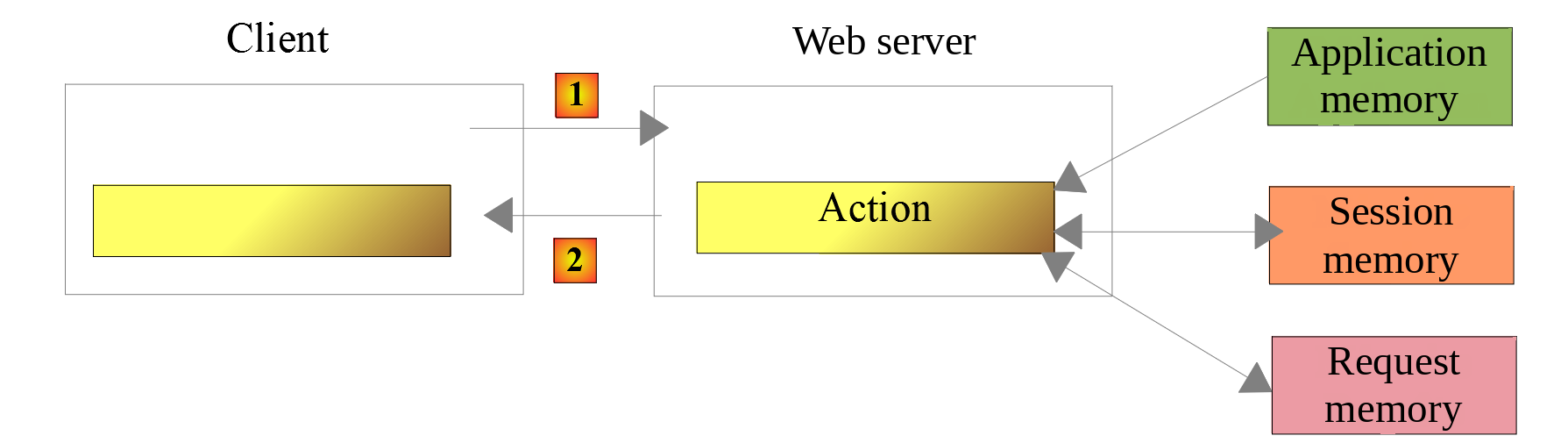
Tools are available to assign application memory to PHP. The new version of the application exercise demonstrates the use of one such tool.