1. Introduction
1.1. Objective
The PDF version of the document is available |HERE|.
The examples in the document are available |HERE|.
Entity Framework is an ORM (Object-Relational Mapper) originally created by Microsoft and now available as open source. In a course, I use the following architecture for a certain web application:
 |
The NHibernate [http://sourceforge.net/projects/nhibernate/] framework is a ORM that predates Entity Framework. It is a mature product that allows you to connect to various databases. The ORM isolates the [DAO] layer (Data Access Objects) from the ADO.NET connector. It is the ORM that issues SQL commands to the connector. The [DAO] layer, in turn, uses the interface provided by the ORM. This layer depends on ORM. Therefore, changing ORM requires changing the [DAO] layer.
This architecture is resilient to changes in SGBD.
When the [DAO] layer is connected directly to the ADO.NET connector, changing SGBD affects the [DAO] layer:
- the SGBD layers do not all have the same data types;
- the SGBD do not have the same primary key generation strategies;
- the SGBDs contain proprietary SQLs;
- the [DAO] layer may have used libraries linked to a specific SGBD;
- ...
When a ORM is linked to the ADO.NET, changing from SGBD is equivalent to changing the configuration of ORM to adapt it to the new SGBD. The [DAO] layer does not change.
The Spring.NET [http://www.springframework.net/index.html] framework ensures the integration of an application’s layers. Above:
- the ASP.NET application requests a reference to the [DAO] layer from Spring;
- Spring uses a configuration file to create this layer and return the reference.
This architecture handles layer changes well as long as the layers continue to present the same interface. Changing the [DAO] layer above involves modifying the Spring configuration file so that the new layer is instantiated in place of the old one. Since these layers implement the same interface and the ASP.NET layer uses this interface, the ASP.NET layer remains unchanged.
This results in a flexible and scalable architecture. To demonstrate this, we will replace ORM and NHibernate with Entity Framework 5:
 |
We will proceed in several steps:
- we will explore Entity Framework 5 using several SGBD;
- we will build the [DAO2] layer;
- we will connect the existing ASP.NET application to this new [DAO] layer.
1.2. Tools used
The tests were performed on a laptop HP EliteBook running Windows 7 Pro, with an Intel Core i7 processor and 8 GB of RAM. We will use C# as the development language.
This document uses the following tools, all of which are available for free:
Development tools:
- Visual Studio Express for Desktop 2012 [http://www.microsoft.com/visualstudio/fra/downloads];
- Visual Studio Express for Web 2012 [http://www.microsoft.com/visualstudio/fra/downloads].
SGBD SQL Server Express 2012:
- SGBD: [http://www.microsoft.com/fr-fr/download/details.aspx?id=29062];
- an administration tool: EMS SQL Manager for SQL Server Freeware [http://www.sqlmanager.net/fr/products/mssql/manager/download].
SGBD Oracle Database Express Edition 11g Release 2:
- SGBD: [http://www.oracle.com/technetwork/products/express-edition/downloads/index.html];
- an administration tool: EMS SQL Manager for Oracle Freeware [http://www.sqlmanager.net/fr/products/oracle/manager/download];
- an Oracle client for .NET: ODAC 11.2 Release 5 (11.2.0.3.20) with Oracle Developer Tools for Visual Studio: [http://www.oracle.com/technetwork/developer-tools/visual-studio/downloads/index.html].
SGBD MySQL 5.5.28:
- SGBD: [http://dev.mysql.com/downloads/];
- an administration tool: EMS SQL Manager for MySQL Freeware [http://www.sqlmanager.net/fr/products/mysql/manager/download].
SGBD PostgreSQL 9.2.1:
- SGBD: [http://www.enterprisedb.com/products-services-training/pgdownload#windows];
- an administration tool: EMS SQL Manager for PostgreSQL Freeware [http://www.sqlmanager.net/fr/products/postgresql/manager/download].
SGBD Firebird 2.1:
- SGBD: [http://www.firebirdsql.org/en/firebird-2-1-5/];
- an administration tool: EMS SQL Manager for InterBase/Firebird Freeware [http://www.sqlmanager.net/fr/products/ibfb/manager/download].
LINQPad 4: a learning tool for LINQ (Language INtegrated Query) [http://www.linqpad.net/, http://www.linqpad.net/GetFile.aspx?LINQPad4.zip].
1.3. Source codes
The source code for the following examples is available [HERE].
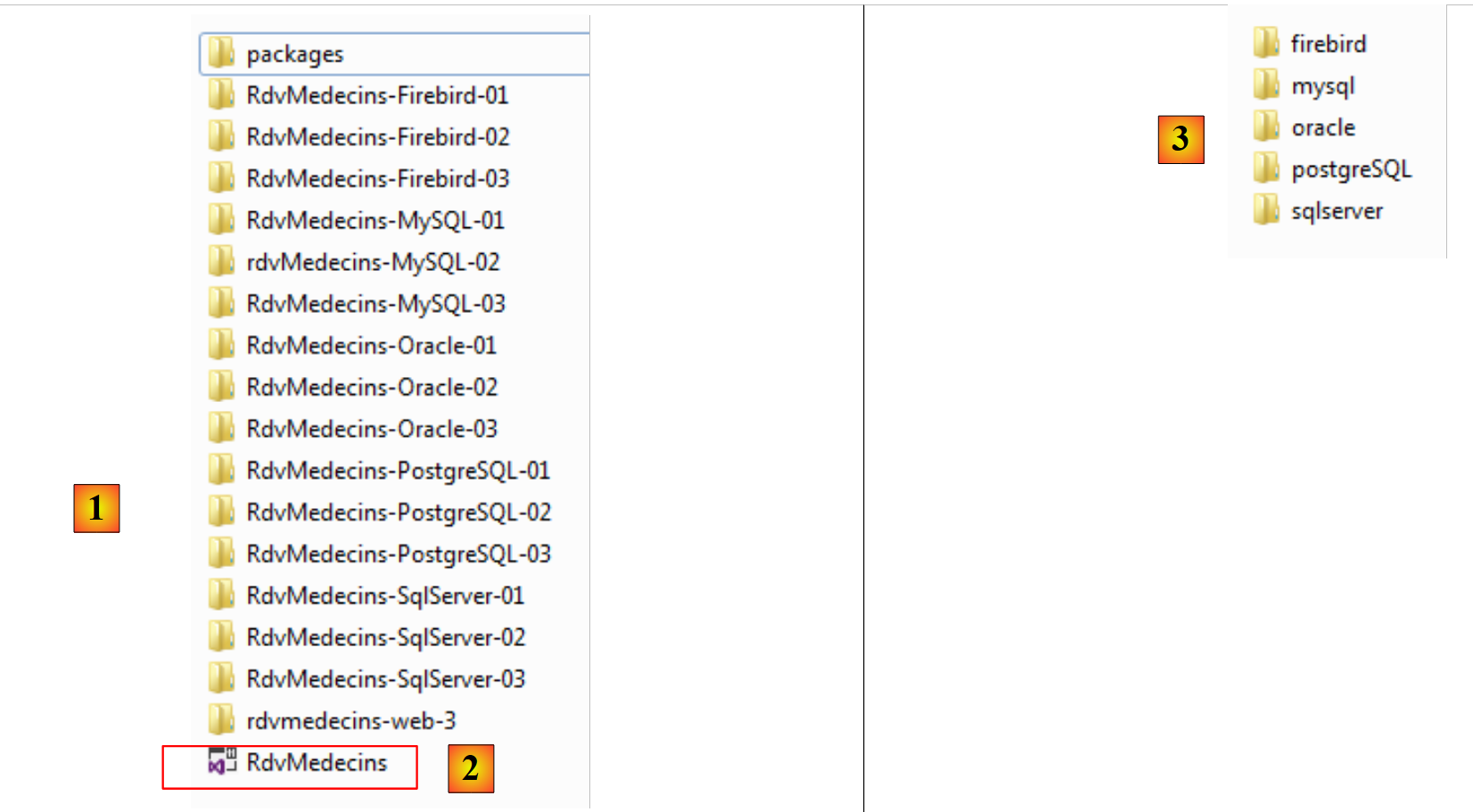 |
These are Visual Studio 2012 projects [1], grouped into a solution [2]. In a folder named [databases], you will find a folder for each SGBD used. There you will find the SQL scripts for generating the sample database for these SGBD.
1.4. The method
To learn about Entity Framework 5 (First), I started with the following book: "Professional ASP.NET MVC 3" by Jon Galloway, Phil Haack, Brad Wilson, and Scott Allen, published by Wrox. In the book’s sample application, the authors use Entity Framework (EF) as ORM. Since I wasn’t familiar with it, I browsed through net to learn more. I discovered that the most recent version of version was EF 5 and thatthere were incompatibilities with EF 4 because the code from the book tested with EF 5 produced compilation errors.
I then discovered that there were several ways to use EF:
- Model First: there are many articles on this approach to EF, for example [http://msdn.microsoft.com/en-us/data/ff830362.aspx]. This article begins as follows:
Summary: In this paper, we’ll look at the new Entity Framework 4 that ships with .NET Framework 4 and Visual Studio 2010. I’ll discuss how you can approach its usage from a model-first perspective, based on the premise that you can drive database design from a model and build both your database as and your as access layer declaratively from this model. The model contains the description of your represented entities and relationships, providing a powerful approach to working with ADO.NET, creating a separation of concerns through an abstraction between a model definition and its implementation.
A ORM acts as a bridge between database tables and classes.
 |
Above,
- to the left of the EF5 layer, we have objects, which are called entities;
- to the right of the EF5 layer, we have database tables.
 |
The [DAO] layer works with objects representing database tables. These objects are grouped within a persistence context and are called entities (Entity). Changes made to the entities are reflected, via ORM, in the database tables (insertion, modification, deletion). In addition, the [DAO] layer features a query language called LINQ to Entity (INtegrated Query Language) that queries entities rather than tables. The First model method involves building entities using a graphical tool. Each entity and the relationships linking it to others are defined. Once this is done, a tool generates:
- the various classes reflecting the entities built graphically;
- the DDL (Data Definition Language) used to generate the database.
The examples I found for this method all used Visual Studio 2010 Professional and a template called ADO.NET Entity Data Model. I was able to test this model with Visual Studio 2010 Professional, but when I switched to Visual Studio Express 2012—which was my target—I found that this model was no longer available. So I abandoned this approach.
- Database First: The starting point for this method is an existing database. From there, a tool automatically generates the image entities for the database tables. Again, the examples I found, such as [http://msdn.microsoft.com/en-us/data/gg685489.aspx], use Visual Studio 2010 Professional and the ADO.NET Entity and Data Model templates. So I also abandoned this approach, even though it was my preferred one. To determine which entities to use as representations of an existing database, it was straightforward to start with a tool that generates them.
- Code First: you write the classes that will form the entities yourself. This requires a basic understanding of how EF works. This is the approach I took because it was compatible with Visual Studio Express 2012.
With that in mind, I proceeded as follows:
- I wrote code for SQL Server Express 2012 because that is the version for which the most examples are available;
- once this code was debugged, I ported it to the other SGBD versions (Firebird, Oracle, MySQL, PostgreSQL).
Here, we will proceed differently. I will first describe all the code for SQL Server, then I will describe how it was ported to the other SGBD files. In this port, the following adjustments were made:
- the databases have proprietary features. In particular, I used triggers to automatically generate the content of certain columns. Each SGBD has its own way of handling this;
- the image entities in the tables may change, but this is intentional. I could have chosen entities suitable for all databases;
- The ADO.NET driver for SGBD changes;
- the connection string for SGBD changes.
The procedure is as follows:
- mapping entities to the database. Populating the database;
- dump the database using LINQ queries;
- LINQPad, a learning tool for LINQ;
- adding, deleting, and modifying entities;
- access concurrency management;
- persistence context saved in a transaction;
- modifying an entity outside the persistence context;
- Eager and Lazy loading;
- building the [DAO] layer;
- construction of the ASP.NET web layer.
1.5. Target Audience
The target audience is beginners.
This document is not a course on Entity Framework 5 Code First. For that, you might want to read, for example, "Programming Entity Framework: Code First" by Julie Lerman and Rowan Miller, published by O'Reilly. This document does not aim to be exhaustive but simply outlines the approach I used to understand this ORM. I believe this approach may be useful to others working with EF5. My objective does not extend beyond this scope.
1.6. Related articles on developpez.com
The book cited above will serve as a reference. There are also articles dedicated to Entity Framework on developpez.com. Here are a few of them:
- "Entity Framework – The Code Approach," June 2012 – by Reward. This article and the present document partially overlap. However, it goes further on certain points, particularly regarding class <--> table inheritance mapping;
- "Introduction to Entity Framework," December 2008, by Paul Musso;
- "Creating a Class Model with Entity Framework," April 2009, by Jérôme Lambert;
- "Performance Measurement of Linq to SQL Compared to Sql and Entity Framework," June 2011, by Immobilis;
- "Entity Framework Code First: Enabling Automatic Migration," June 2012, by Hinault Romaric;
- "Creating a CRUD Application with WebMatrix, Razor, and Entity Framework," May 2012, by Hinault Romaric;
- "Entity Framework: Exploring Code First Migrations," June 2012, by Hinault Romaric;
As noted above, this document is not exhaustive. Readers will benefit from consulting the articles listed above to fill in certain gaps. My research may have been incomplete. I apologize to any authors I may have overlooked.