13. Esercizio [Calcolo delle imposte] con un servizio web
Torniamo all'esercizio [IMPOSTE] già trattato nelle sezioni 4.2, 4.3, 8 e 10.
13.1. Il server
Stiamo lavorando nell'ambito della seguente architettura client-server:
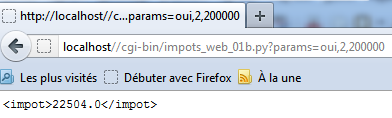
Sul lato server, utilizzeremo nuovamente un'architettura a tre livelli. Il livello [DAO] sarà implementato dalla classe ImpotsMySQL utilizzata nella versione con il DBMS MySQL nella sezione 10. Il livello [business] sarà implementato dalla classe [ImpotsMetier] già studiata. Non resta che scrivere il servizio web. Questo servizio riceve dai propri clienti un parametro params nella forma params= yes,2,200000, dove il primo elemento indica se il contribuente è sposato o meno, il secondo il numero di figli e il terzo lo stipendio annuo.
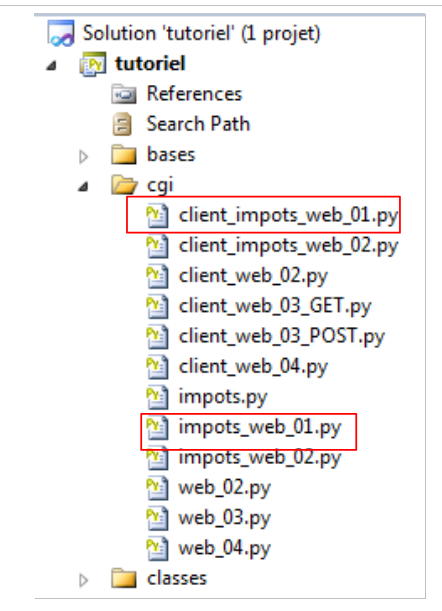
Il servizio web è il seguente (impots_web_01):
| # !D:\Programs\ActivePython\Python2.7.2\python.exe
# -*- coding=Utf-8 -*-
# import of Impots* class module
from impots import *
import cgi,cgitb,re
# allow debugging information to be displayed
cgitb.enable()
sys.stderr=sys.stdout
# ------------------------------------------------
# tax web service
# ------------------------------------------------
# the data required to calculate the tax has been placed in table mysqL TABLE
# belonging to the BASE database. The table has the following structure
# limits decimal(10,2), coeffR decimal(6,2), coeffN decimal(10,2)
# taxable person parameters (marital status, number of children, annual salary)
# are sent by the customer in the form params=marital status, number of children, annual salary
# results (marital status, number of children, annual salary, tax payable) are returned to the customer
# in the form <impot>value</impot>
# or as <error>msg</error>, if parameters are invalid
# the server returns unformatted text to the client
print "Content-Type: text/plain\n"
# definition of constants
USER="root"
PWD=""
HOTE="localhost"
BASE="dbimpots"
TABLE="impots"
# we create the [metier] layer
# Python doesn't seem to support sessions
# in PHP, we would have used a session to memorize the metier object
# here, it is systematically constructed from data in the MySQL database
# instantiation layer [metier]
try:
metier=ImpotsMetier(ImpotsMySQL(HOTE,USER,PWD,BASE,TABLE))
except (IOError, ImpotsError) as infos:
print ("<erreur>Une erreur s'est produite : {0}</erreur>".format(infos))
sys.exit()
# retrieve the line sent by the client to the server
params=cgi.FieldStorage().getlist('params')
# if no parameters then error
if not params:
print "<erreur>Le parametre [params] est absent<erreur>"
sys.exit()
# we use the params parameter
items=params[0].strip().lower().split(',')
# there must be only 3 fields
if len(items)!=3:
print "<erreur>[%s] : nombre de parametres invalide</erreur>" % (params[0])
sys.exit()
# first parameter (marital status) must be yes/no
marie=items[0].strip()
if marie!="oui" and marie != "non":
print "<erreur>[%s] : 1er parametre invalide</erreur>\n"% (params[0])
sys.exit()
# the second parameter (number of children) must be an integer
match=re.match(r"^\s*(\d+)\s*$",items[1])
if not match:
print "<erreur>[%s] : 2ieme parametre invalide</erreur>\n"% (params[0])
sys.exit()
enfants=int(match.groups()[0])
# the third parameter (salary) must be an integer
match=re.match(r"^\s*(\d+)\s*$",items[2])
if not match:
print "<erreur>[%s] : 3ieme parametre invalide</erreur>\n"% (params[0])
sys.exit()
salaire=int(match.groups()[0])
# tax calculation
impot=metier.calculer(marie,enfants,salaire)
# return the result
print "<impot>%s</impot>\n" % (impot)
# end
|
Note:
- riga 5: importa gli oggetti dal file impots.py;
- riga 9: il debug di uno script CGI può essere problematico. Il modulo cgitb invia il motivo del crash in caso di errore. Per farlo, è necessario reindirizzare l'output di errore standard (sys.stderr) all'output standard (sys.stdout) (riga 10);
- riga 26: l'intestazione HTTP che specifica la natura del documento inviato, in questo caso testo non formattato. Il servizio web restituisce la sua risposta come una singola riga di testo:
- <error>message</error> se c'è un errore;
- <tax>value</tax> dove value è l'importo dell'imposta.
- riga 43: istanziazione dei livelli [dao] e [business];
- righe 44–46: se si verifica un errore di istanziazione, lo script invia la sua risposta e termina;
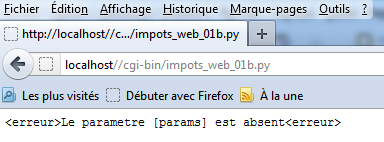
- righe 49-53: viene recuperato il parametro 'params'. Se manca, lo script invia la sua risposta e termina;
- riga 56: il parametro 'yes,2,200000' viene suddiviso in 3 campi nell'array items;
- righe 58-77: viene verificata la validità dei 3 campi. Se si verifica un errore, lo script invia la sua risposta e termina;
- riga 79: viene calcolata l'imposta;
- riga 81: e inviata al cliente.
In un browser web si ottengono i seguenti risultati:
13.2. Un client programmato
Il programma (client_impots_web_01)
| # -*- coding=utf-8 -*-
import httplib,urllib,re
# constant
HOST="localhost"
URL="/cgi-bin/impots_web_01b.py"
data=("oui,2,200000","non,2,200000","oui,3,200000","non,3,200000","x,y,z,t","x,2,200000", "oui,x,200000","oui,2,x");
# connection
connexion=httplib.HTTPConnection(HOST)
# follow-up
# connexion.set_debuglevel(1)
# loop over the data to be sent to the server
for params in data:
# parameters must be encoded before being sent to the server
parametres = urllib.urlencode({'params': params})
# send request
connexion.request("POST",URL,parametres)
# answer processing (text line)
reponse=connexion.getresponse().read()
lignes=reponse.split("\n")
# the text line is of the form
# <impot>xxx</impot>
# or <error>xxx</error>
impot=re.match(r"^<impot>(\S+)</impot>\s*$",lignes[0])
if impot:
print "params=%s, impot=%s" % (params,impot.groups()[0])
else:
erreur=re.match(r"^<erreur>(.+)</erreur>\s*$",lignes[0])
if erreur:
print "params=%s, erreur=%s" % (params,erreur.groups()[0])
else:
print lignes
# locking connection
connexion.close()
|
13.3. Risultati
| params=oui,2,200000, impot=22504.0
params=non,2,200000, impot=33388.0
params=oui,3,200000, impot=16400.0
params=non,3,200000, impot=22504.0
params=x,y,z,t, erreur=[x,y,z,t] : nombre de parametres invalide
params=x,2,200000, erreur=[x,2,200000] : 1er parametre invalide
params=oui,x,200000, erreur=[oui,x,200000] : 2ieme parametre invalide
params=oui,2,x, erreur=[oui,2,x] : 3ieme parametre invalide
|