7. A solution
7.1. The Visual Studio project
 |  |
Comments:
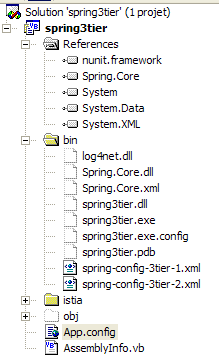
- The files required for Spring have been placed in the [bin] folder: Spring.Core.dll, log4net.dll, Spring.Core.xml
- The Spring configuration files [spring-config-3tier-*.xml] have also been placed in the [bin] folder
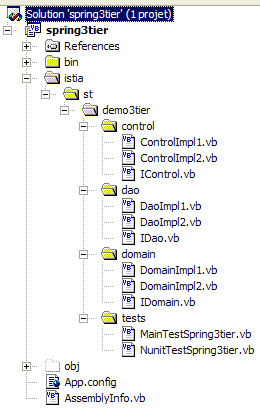
- under the root directory [istia], you will find the various classes of the application
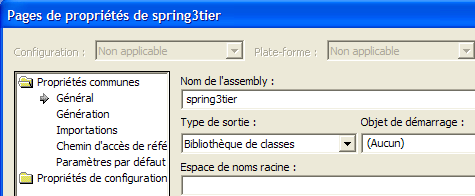
The project has been configured to generate DLL and [spring3tier.dll] in the [bin] folder:
7.2. The [istia.st.spring3tier.dao] package
The IDao interface:
Namespace istia.st.spring3tier.dao
    Public Interface IDao
         ' do something in the [dao] layer
        Function doSomethingInDaoLayer(ByVal a As Integer, ByVal b As Integer) As Integer
    End Interface
End Namespace
A first implementation class:
Namespace istia.st.spring3tier.dao
    Public Class DaoImpl1
        Implements istia.st.spring3tier.dao.IDao

         ' do something in the [dao] layer
        Public Function doSomethingInDaoLayer(ByVal a As Integer, ByVal b As Integer) As Integer Implements IDao.doSomethingInDaoLayer

            Return a + b
        End Function
    End Class

End Namespace
- The class has no private fields
- The [doSomethingInDaoLayer] method returns the sum of its parameters as requested.
A second implementation class:
Namespace istia.st.spring3tier.dao
    Public Class DaoImpl2
        Implements istia.st.spring3tier.dao.IDao

         ' do something in the [dao] layer
        Public Function doSomethingInDaoLayer(ByVal a As Integer, ByVal b As Integer) As Integer Implements IDao.doSomethingInDaoLayer

            Return a - b
        End Function
    End Class

End Namespace
- The class has no private fields
- The [doSomethingInDaoLayer] method returns the difference between its parameters as requested.
7.3. The package [istia.st.spring3tier.domain]
The IDomain interface:
Namespace istia.st.spring3tier.domain
    Public Interface IDomain
         ' do something in the [domain] layer
        Function doSomethingInDomainLayer(ByVal a As Integer, ByVal b As Integer) As Integer
    End Interface
End Namespace
A first implementation class IDomainImpl1:
Imports istia.st.spring3tier.dao

Namespace istia.st.spring3tier.domain
    Public Class DomainImpl1
        Implements istia.st.spring3tier.domain.IDomain

         ' private fields
        Private _dao As IDao

         ' associated property
        Public WriteOnly Property dao() As IDao
            Set(ByVal Value As IDao)
                _dao = Value
            End Set
        End Property

         ' default builder
        Public Sub New()
        End Sub

         ' do something in the [domain] layer
        Public Function doSomethingInDomainLayer(ByVal a As Integer, ByVal b As Integer) As Integer Implements IDomain.doSomethingInDomainLayer
            a += 1
            b += 1
            Return _dao.doSomethingInDaoLayer(a, b)
        End Function
    End Class

End Namespace
- The class has a private field that is a reference to the singleton of type [IDao], which provides access to the [Dao] layer. This field will be initialized by Spring (dependency injection) when the object is constructed.
- The [doSomethingInDomainLayer] method increments its parameters and then passes them to the [doSomethingInDaoLayer] method of the [dao] singleton
A second implementation class, IDomainImpl2:
Imports istia.st.spring3tier.dao

Namespace istia.st.spring3tier.domain
    Public Class DomainImpl2
        Implements istia.st.spring3tier.domain.IDomain

         ' private fields
        Private _dao As IDao

         ' associated property
        Public WriteOnly Property dao() As IDao
            Set(ByVal Value As IDao)
                _dao = Value
            End Set
        End Property

         ' default builder
        Public Sub New()
        End Sub

         ' do something in the [domain] layer
        Public Function doSomethingInDomainLayer(ByVal a As Integer, ByVal b As Integer) As Integer Implements IDomain.doSomethingInDomainLayer
            a -= 1
            b -= 1
            Return _dao.doSomethingInDaoLayer(a, b)
        End Function
    End Class

End Namespace
- The class has a private field that is a reference to the singleton of type [IDao], which provides access to the [Dao] layer. This field will be initialized by Spring (dependency injection) when the object is constructed.
- The [doSomethingInDomainLayer] method decrements its parameters and then passes them to the [doSomethingInDaoLayer] method of the [dao] singleton
7.4. The [istia.st.spring3tier.control] package
The IControl interface:
Namespace istia.st.spring3tier.control
    Public Interface IControl
         ' do something in the [control] layer
        Function doSomethingInControlLayer(ByVal a As Integer, ByVal b As Integer) As Integer
    End Interface
End Namespace
A first implementation class ControlImpl1:
Imports istia.st.spring3tier.domain

Namespace istia.st.spring3tier.control
    Public Class ControlImpl1
        Implements istia.st.spring3tier.control.IControl

         ' private fields
        Private _domain As IDomain

         ' associated property
        Public WriteOnly Property domain() As IDomain
            Set(ByVal Value As IDomain)
                _domain = Value
            End Set
        End Property

         ' default builder
        Public Sub New()
        End Sub

         ' do something in the [control] layer
        Public Function doSomethingInControlLayer(ByVal a As Integer, ByVal b As Integer) As Integer Implements IControl.doSomethingInControlLayer
            a += 1
            b += 1
            Return _domain.doSomethingInDomainLayer(a, b)
        End Function
    End Class

End Namespace
- The class has a private field that is a reference to the singleton of type [IDomain], which provides access to the [Domain] layer. This field will be initialized by Spring (dependency injection) when the object is constructed.
- The [doSomethingInControlLayer] method increments its parameters and then passes them to the [doSomethingInDomainLayer] method of the [domain] singleton
A second implementation class, IControlImpl2:
Imports istia.st.spring3tier.domain

Namespace istia.st.spring3tier.control
    Public Class ControlImpl2
        Implements istia.st.spring3tier.control.IControl

         ' private fields
        Private _domain As IDomain

         ' associated property
        Public WriteOnly Property domain() As IDomain
            Set(ByVal Value As IDomain)
                _domain = Value
            End Set
        End Property

         ' default builder
        Public Sub New()
        End Sub

         ' do something in the [control] layer
        Public Function doSomethingInControlLayer(ByVal a As Integer, ByVal b As Integer) As Integer Implements IControl.doSomethingInControlLayer
            a -= 1
            b -= 1
            Return _domain.doSomethingInDomainLayer(a, b)
        End Function
    End Class

End Namespace
- The class has a private field that is a reference to the singleton of type [IDomain], which provides access to the [Domain] layer. This field will be initialized by Spring (dependency injection) when the object is constructed.
- The [doSomethingInControlLayer] method decrements its parameters and then passes them to the [doSomethingInDomainLayer] method of the [domain] singleton.
7.5. The [Spring] configuration files
The [spring-config-3tier-1.xml] file uses version 1 of the implementations:
<?xml version="1.0" encoding="iso-8859-1" ?>
<!DOCTYPE objects PUBLIC "-//SPRING//DTD OBJECT//EN"
"http://www.springframework.net/dtd/spring-objects.dtd">
<objects>
     <!-- the dao class -->
    <object id="dao" type="istia.st.spring3tier.dao.DaoImpl1, spring3tier"></object>
     <!-- the domain class -->
    <object id="domain" type="istia.st.spring3tier.domain.DomainImpl1, spring3tier">
        <property name="dao">
            <ref object="dao" />
        </property>
    </object>
     <!-- the control class -->
    <object id="control" type="istia.st.spring3tier.control.ControlImpl1, spring3tier">
        <property name="domain">
            <ref object="domain" />
        </property>
    </object>
</objects>
The [spring-config-3tier-2.xml] file uses version 2 of the implementations:
<?xml version="1.0" encoding="iso-8859-1" ?>
<!DOCTYPE objects PUBLIC "-//SPRING//DTD OBJECT//EN"
"http://www.springframework.net/dtd/spring-objects.dtd">
<objects>
     <!-- the dao class -->
    <object id="dao" type="istia.st.spring3tier.dao.DaoImpl2, spring3tier"></object>
     <!-- the domain class -->
    <object id="domain" type="istia.st.spring3tier.domain.DomainImpl2, spring3tier">
        <property name="dao">
            <ref object="dao" />
        </property>
    </object>
     <!-- the control class -->
    <object id="control" type="istia.st.spring3tier.control.ControlImpl2, spring3tier">
        <property name="domain">
            <ref object="domain" />
        </property>
    </object>
</objects>
7.6. The [istia.st.spring3tier.tests] test suite
A NUnit test [NunitTestSpring3tier.vb]:
Imports System
Imports Spring.Objects.Factory.Xml
Imports System.IO
Imports NUnit.Framework
Imports istia.st.spring3tier.control
Imports istia.st.spring3tier.domain

Namespace istia.st.springioc.tests

    <TestFixture()> _
    Public Class NunitTestSpring3tier
         ' the singleton factories
        Private factory1 As XmlObjectFactory
        Private factory2 As XmlObjectFactory

        <SetUp()> _
        Public Sub init()
             ' singleton factories are created
            factory1 = New XmlObjectFactory(New FileStream("spring-config-3tier-1.xml", FileMode.Open))
            factory2 = New XmlObjectFactory(New FileStream("spring-config-3tier-2.xml", FileMode.Open))
        End Sub

        <TearDown()> _
        Public Sub destroy()
             ' we destroy the singletons
            factory1.Dispose()
            factory2.Dispose()
             ' we free the singletons factories
            factory1 = Nothing
            factory2 = Nothing
        End Sub

        <Test()> _
        Public Sub test()
             'we retrieve an implementation of the IControl interface
            Dim control1 As IControl = CType(factory1.GetObject("control"), IControl)
             ' we use the
            Dim a1 As Integer = 10, b1 As Integer = 20
            Dim res1 As Integer = control1.doSomethingInControlLayer(a1, b1)
            Assert.AreEqual(34, res1)
             ' we retrieve another implementation of the IControl interface
            Dim control2 As IControl = CType(factory2.GetObject("control"), IControl)
             ' we use the
            Dim a2 As Integer = 10, b2 As Integer = 20
            Dim res2 As Integer = control2.doSomethingInControlLayer(a2, b2)
            Assert.AreEqual(-10, res2)
        End Sub

    End Class
End Namespace
Running this test yields the following results:
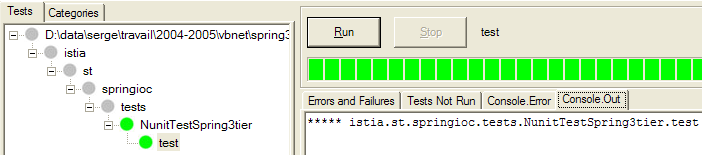
A reader viewing this document in version with colors will see that the results are "green," indicating that the test was successful.
7.7. Another type of Spring configuration file
A VB.net application can be configured using a file named [App.config]. This file is placed in the root of the Visual Studio project:
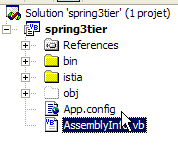
Spring can utilize this configuration file. Consider the following [App.config] file, inspired by examples from the [Spring.net] documentation:
<?xml version="1.0" encoding="iso-8859-1" ?>
<configuration>
    <configSections>
        <sectionGroup name="spring">
            <section name="context" type="Spring.Context.Support.ContextHandler, Spring.Core" />
            <section name="objects" type="Spring.Context.Support.DefaultSectionHandler, Spring.Core" />
        </sectionGroup>
    </configSections>
    <spring>
        <context type="Spring.Context.Support.XmlApplicationContext, Spring.Core">
            <resource uri="config://spring/objects" />
        </context>
        <objects>
             <!-- an initial configuration -->
             <!-- the dao class -->
            <object id="dao1" type="istia.st.spring3tier.dao.DaoImpl1, spring3tier"></object>
             <!-- the domain class -->
            <object id="domain1" type="istia.st.spring3tier.domain.DomainImpl1, spring3tier">
                <property name="dao">
                    <ref object="dao1" />
                </property>
            </object>
             <!-- the control class -->
            <object id="control1" type="istia.st.spring3tier.control.ControlImpl1, spring3tier">
                <property name="domain">
                    <ref object="domain1" />
                </property>
            </object>
             <!-- a second configuration -->
             <!-- the dao class -->
            <object id="dao2" type="istia.st.spring3tier.dao.DaoImpl2, spring3tier"></object>
             <!-- the domain class -->
            <object id="domain2" type="istia.st.spring3tier.domain.DomainImpl2, spring3tier">
                <property name="dao">
                    <ref object="dao2" />
                </property>
            </object>
             <!-- the control class -->
            <object id="control2" type="istia.st.spring3tier.control.ControlImpl2, spring3tier">
                <property name="domain">
                    <ref object="domain2" />
                </property>
            </object>
        </objects>
    </spring>
</configuration>
Note: The information below is provided with reservations. I am not sure I have correctly understood the meaning of all the elements in the configuration file above.
The XML syntax of the [App.config] file requires that it follow the syntax:
The management of the various sections of [App.config] can be delegated to external programs. This is what is done here in the [ConfigSections] section:
    <configSections>
        <sectionGroup name="spring">
            <section name="context" type="Spring.Context.Support.ContextHandler, Spring.Core" />
            <section name="objects" type="Spring.Context.Support.DefaultSectionHandler, Spring.Core" />
        </sectionGroup>
    </configSections>
The code above means that the section named [spring/context] must be managed by the class [Spring.Context.Support.ContextHandler], whichis found in the [Spring.Core.dll] assembly, and that the section named [spring/objects] must be handled by the [Spring.Context.Support.DefaultSectionHandler] class, which is also found in the [Spring.Core.dll] assembly.
The section [spring/context] is as follows:
    <spring>
        <context type="Spring.Context.Support.XmlApplicationContext, Spring.Core">
            <resource uri="config://spring/objects" />
        </context>
...
    </spring>
This appears to indicate that the [spring/objects] section of the configuration file must be managed by the [Spring.Context.Support.XmlApplicationHandler] class, which can be found in the [Spring.Core.dll] assembly. This class must use a resource named XML, located at [ config://spring/objects], c.a.d, and the [spring/objects] section of the current configuration file.
In the [spring/objects] section, we find the Spring syntax we are now familiar with.
In the <objects>... </objects> section of the [App.config] file, we have defined two possible configurations for our 3-tier application:
- one that uses version 1 of the interface implementations
- another that uses version 2 of these same implementations
Now, how do we use the [App.config] file?
The following code shows a console application that uses the previous [App.config] file:
Imports System
Imports Spring.Context
Imports System.IO
Imports NUnit.Framework
Imports istia.st.spring3tier.control
Imports istia.st.spring3tier.domain
Imports System.Configuration

Namespace istia.st.springioc.tests

    Module MainTestSpring3tier

        Public Sub main()
             ' the Spring context that will allow us to retrieve singletons
            Dim contexte As IApplicationContext = CType(ConfigurationSettings.GetConfig("spring/context"), IApplicationContext)
             ' we retrieve a 1st implementation of the IControl interface
            Dim control1 As IControl = CType(contexte.GetObject("control1"), IControl)
             ' we use the
            Dim a1 As Integer = 10, b1 As Integer = 20
            Console.WriteLine("res1({0},{1})={2}", a1, b1, control1.doSomethingInControlLayer(a1, b1))
             ' we retrieve another implementation of the IControl interface
            Dim control2 As IControl = CType(contexte.GetObject("control2"), IControl)
             ' we use the
            Dim a2 As Integer = 10, b2 As Integer = 20
            Console.WriteLine("res2({0},{1})={2}", a2, b2, control2.doSomethingInControlLayer(a2, b2))
             ' break
            Console.WriteLine("Tapez [entrée] pour continuer...")
            Console.ReadLine()
        End Sub

    End Module
End Namespace
Comments:
- In the NUnit examples we have used so far, we used a [XmlObjectFactory] object to obtain the singletons we needed. Here, the object used is of type [IApplicationContext], a Spring interface. It is obtained from [App.config] via the [ConfigurationSettings] class, a class traditionally used in .NET to process configuration files.
- We request the handler for the [spring/context] section. If we refer to the file [App.config], we find that it is of type [XmlApplicationContext] and that it is responsible for managing the section [spring/objects] of [App.config].
- Once the object of type [IApplicationContext] has been retrieved, it is used in the same way as the [XmlObjectFactory] object we have been using up to now.
The previous program is named [MainTestSpring3tier.vb] and is located in the [tests] package:
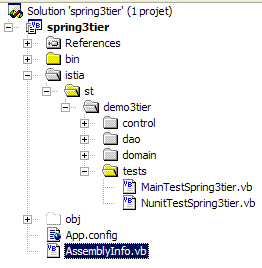
The [spring3tier] project is configured for [MainTestSpring3tier]:
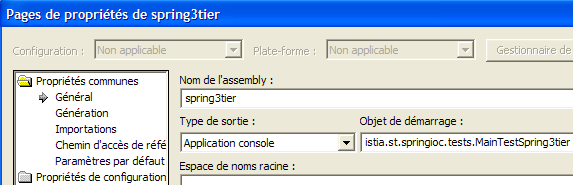
Running the project yields the following results:
7.8. Conclusion
The Spring framework offers true flexibility in both application architecture and configuration. We used the IoC concept, one of Spring’s two pillars. The other pillar is AOP (Aspect-Oriented Programming), which we have not covered. It allows you to add "behavior" to a class method through configuration without modifying the method’s code. In simple terms, AOP allows you to filter calls to certain methods:
 |
- the filter can be executed before or after the target method M, or both.
- The method M is unaware of these filters. They are defined in the Spring configuration file.
- The code of method M is not modified. Filters are Java classes to be constructed. Spring provides predefined filters, notably for managing SGBD transactions.
- Filters are beans and, as such, are defined in the Spring configuration file as beans.
A common filter is the transactional filter. Consider a method M in the business layer that performs two inseparable operations on data (a unit of work). It calls two methods, M1 and M2, in the DAO layer to perform these two operations.
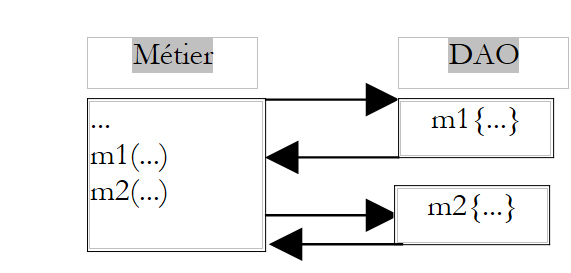 |
Because it is in the business layer, method M abstracts away the data storage. It does not, for example, need to assume that the data is in a SGBD or that it needs to place the two calls to methods M1 and M2 within a SGBD transaction. It is up to the DAO layer to handle these details. One solution to the previous problem is to create a method in the DAO layer that would itself call methods M1 and M2, calls that it would enclose within a SGBD transaction.
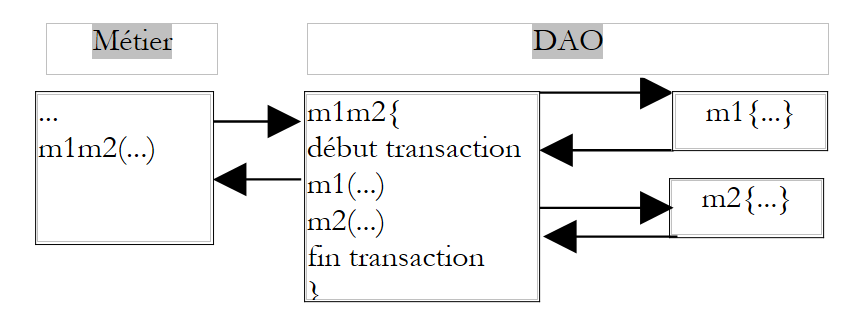 |
The AOP filtering solution is more flexible. It allows you to define a filter that, before calling M, will start a transaction and, after the call, will perform a commit or rollback as appropriate.
 |
There are several advantages to this approach:
- once the filter is defined, it can be applied to multiple methods, for example, all those that require a transaction
- the methods filtered in this way do not need to be rewritten
- since the filters to be used are defined by configuration, they can be changed
For more information: http://www.springframework.net.