3. Conclusion
We have presented the important concepts of Nhibernate. The sample code is available |ICI| in the form of two Visual Studio 2010 projects.
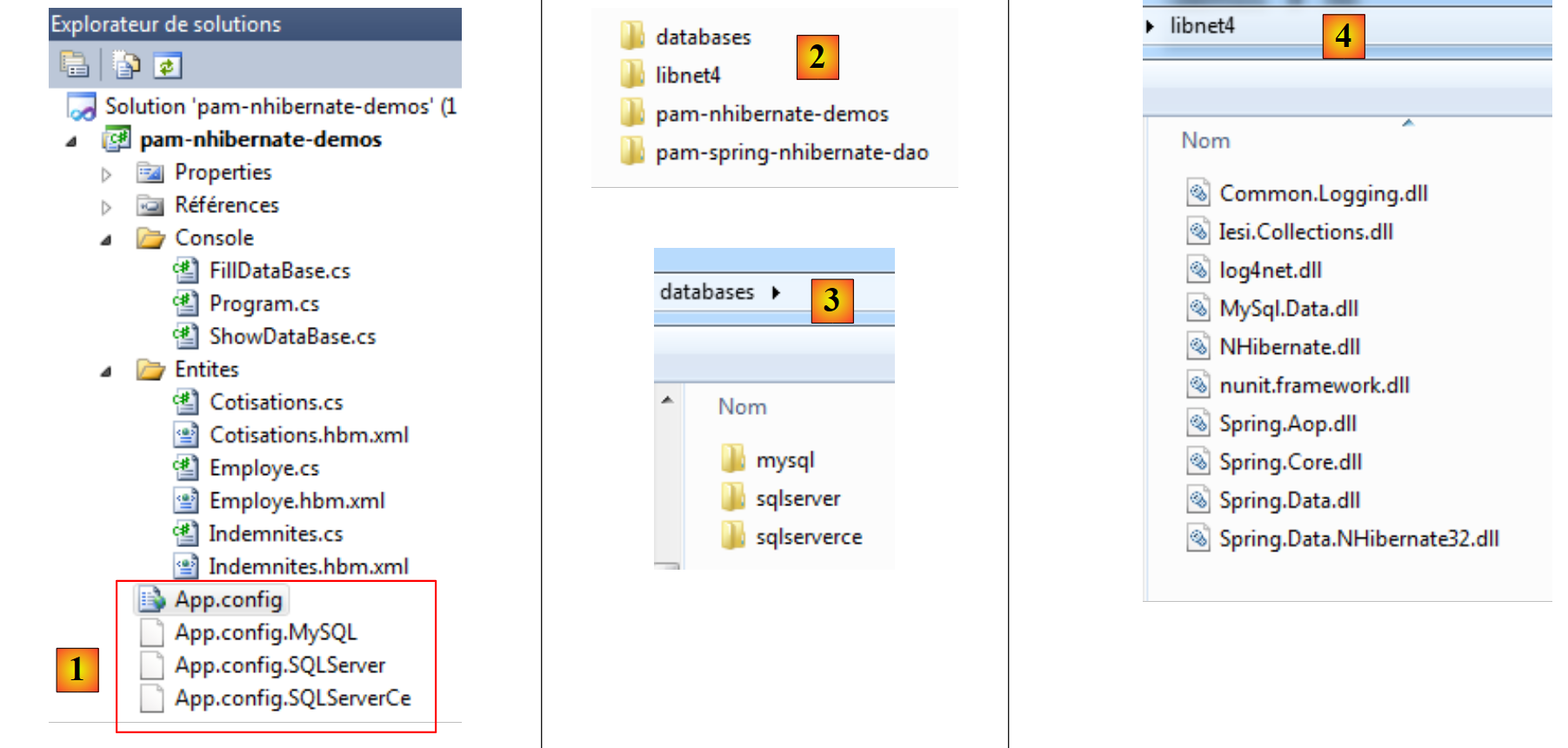 |
The [pam-nhibernate-demos] project comes with three configuration files [1]:
- one for SGBD MySQL [App.config.MySQL]
- one for SGBD, SQL, and Server [App.config.SQLServer]
- one for the SGBD SQL Server Compact [App.config.SQLServerCe]
To use them, simply replace [App.config] with the appropriate file.
In [2], the complete folder accompanying this document:
- the folder [databases] [3] contains
- a script SQL to generate the database MySQL
- a SQL Server 2005 database
- a SQL Server Compact 3.5 database
- the [libnet4] folder [4] contains the DLL files required for the Visual Studio project.
- The [pam-nhibernate-demos] and [pam-spring-nhibernate-dao] folders are those of the two Visual Studio 2010 projects discussed earlier.
This document can be further explored through a case study:
- Building a three-tier application with ASP.NET, C#, Spring.net, and Nhibernate [http://tahe.developpez.com/dotnet/pam-aspnet/]
The application in this case study has the following three-tier structure:
 |
- The [1-dao] layer (dao=Data Access Object) handles data access. The data is stored in a database. The [dao] layer uses the Nhibernate framework to access the data.
- The [2-métier] layer handles the business logic of the application, specifically payroll calculations.
- The [3-présentation] layer handles the presentation of data to the user and the execution of user requests. This is a web layer / ASP.NET.
- The three layers are made independent through the use of interfaces .NET
- The integration of the different layers is handled by Spring.NET
And of course, you can read reference books such as the one cited at the beginning of this document:
Title: NHibernate in Action, Author: Pierre-Henri Kuaté, Publisher: Manning, ISBN: 978-1932394924